Sample results · 19 ideologies
12 Axes Test Results
What 12 axes test results look like: sample results for 19 of the 38 ideologies the test matches you against, drawn by the same code as the picture you save after the test.
These are samples. Your result comes from your own answers. Take the test
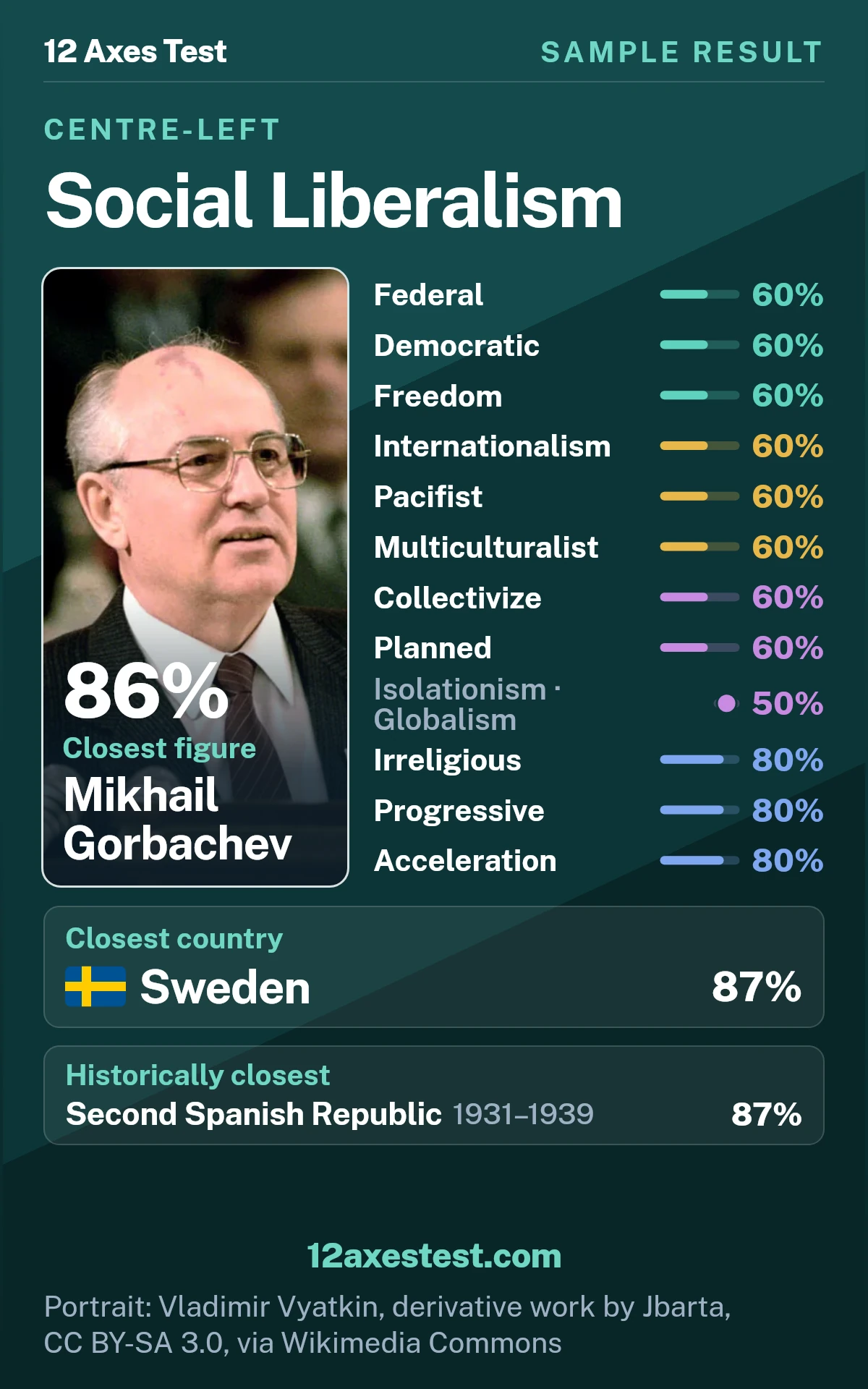
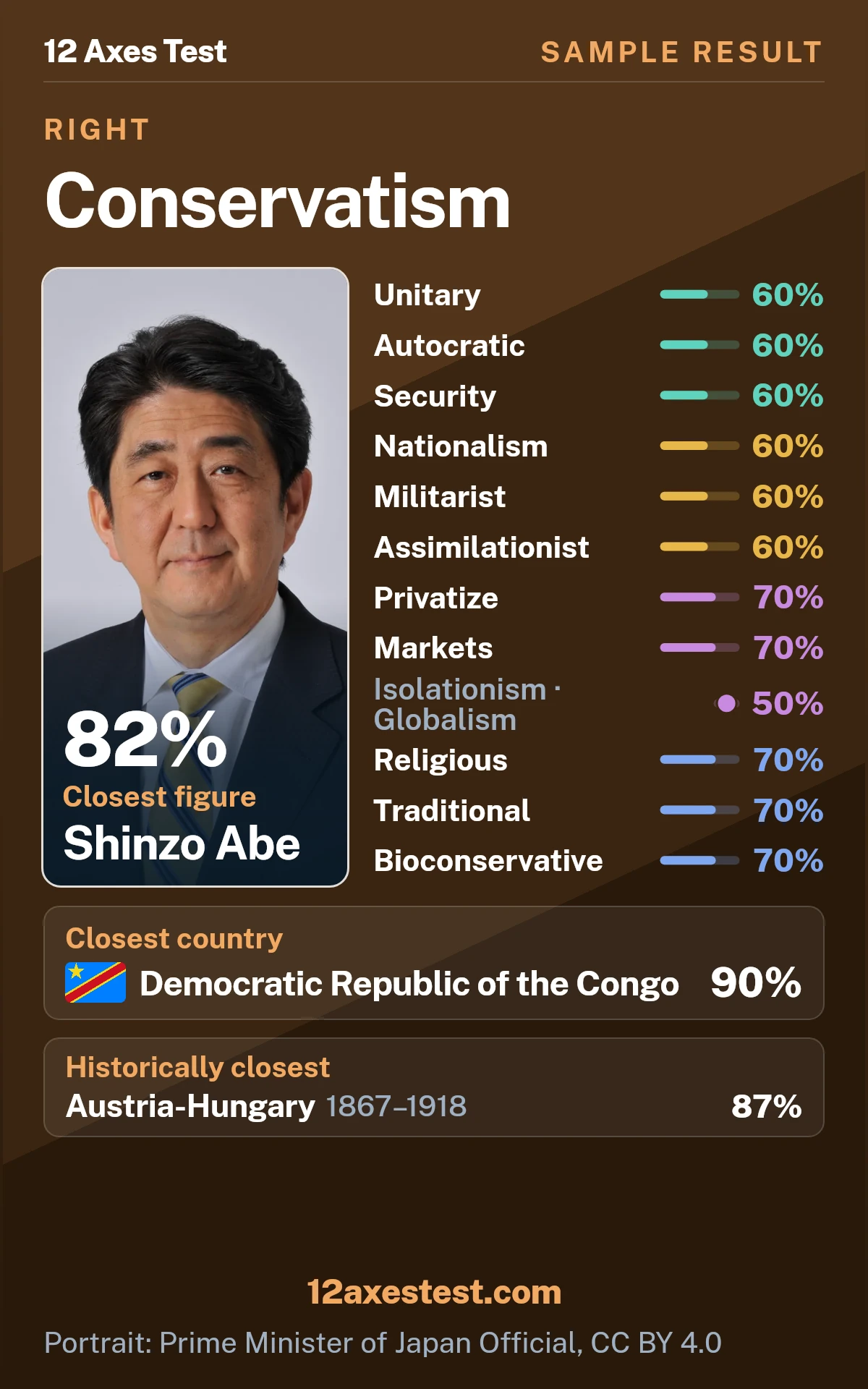
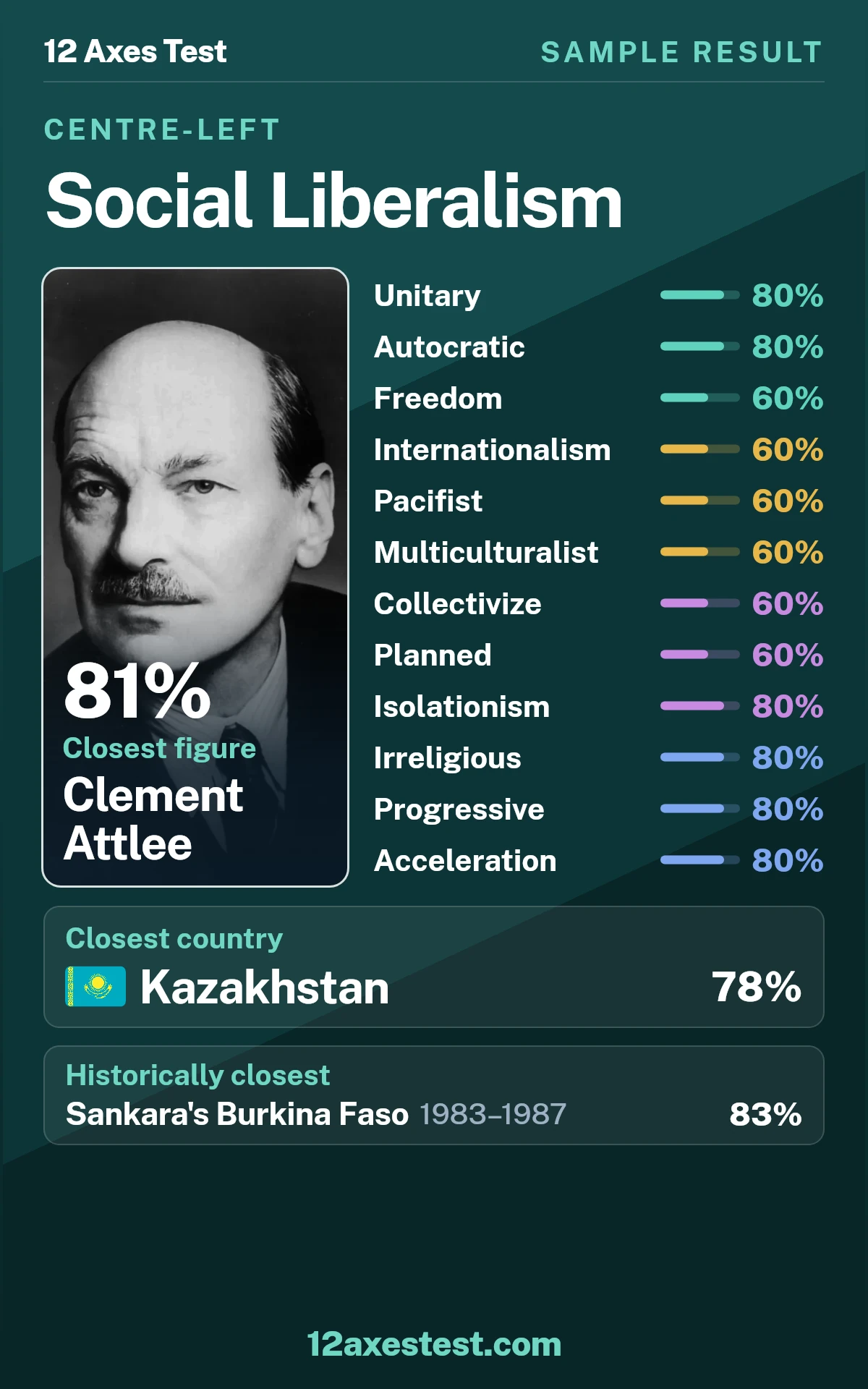
Social Liberalism and Conservatism. Portrait credits are printed on each image.
How a sample is made
How a sample is made: the four axes an ideology is placed on take its own values, and each of the other eight follows the placed axis of its category, the same way or reversed where its poles point the other way, except Isolationism – Globalism, which stays at 50 because its direction is unclear; the closest figure is picked only from historical figures who have died.
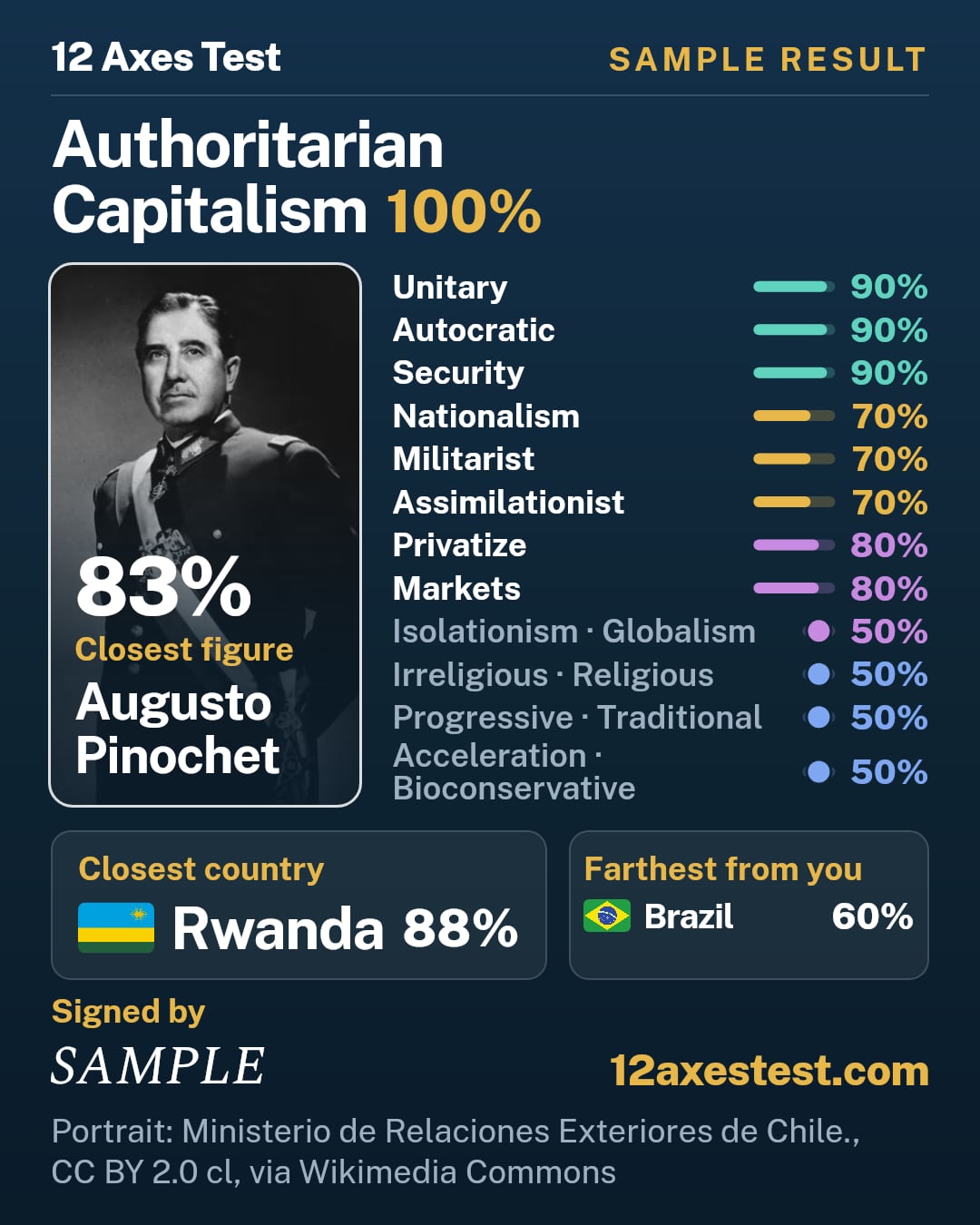
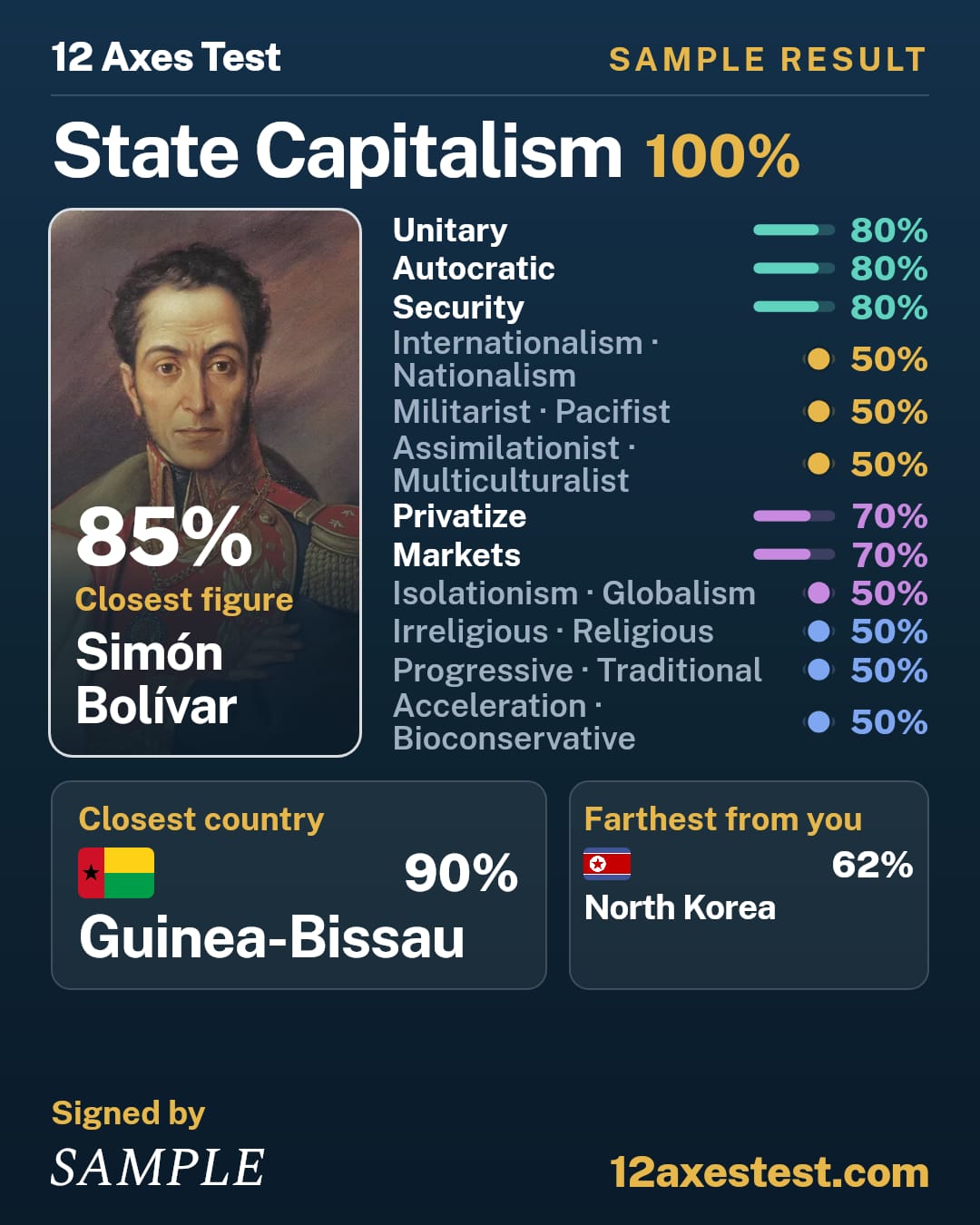
No one answered these, and no real person stands behind any of them: the signature line reads SAMPLE. The closest country, the farthest country and the regime are what the test gives for those scores, worked out the same way as on your own result. Because the scores were made from the ideology's values, its closeness is 100%; a real result lands between ideologies and reads lower.
Portrait: Vladimir Vyatkin, derivative work by Jbarta, CC BY-SA 3.0, via Wikimedia Commons
Portrait: Prime Minister of Japan Official, CC BY 4.0, via Wikimedia Commons
How to read a result
The sample above left is Social Liberalism. Every result the test gives has the same parts.
- Family. Where the ideology is usually placed, from far left to far right, centre or libertarian. An ideology the left-right words do not place has no family line.
- Closest ideology. The closest of the 38 ideologies, by the distance on four axes: economy, government, diplomacy and society. Closeness is 100 minus half that distance.
- Closest figure. The historical figure nearest to the scores on all twelve axes, out of 124, with the closeness.
- Twelve axes. The pole each score leans to and how far, in the order of the four categories: government, diplomacy, economy, society.
- Closest countries. The country nearest to the scores on all twelve axes, out of 195, with its flag and closeness, and the two after it. The picture you save shows the closest country and the farthest.
- Historically closest. The state of the past nearest to the scores on all twelve axes, from a register of 53. Words only, no flag or symbol. The shorter of the two saved pictures, the one the samples below use, leaves it out.
- Signed by. The name you sign your result with (SAMPLE on a sample).
More 12axes test result examples
30 sample results show different political outlooks: six reference profiles and 24 variations on eight matched ideology labels. Open an image to see its twelve-axis scores and closest matches.
These are illustrative score profiles, not answers from real test takers. A label can stay the same when other axis scores change because the ideology comparison uses four axes. Portraits show comparison figures, not people who took the test.
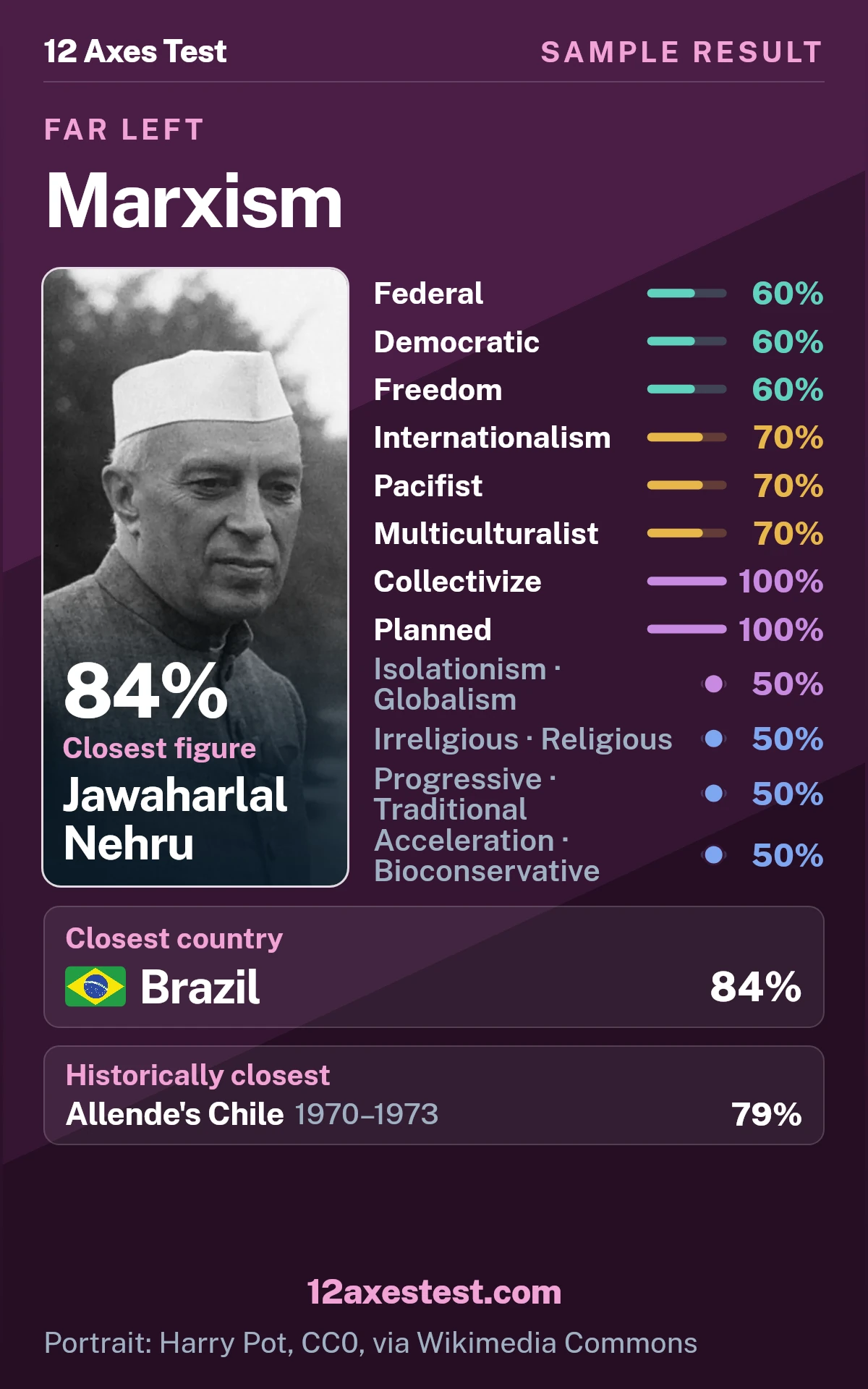
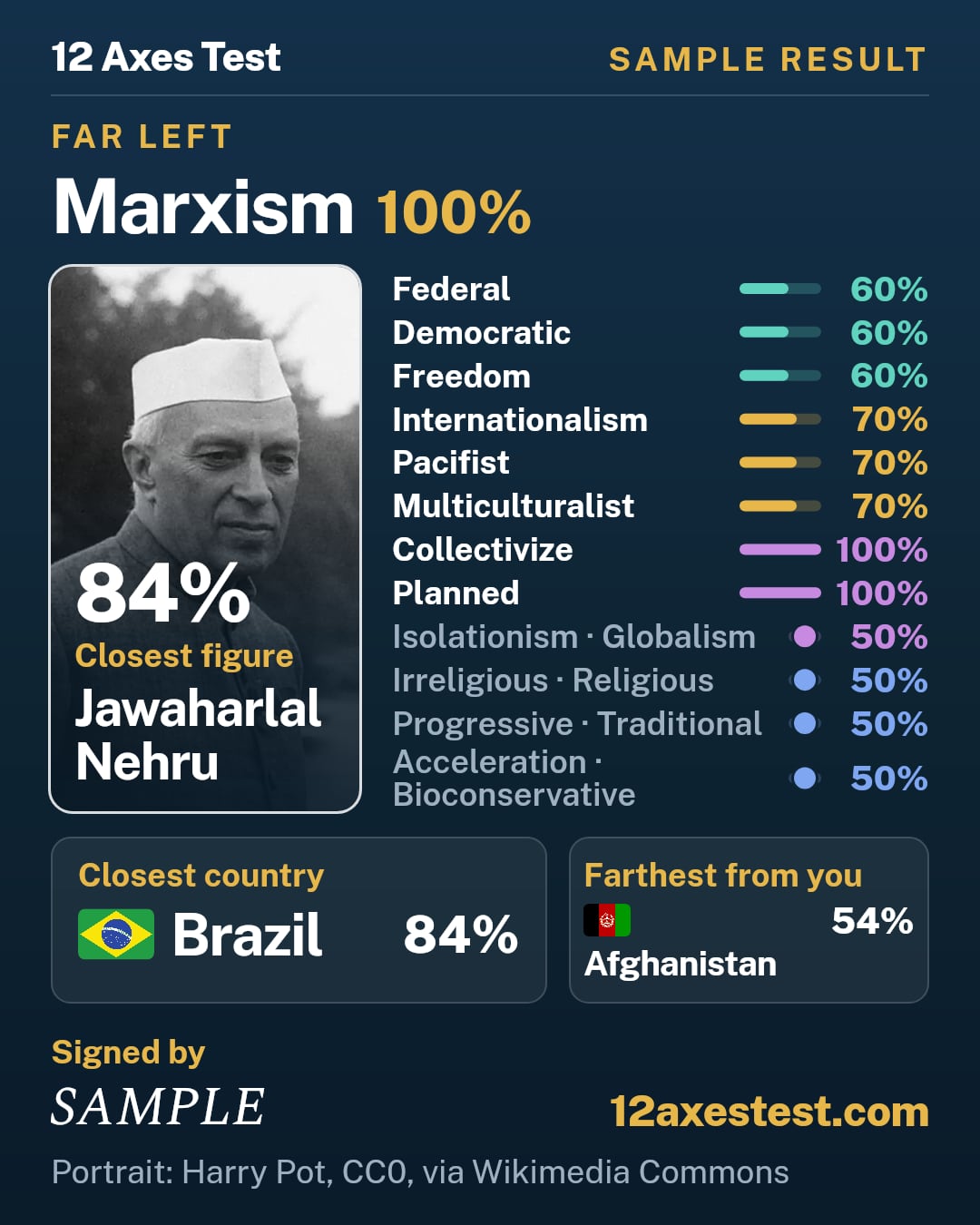
Portrait: Harry Pot, CC0, via Wikimedia Commons
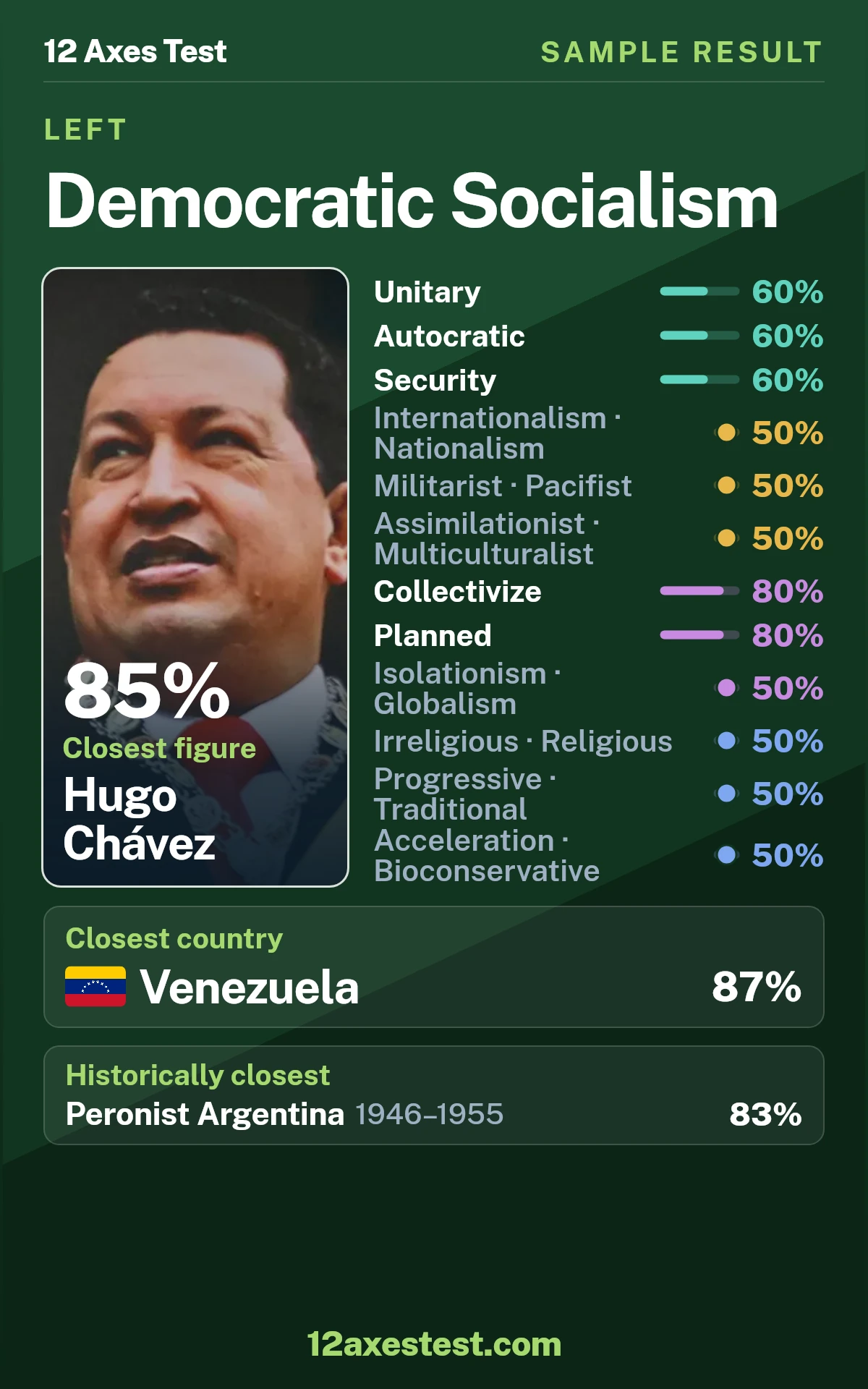
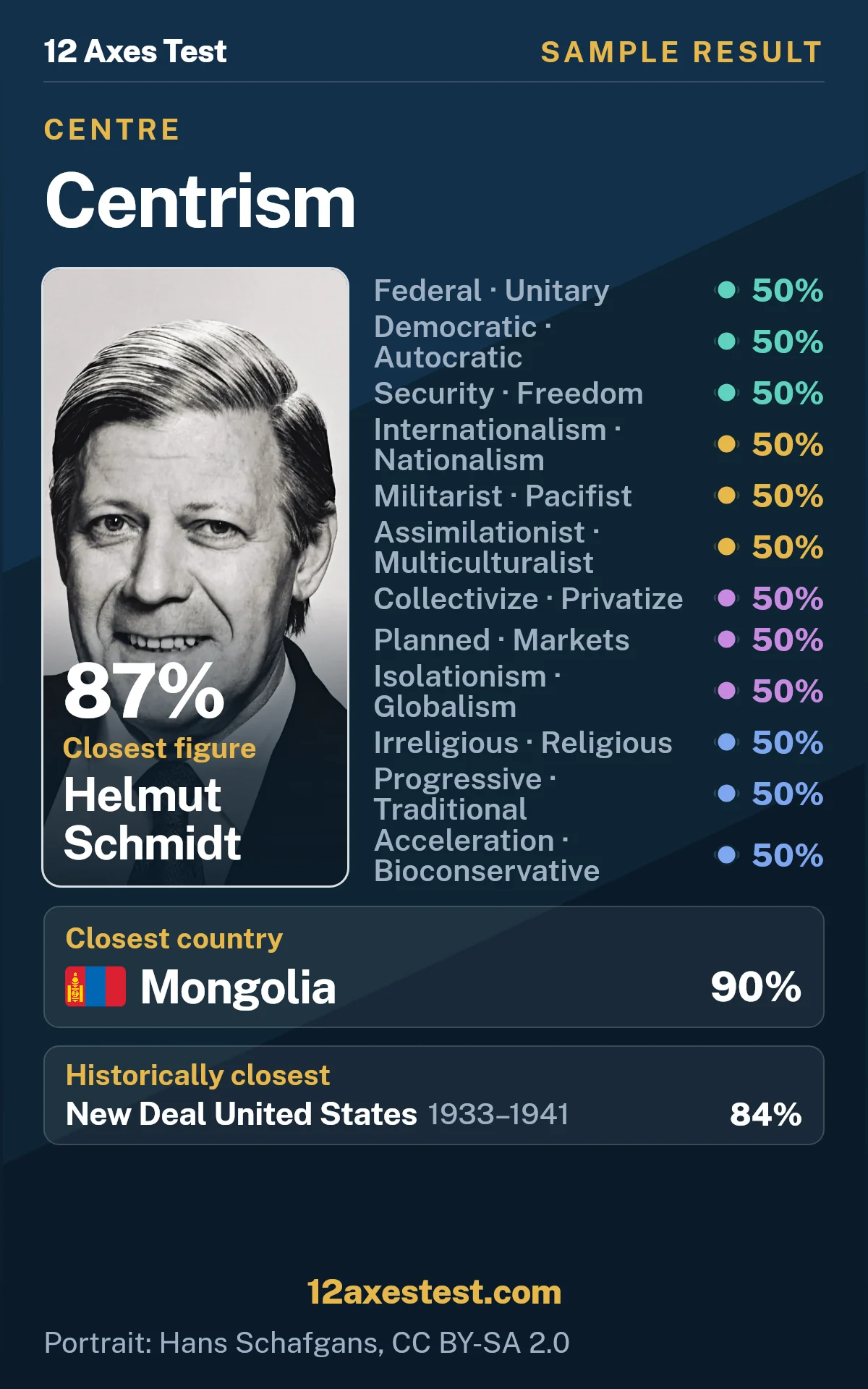
Portrait: Hans Schafgans, CC BY-SA 2.0, via Wikimedia Commons
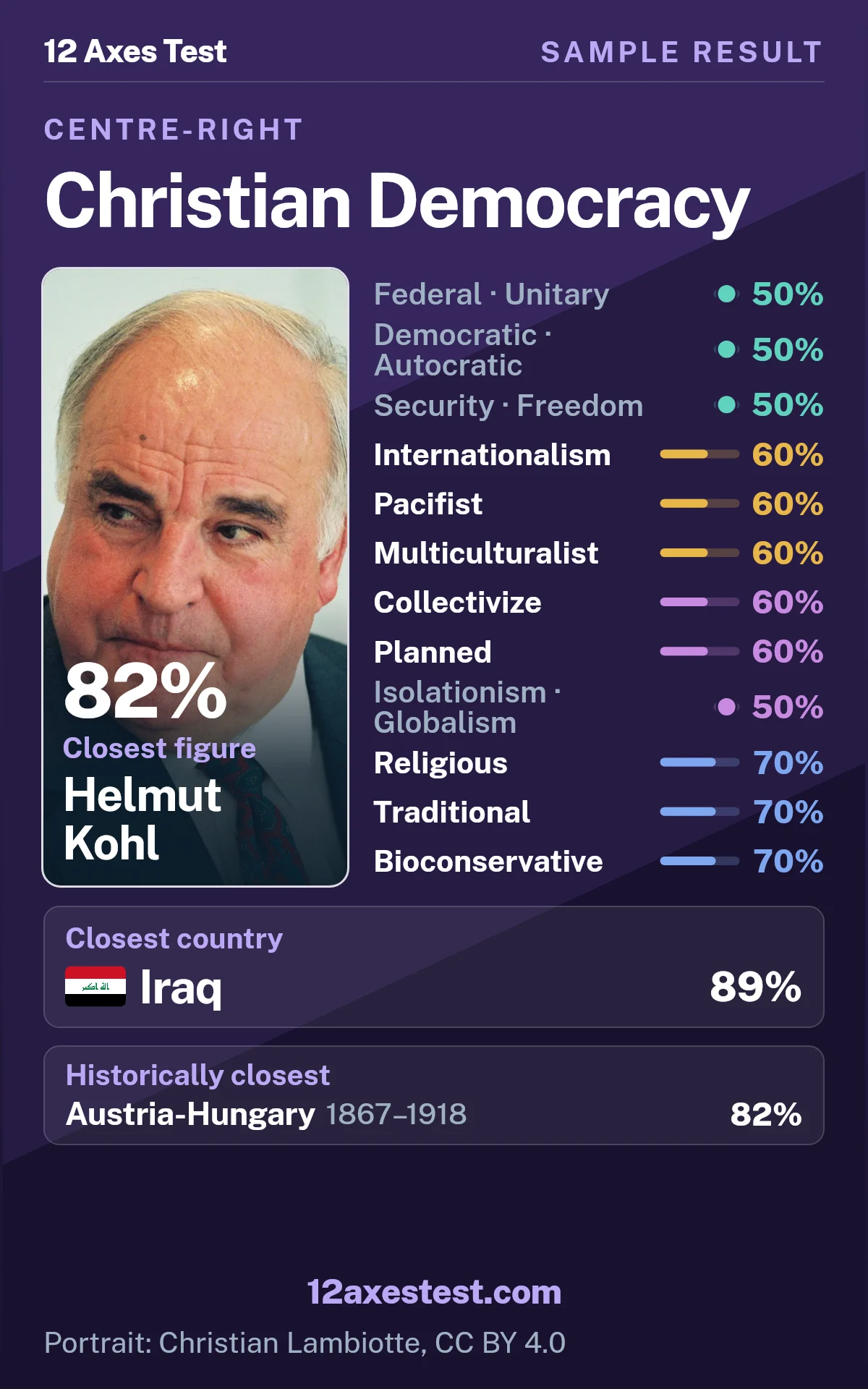
Portrait: Christian Lambiotte, CC BY 4.0, via Wikimedia Commons
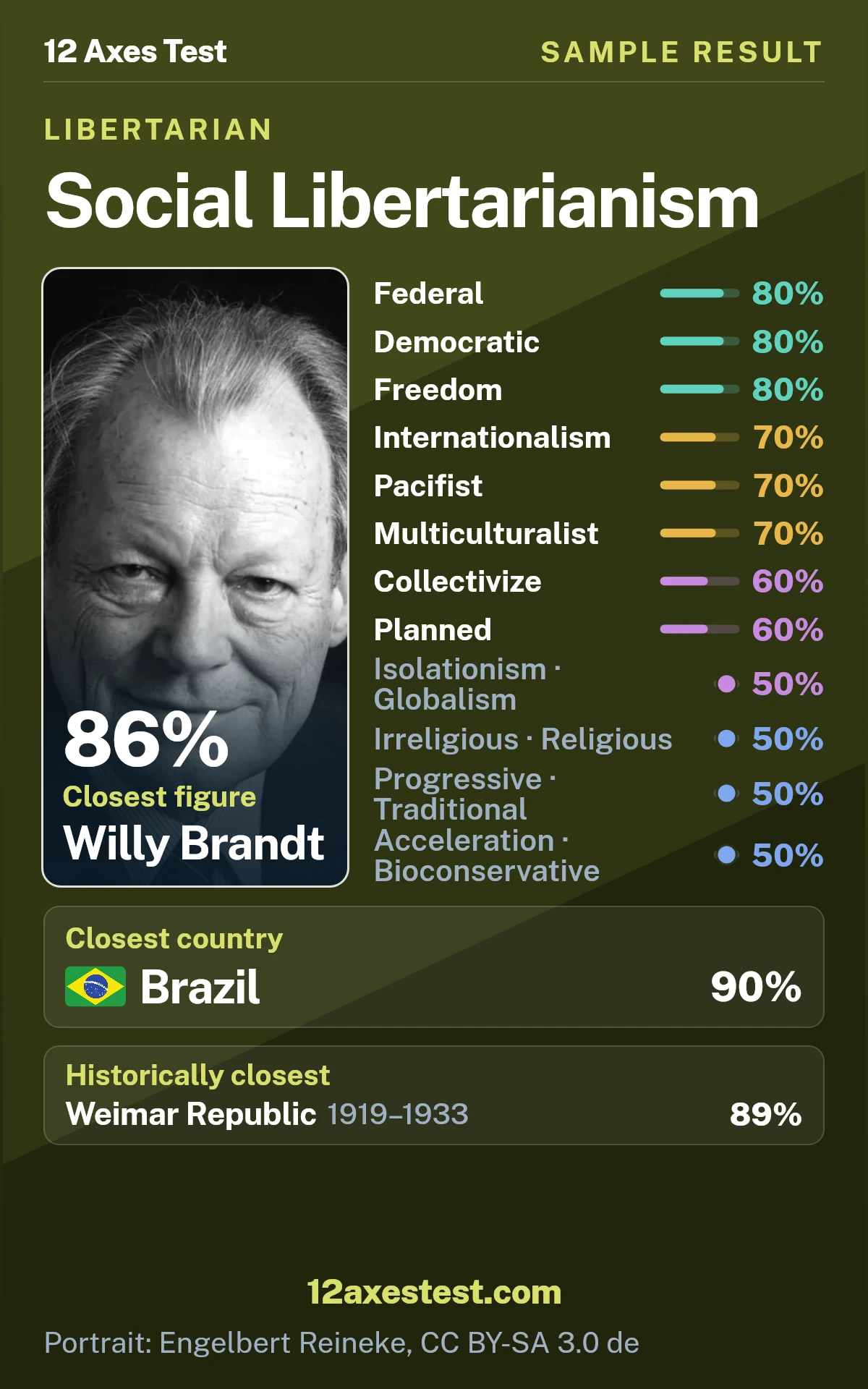
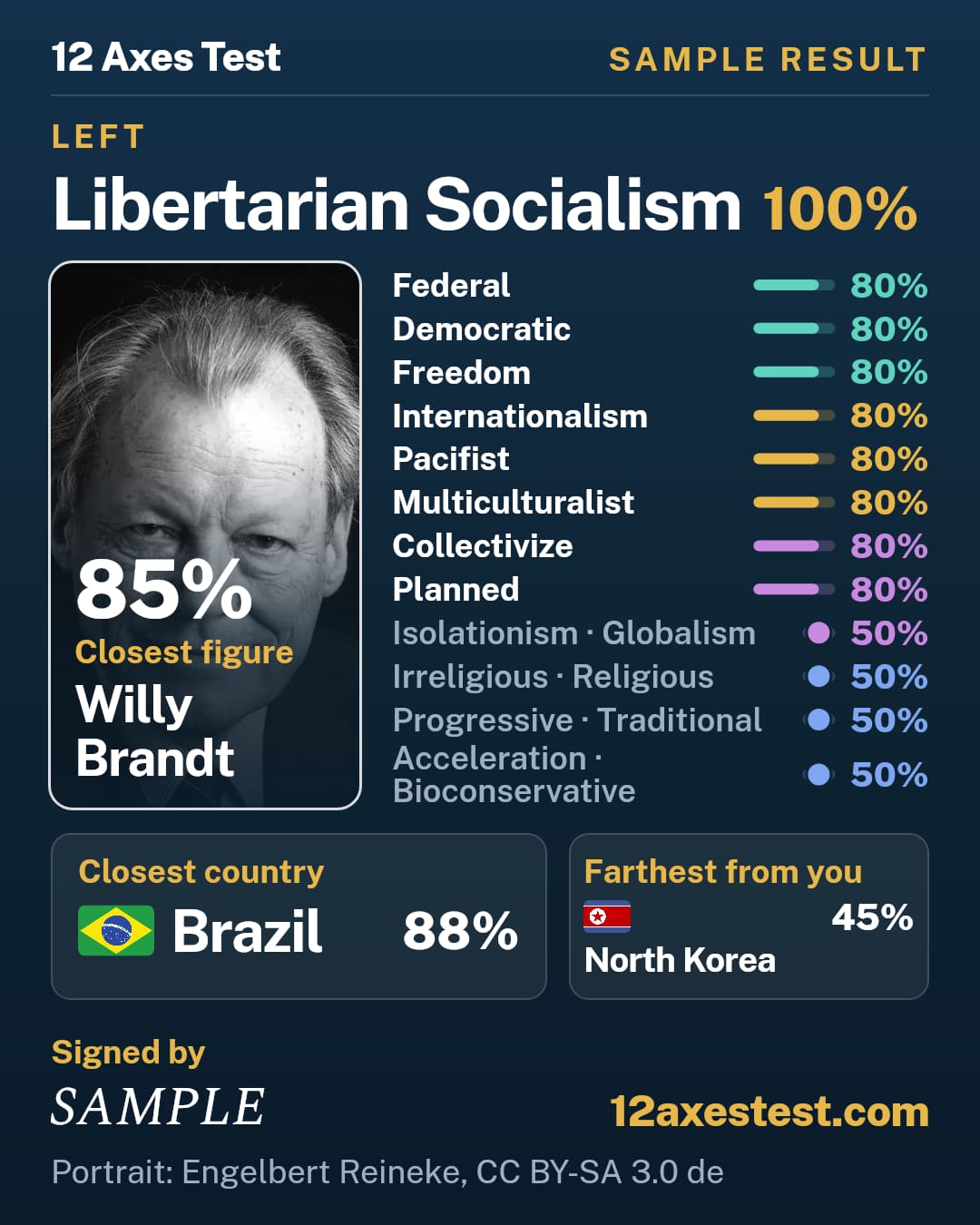
Portrait: Engelbert Reineke, CC BY-SA 3.0 de, via Wikimedia Commons
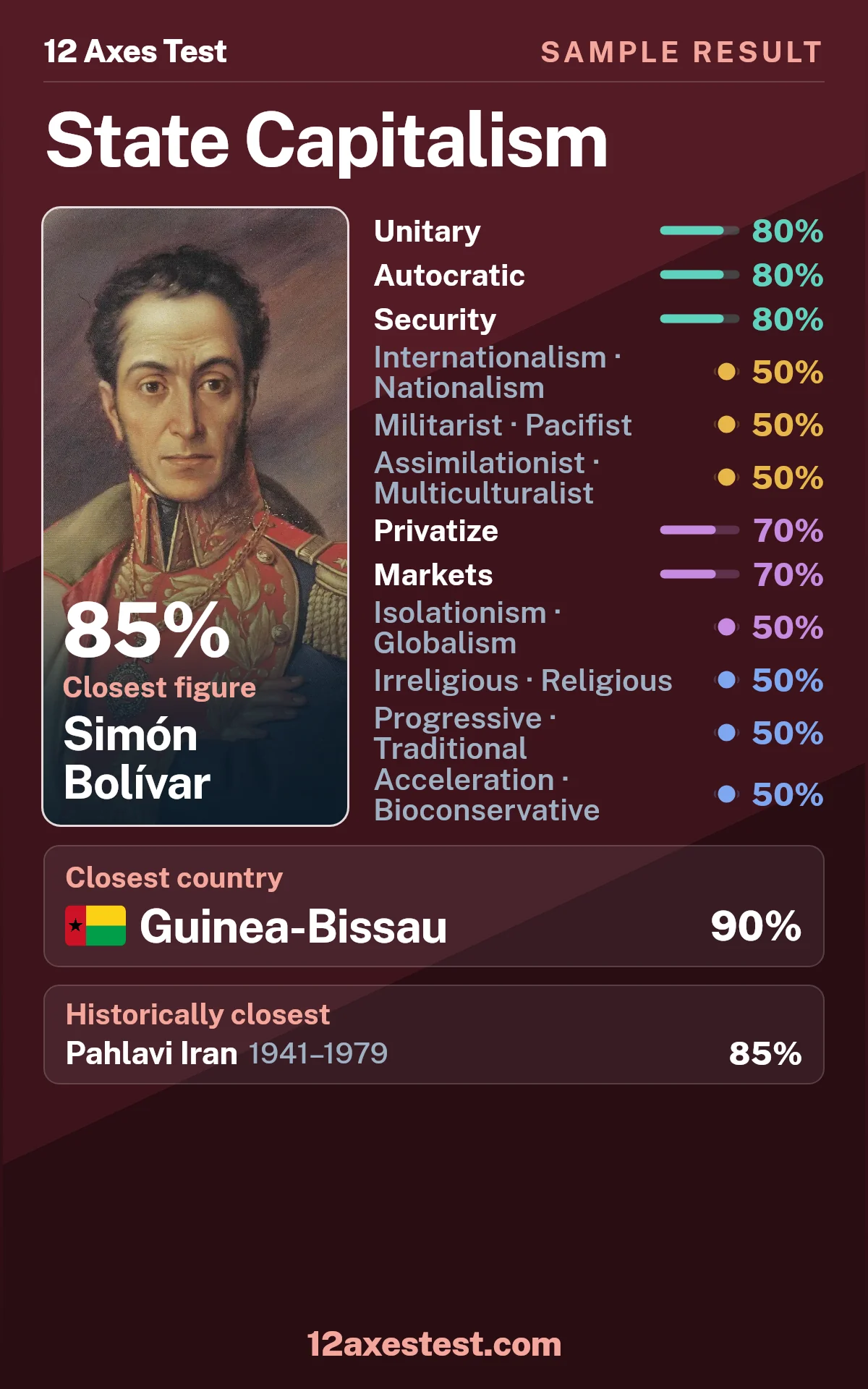
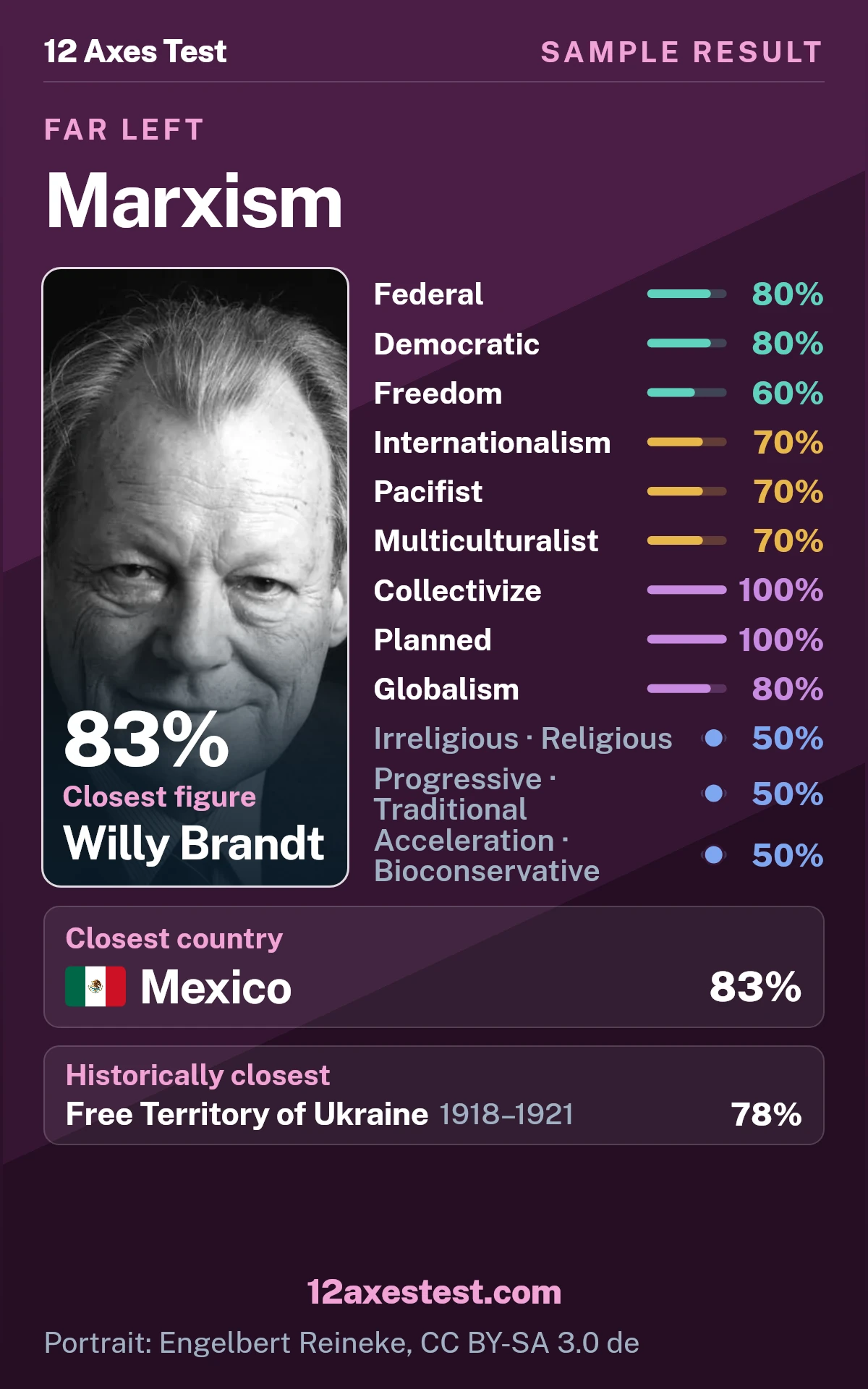
Portrait: Engelbert Reineke, CC BY-SA 3.0 de, via Wikimedia Commons
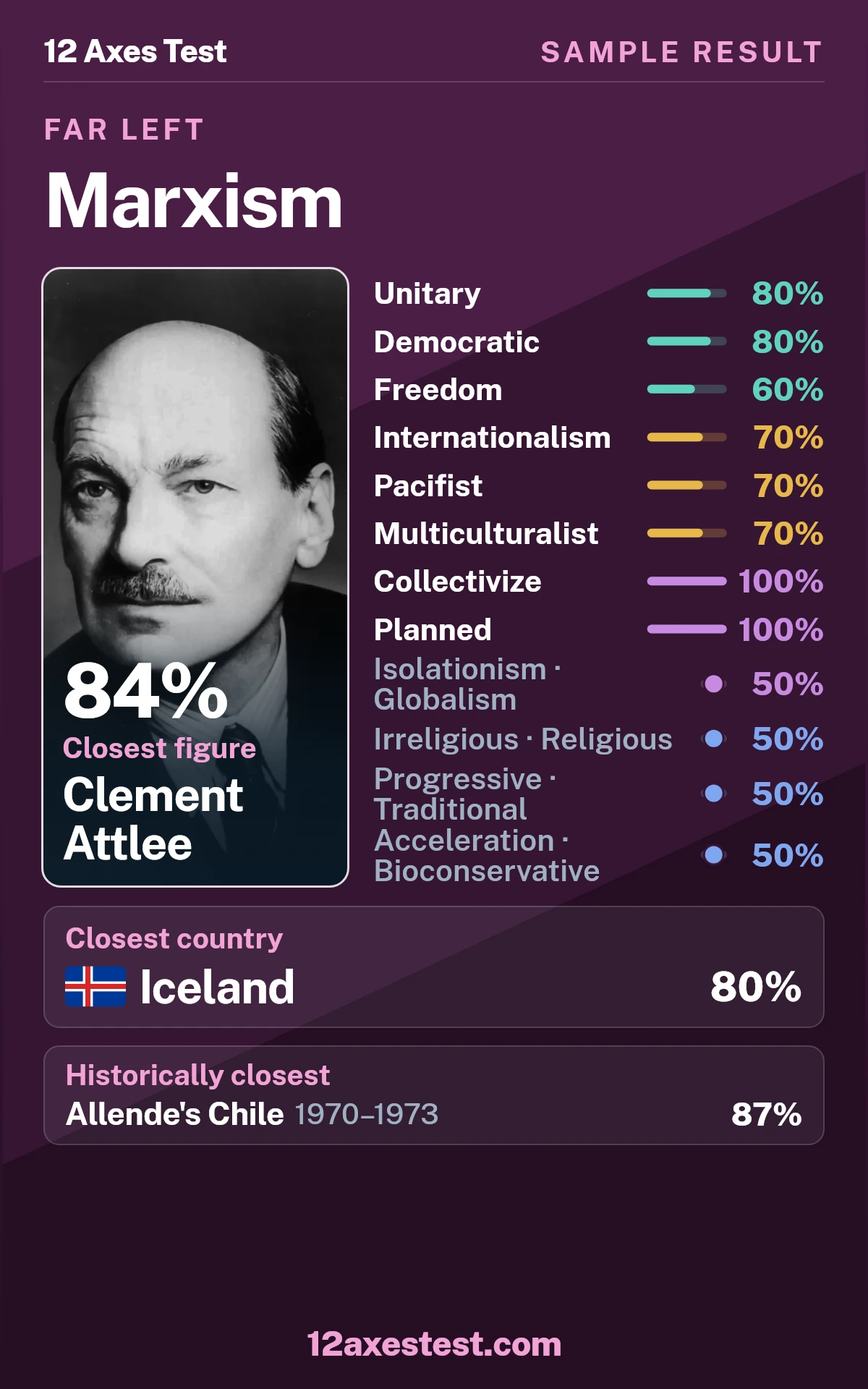
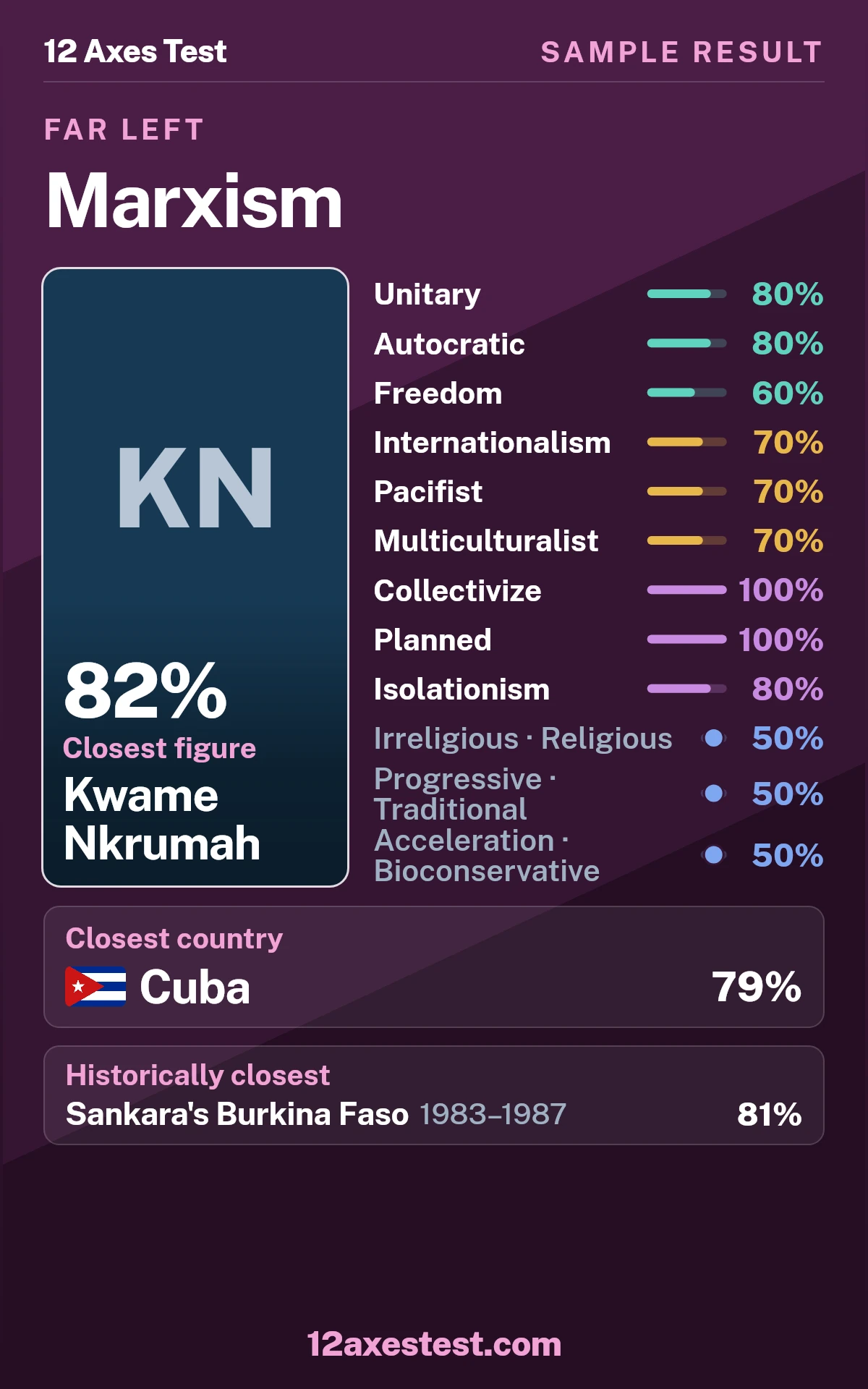
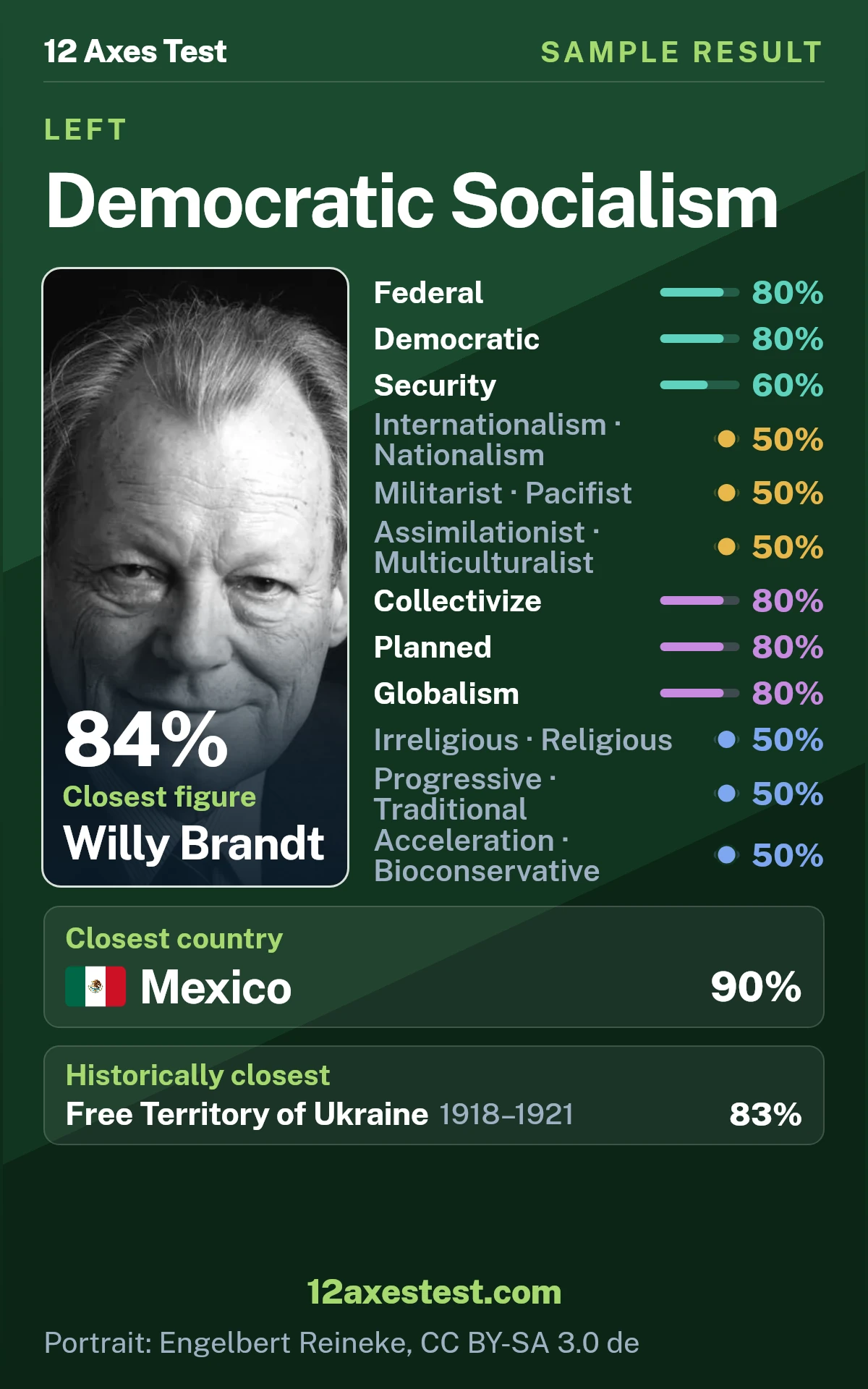
Portrait: Engelbert Reineke, CC BY-SA 3.0 de, via Wikimedia Commons
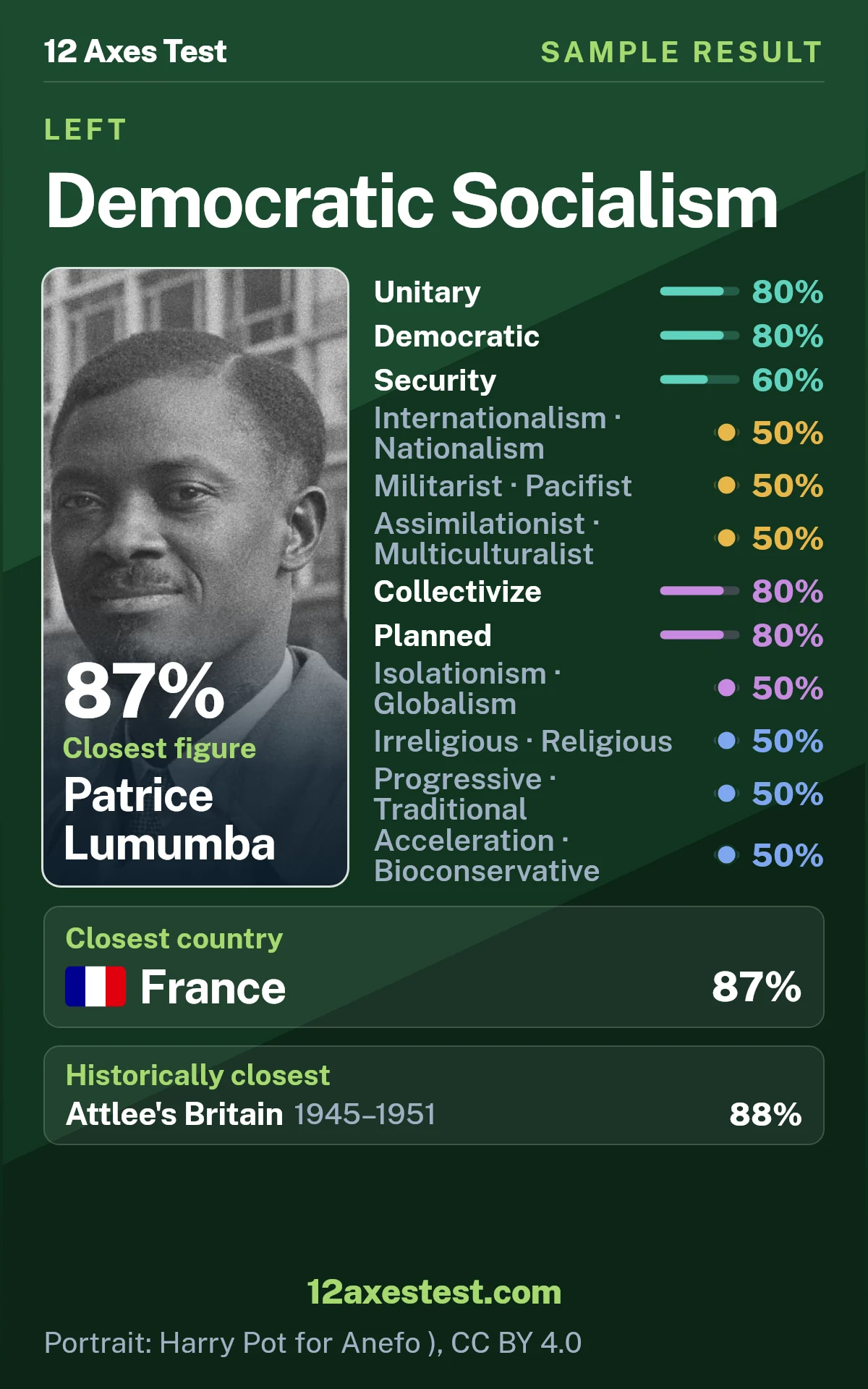
Portrait: Harry Pot for Anefo ), CC BY 4.0, via Wikimedia Commons
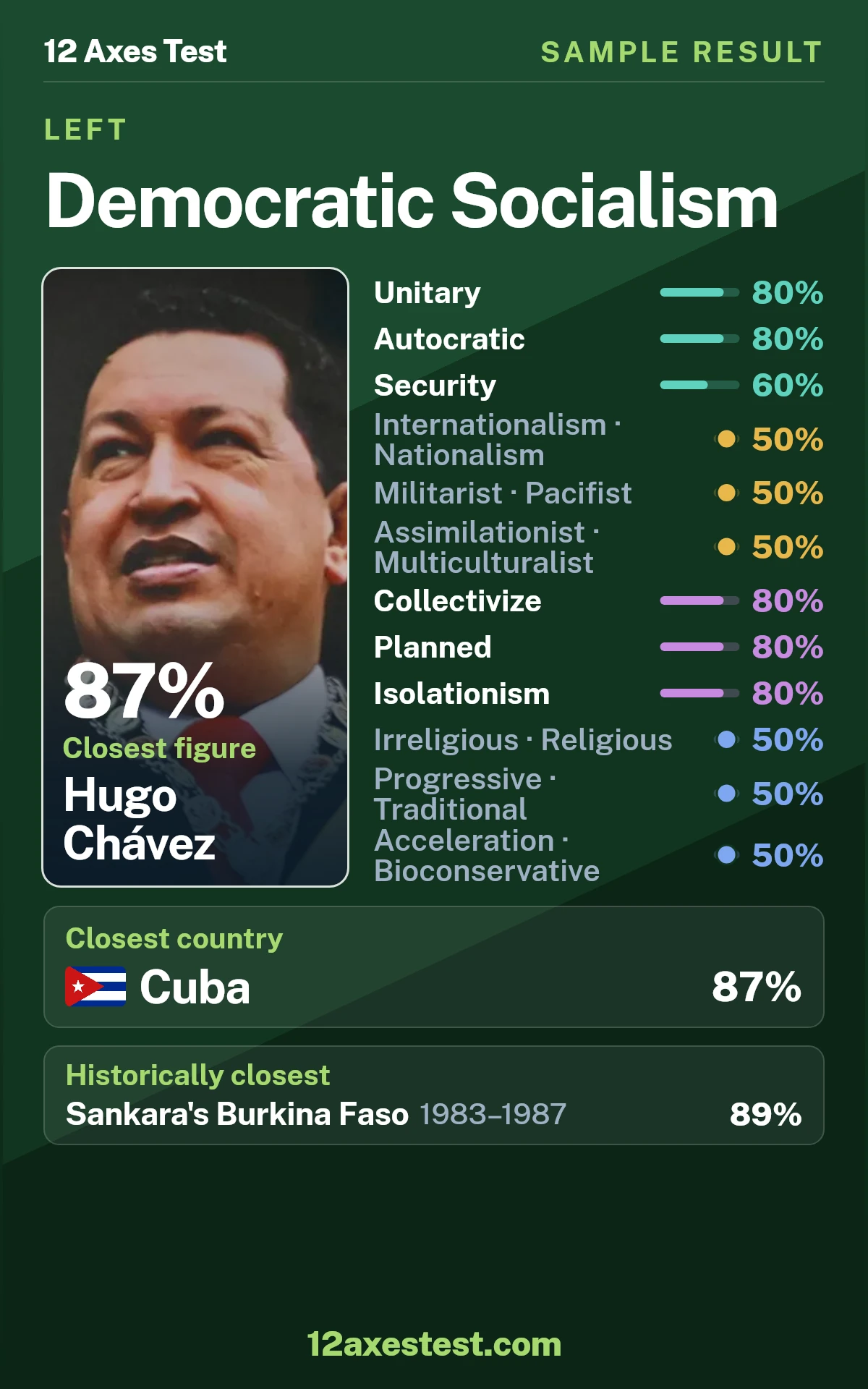
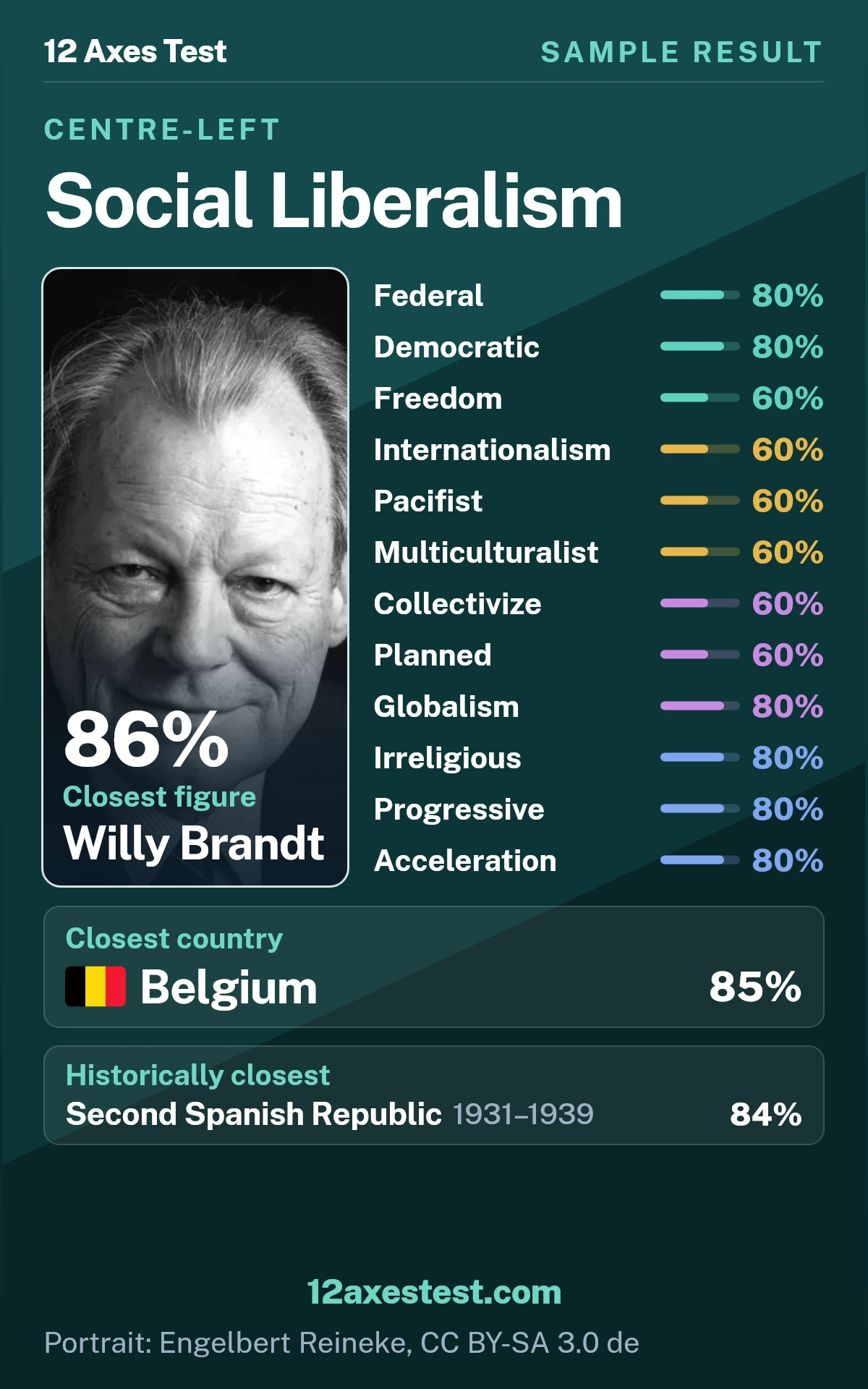
Portrait: Engelbert Reineke, CC BY-SA 3.0 de, via Wikimedia Commons
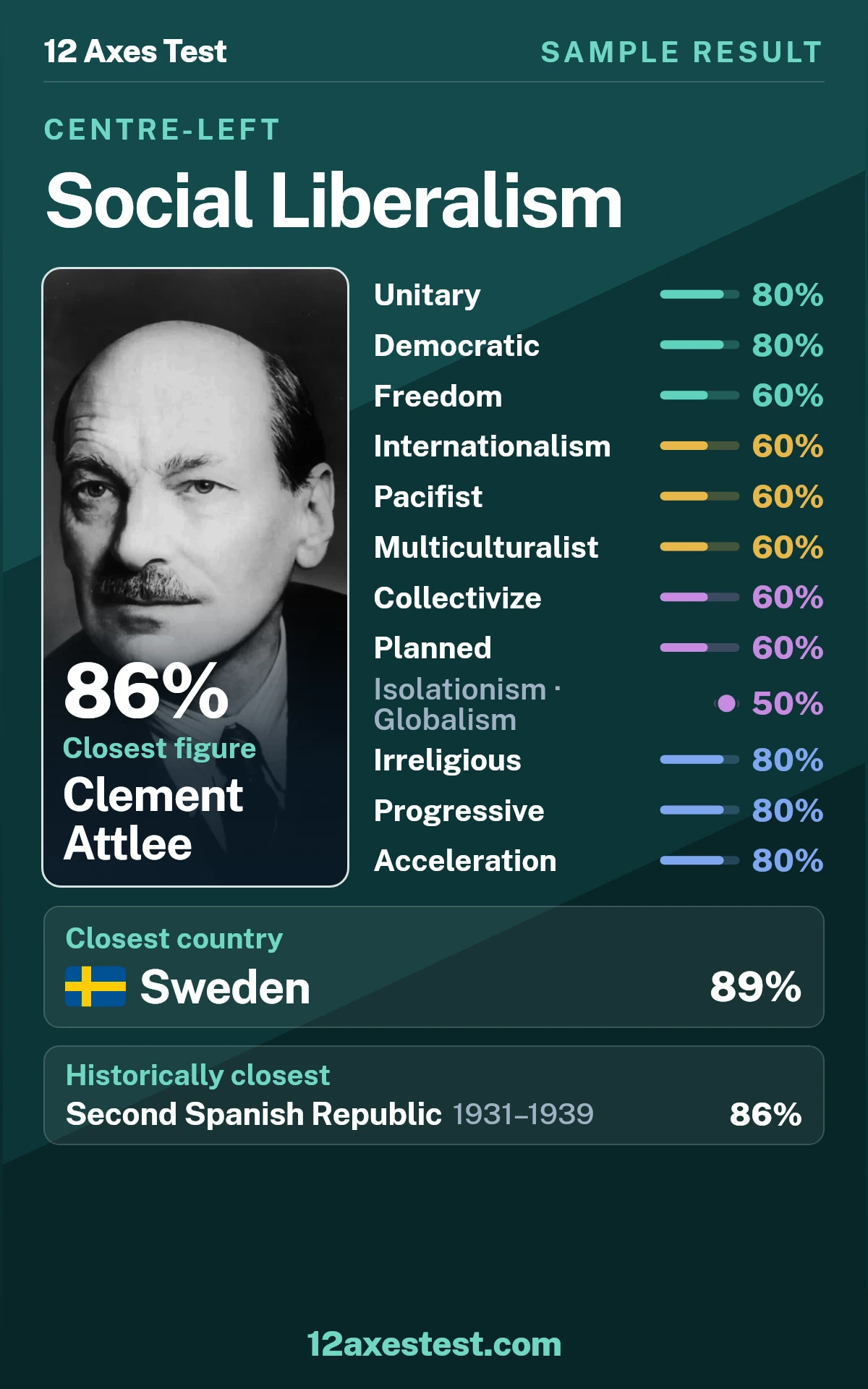
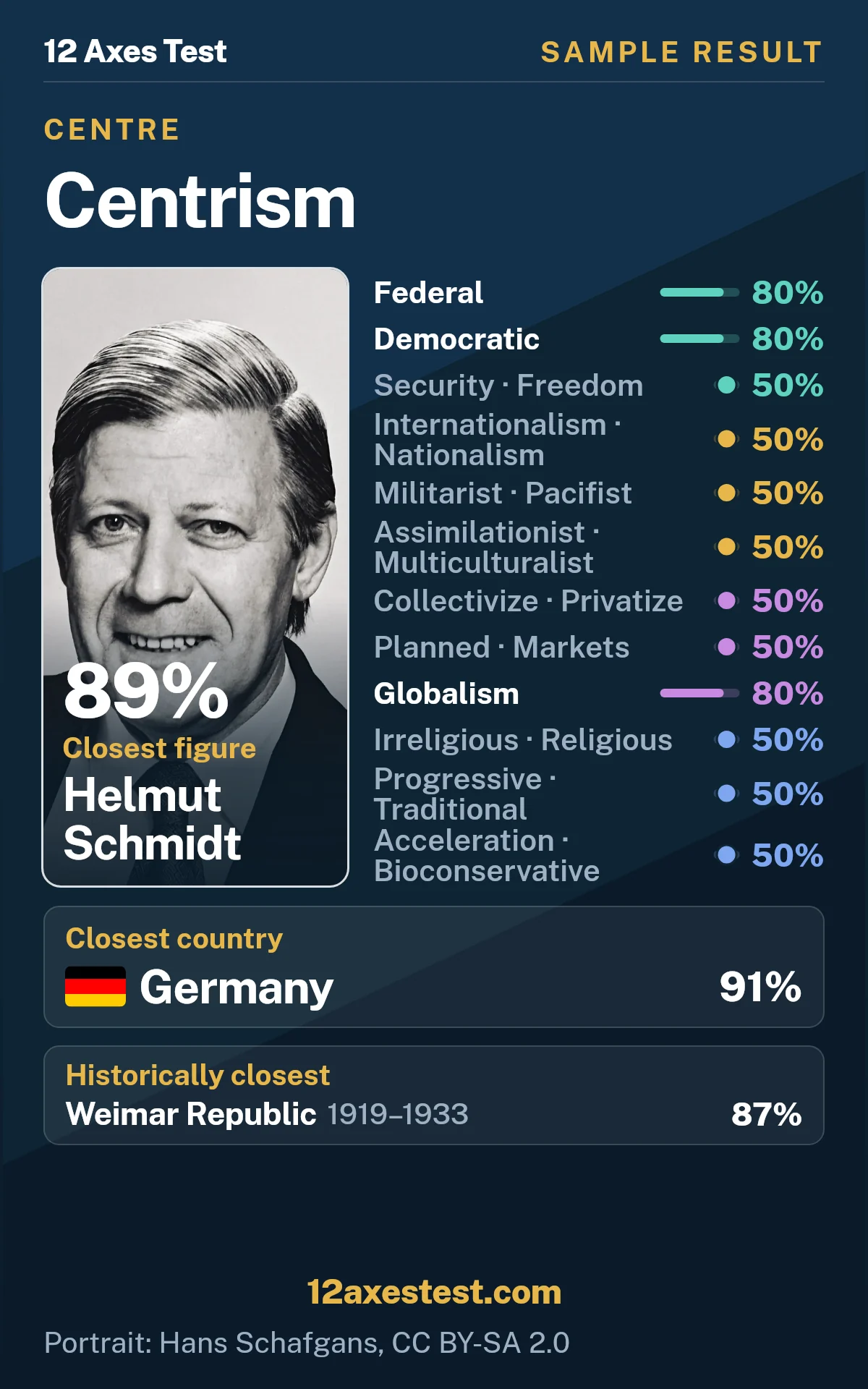
Portrait: Hans Schafgans, CC BY-SA 2.0, via Wikimedia Commons
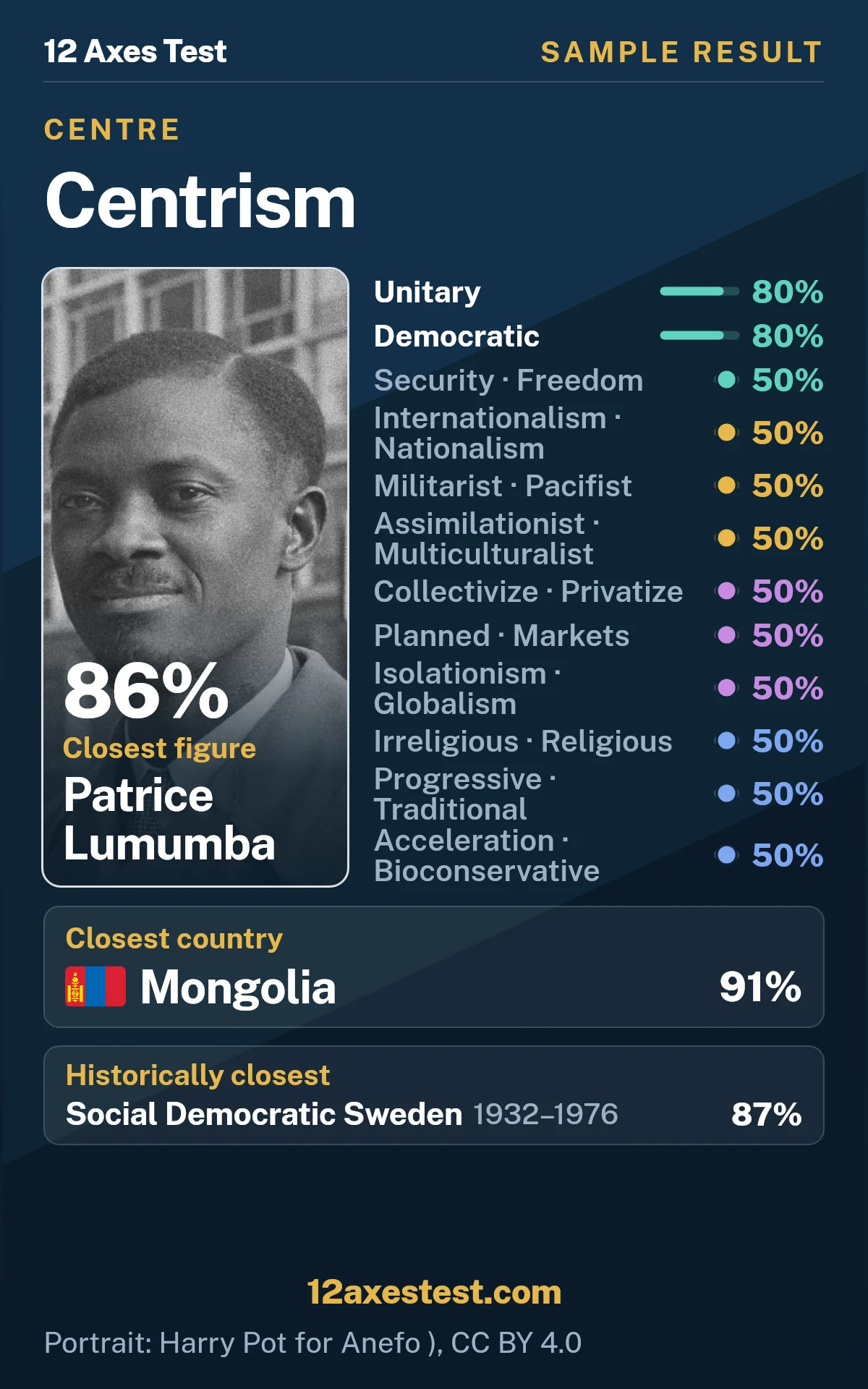
Portrait: Harry Pot for Anefo ), CC BY 4.0, via Wikimedia Commons
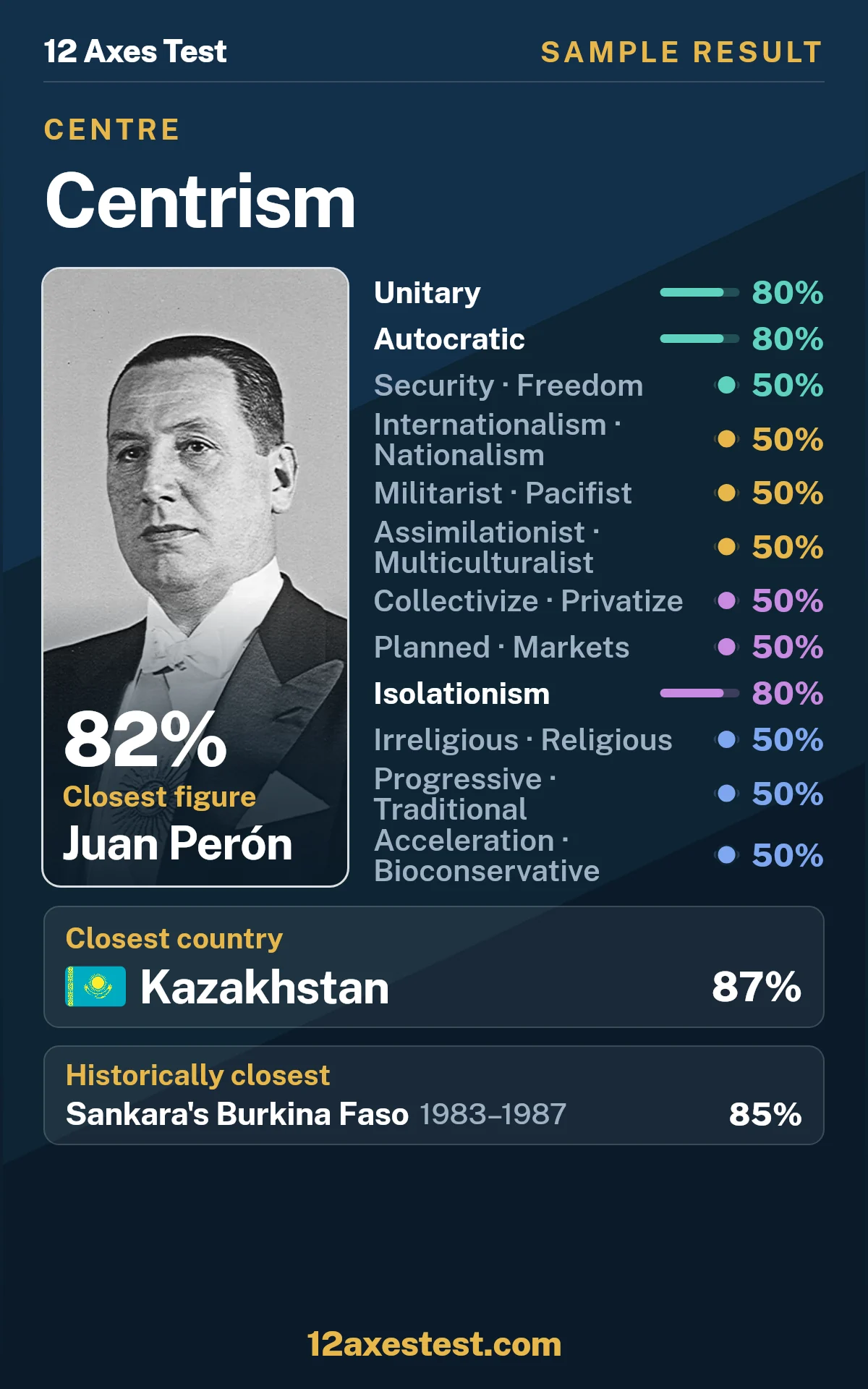
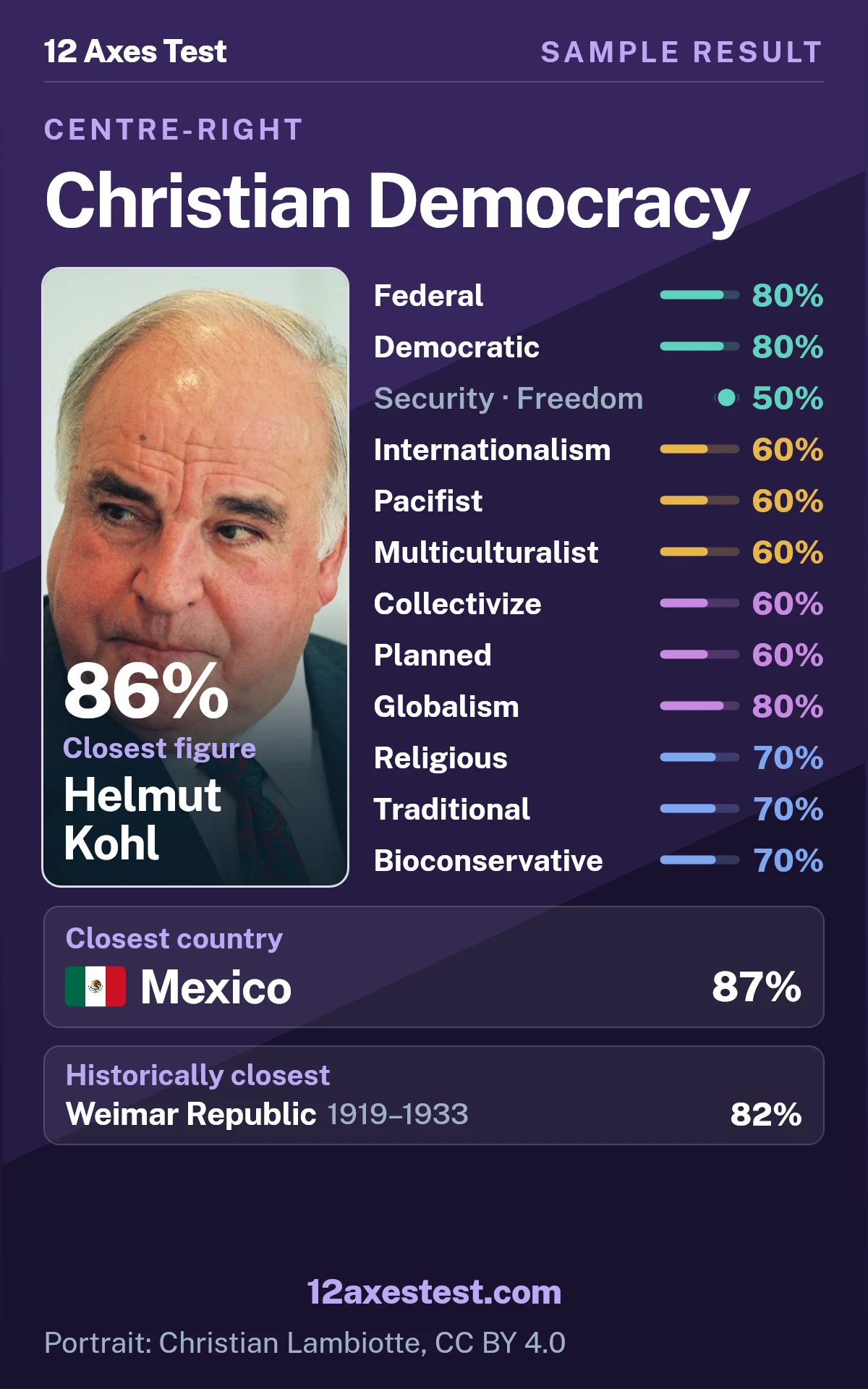
Portrait: Christian Lambiotte, CC BY 4.0, via Wikimedia Commons
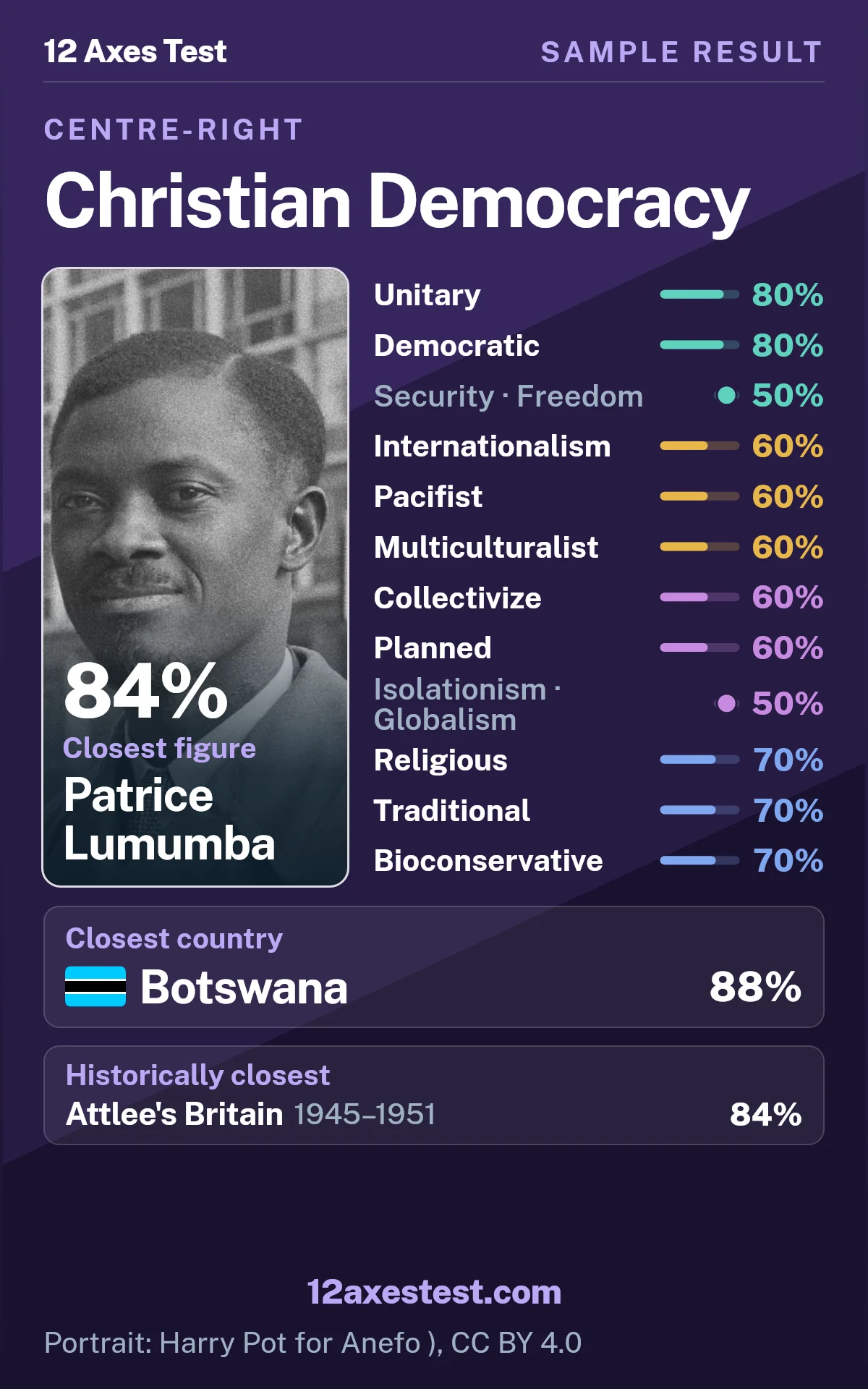
Portrait: Harry Pot for Anefo ), CC BY 4.0, via Wikimedia Commons
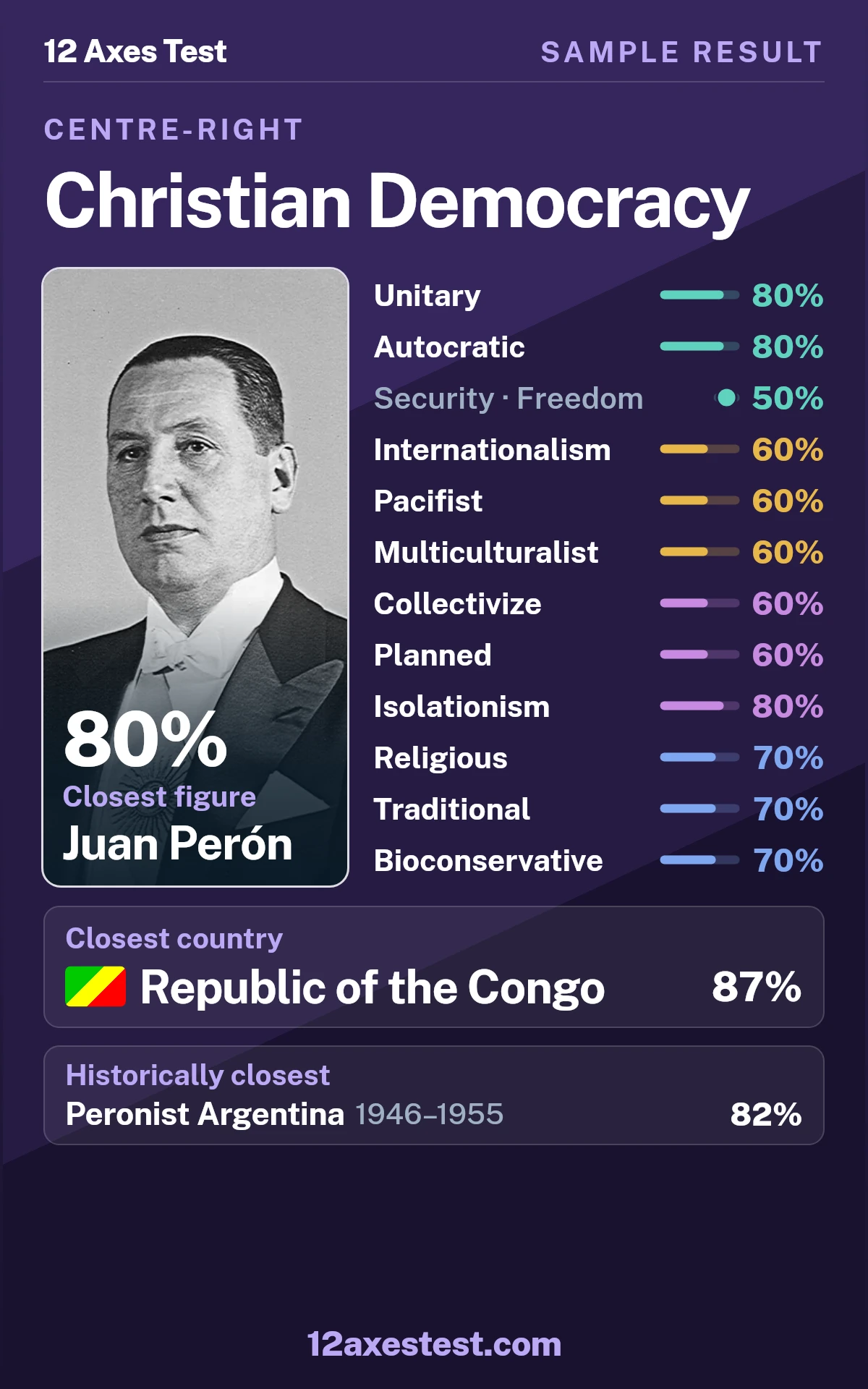
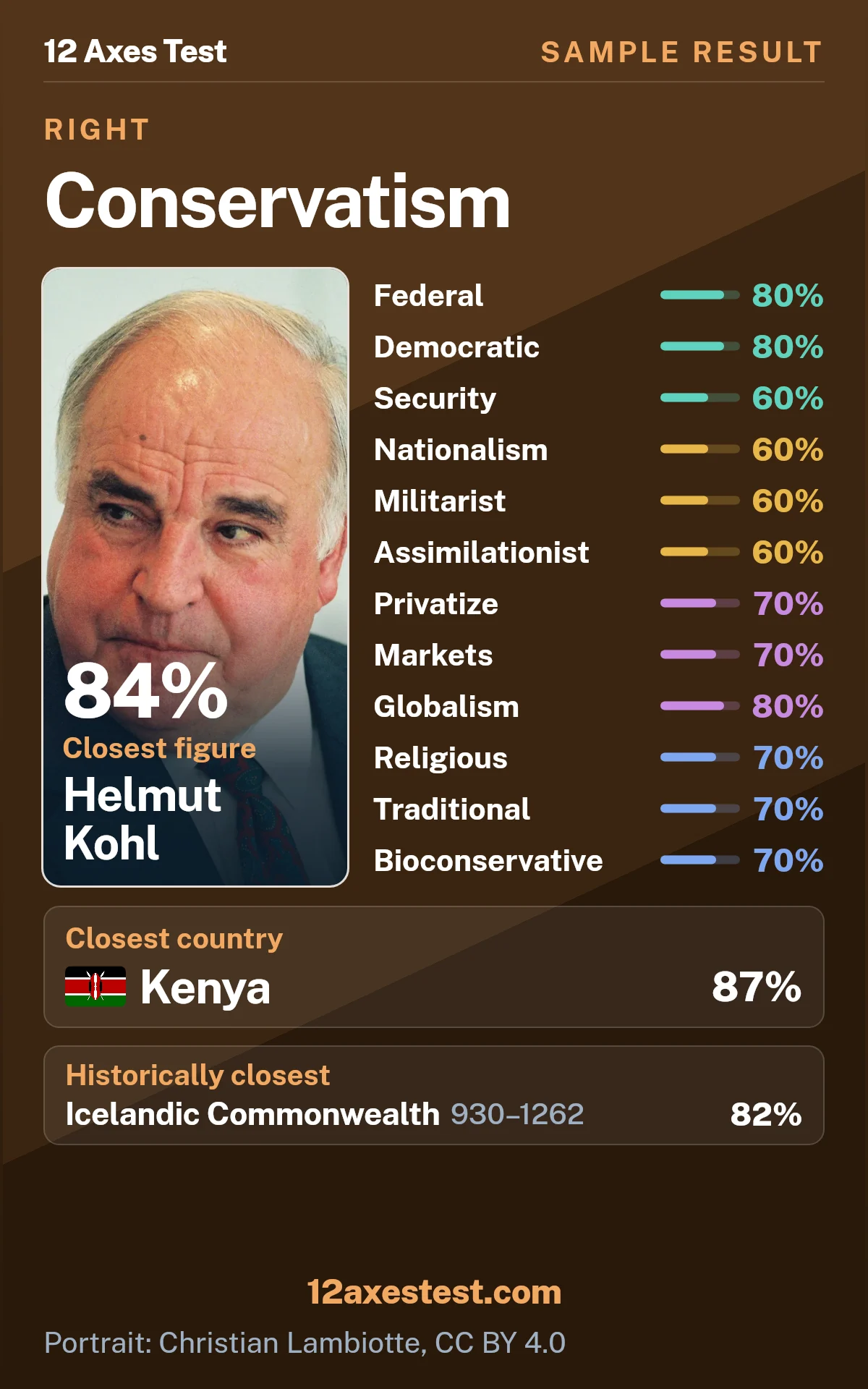
Portrait: Christian Lambiotte, CC BY 4.0, via Wikimedia Commons
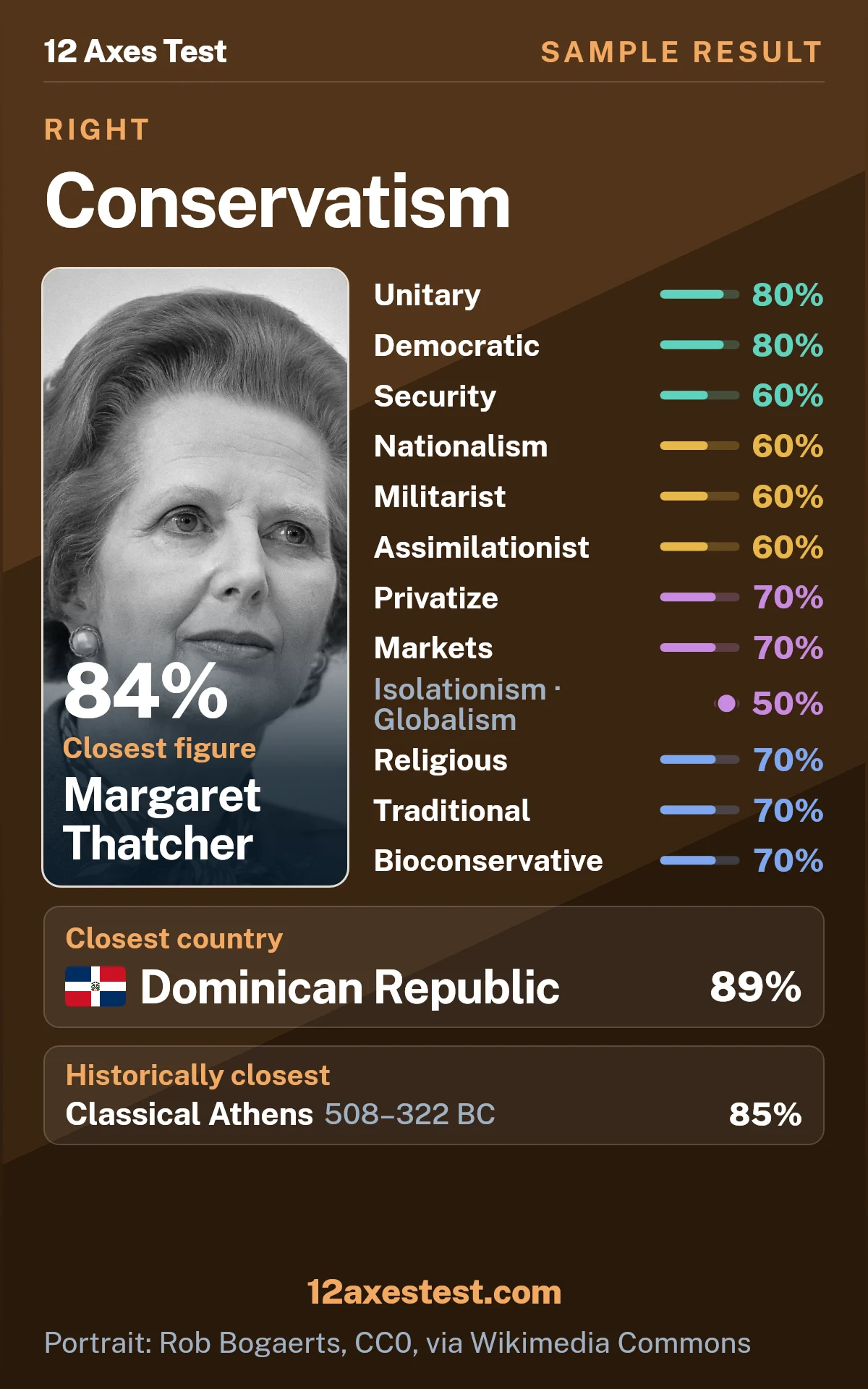
Portrait: Rob Bogaerts, CC0, via Wikimedia Commons
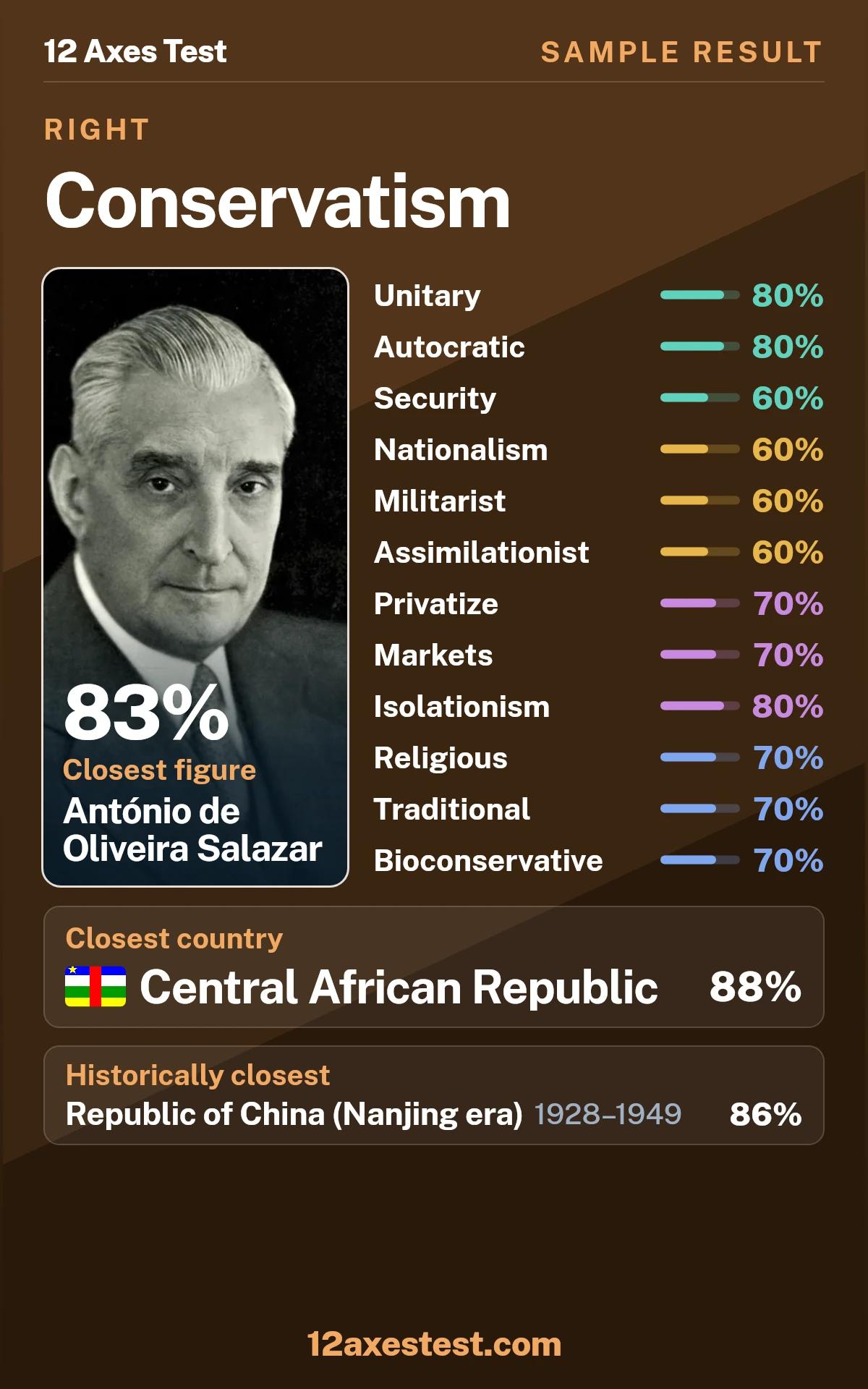
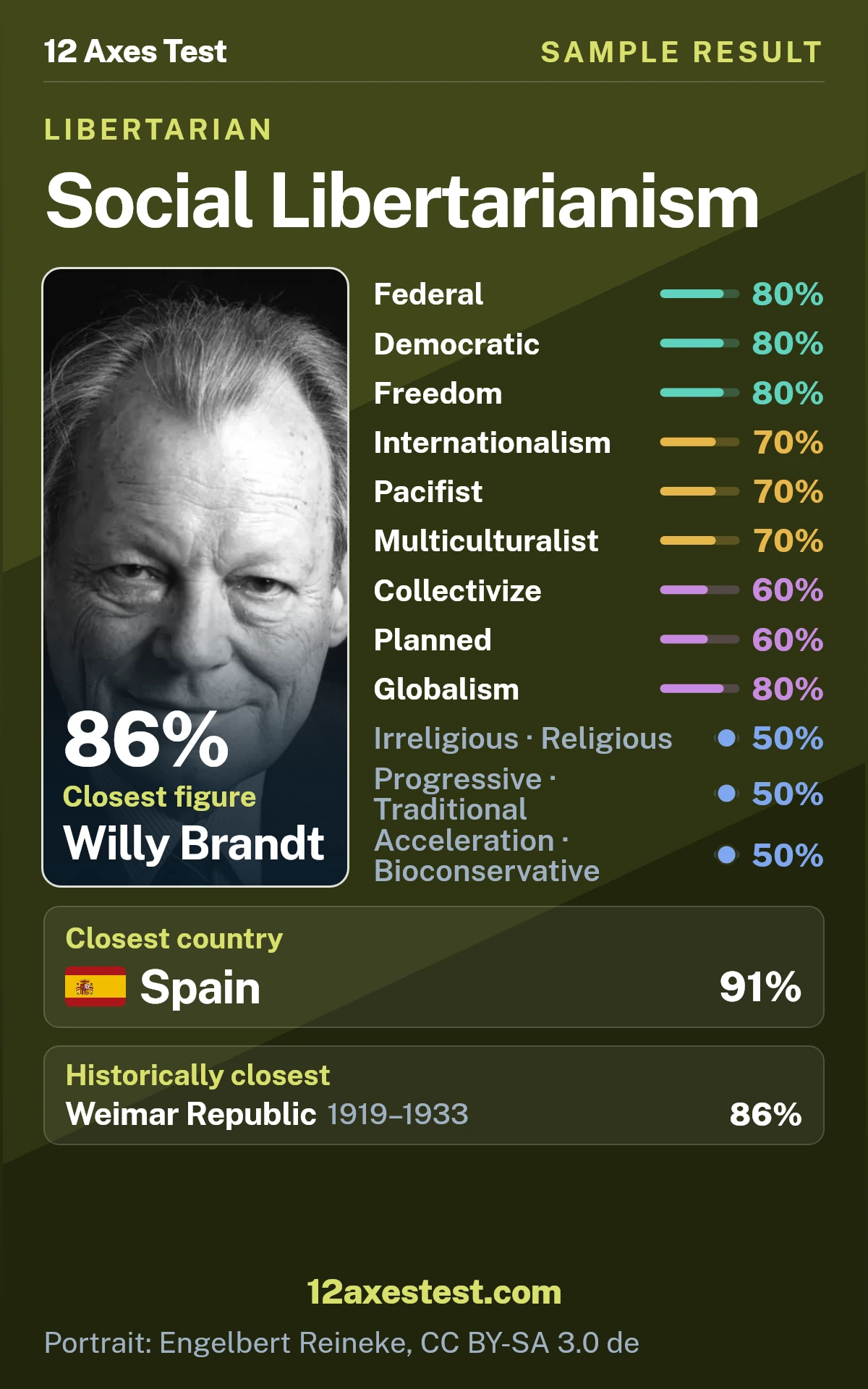
Portrait: Engelbert Reineke, CC BY-SA 3.0 de, via Wikimedia Commons
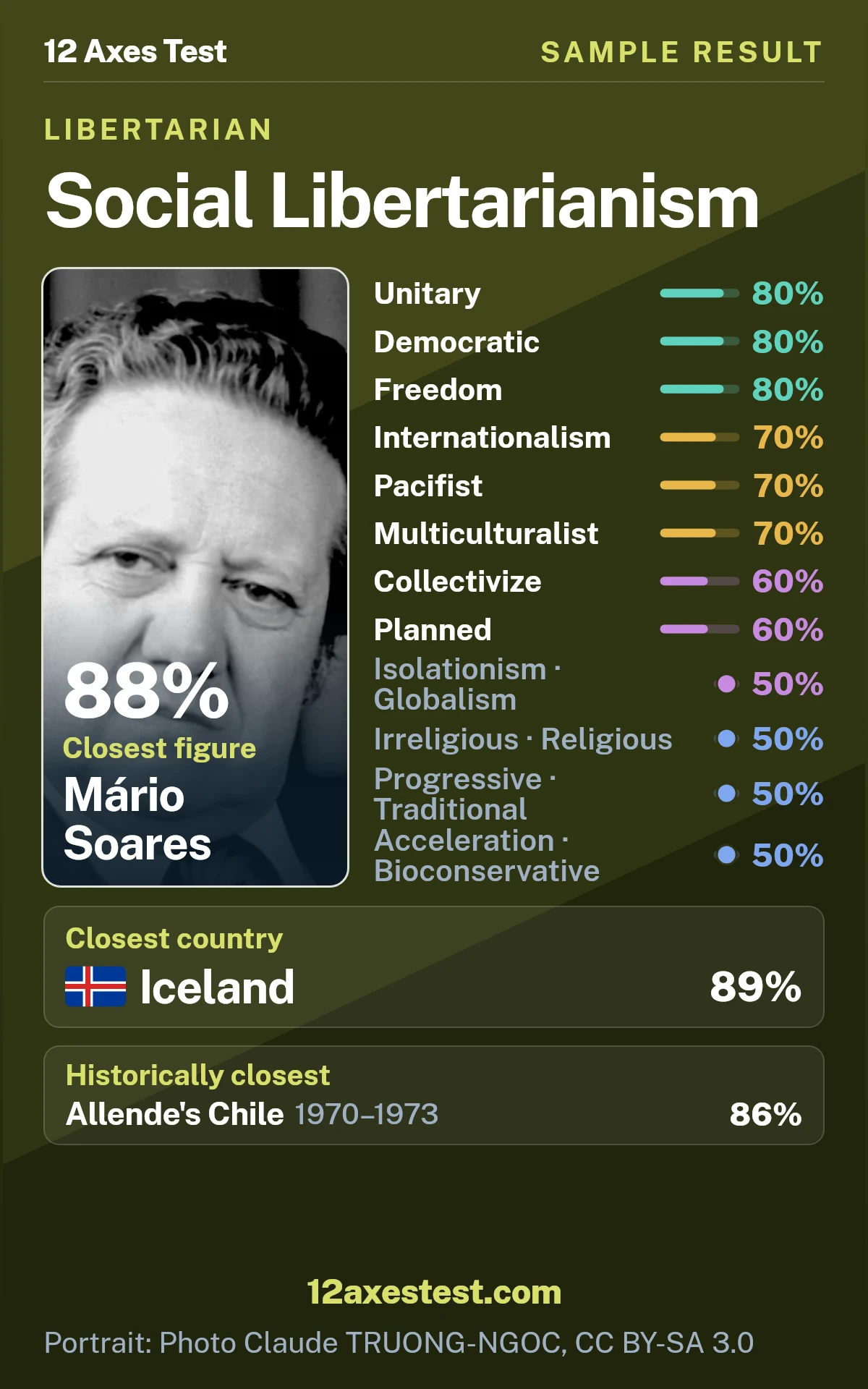
Portrait: Photo Claude TRUONG-NGOC, CC BY-SA 3.0, via Wikimedia Commons
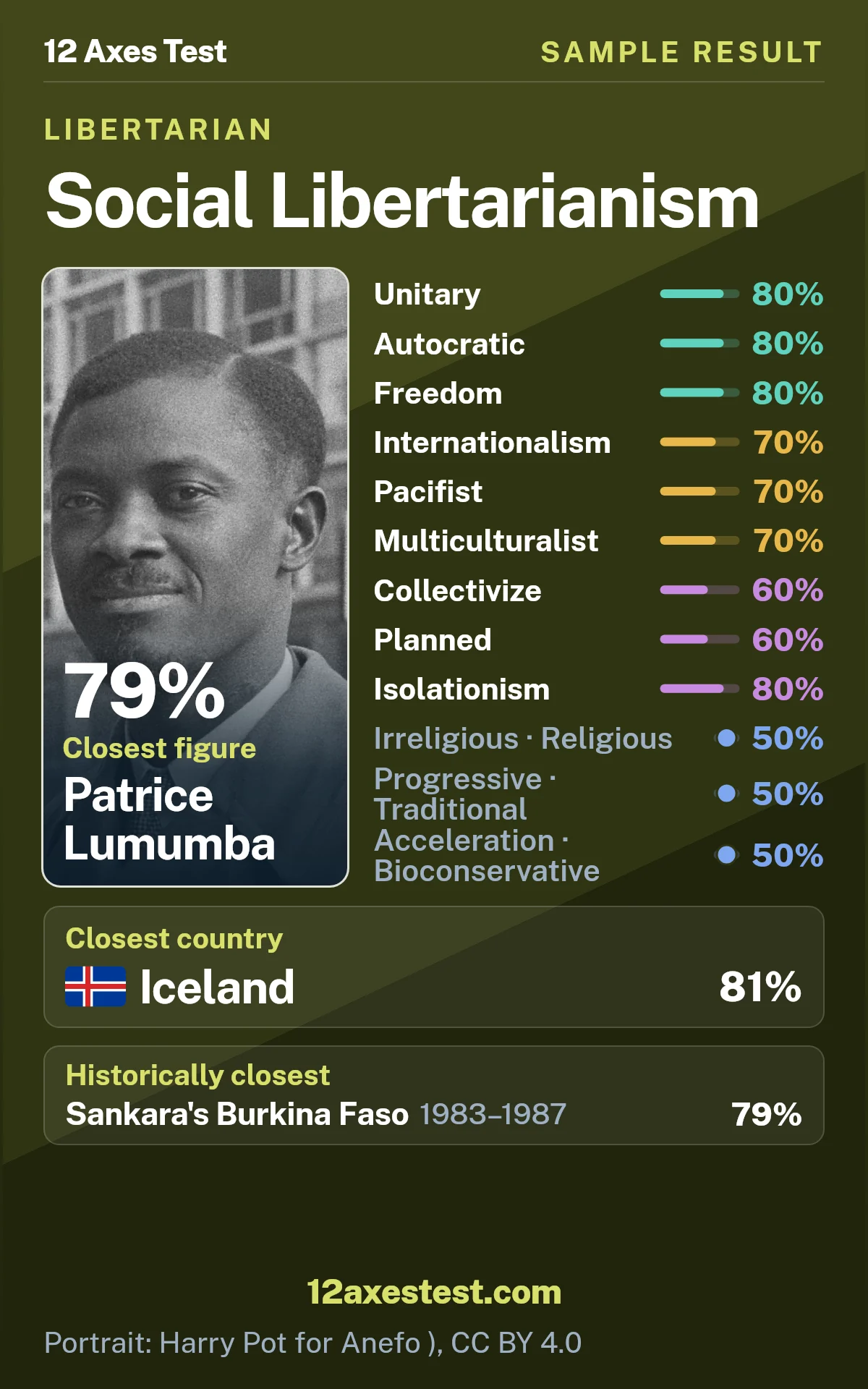
Portrait: Harry Pot for Anefo ), CC BY 4.0, via Wikimedia Commons
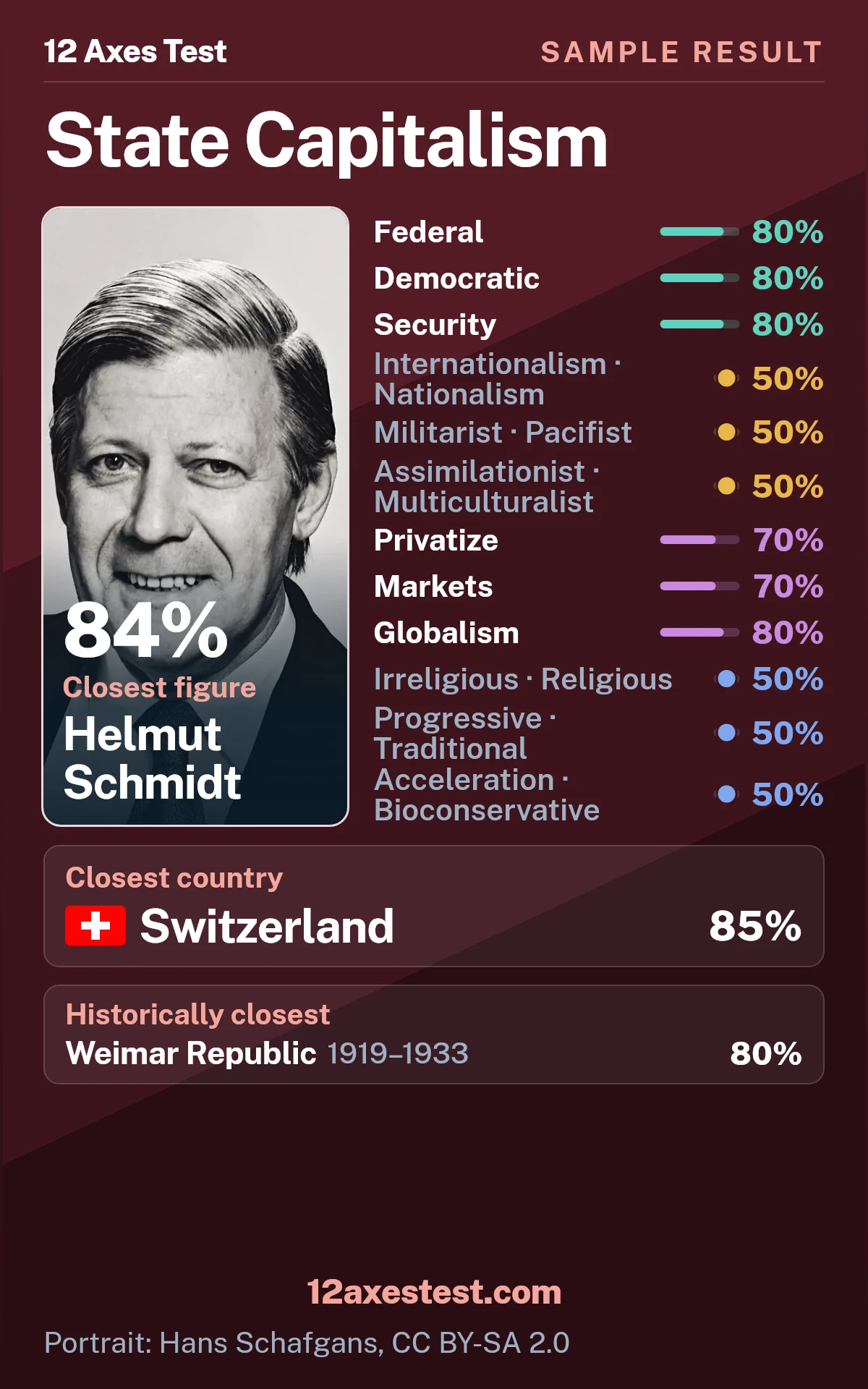
Portrait: Hans Schafgans, CC BY-SA 2.0, via Wikimedia Commons
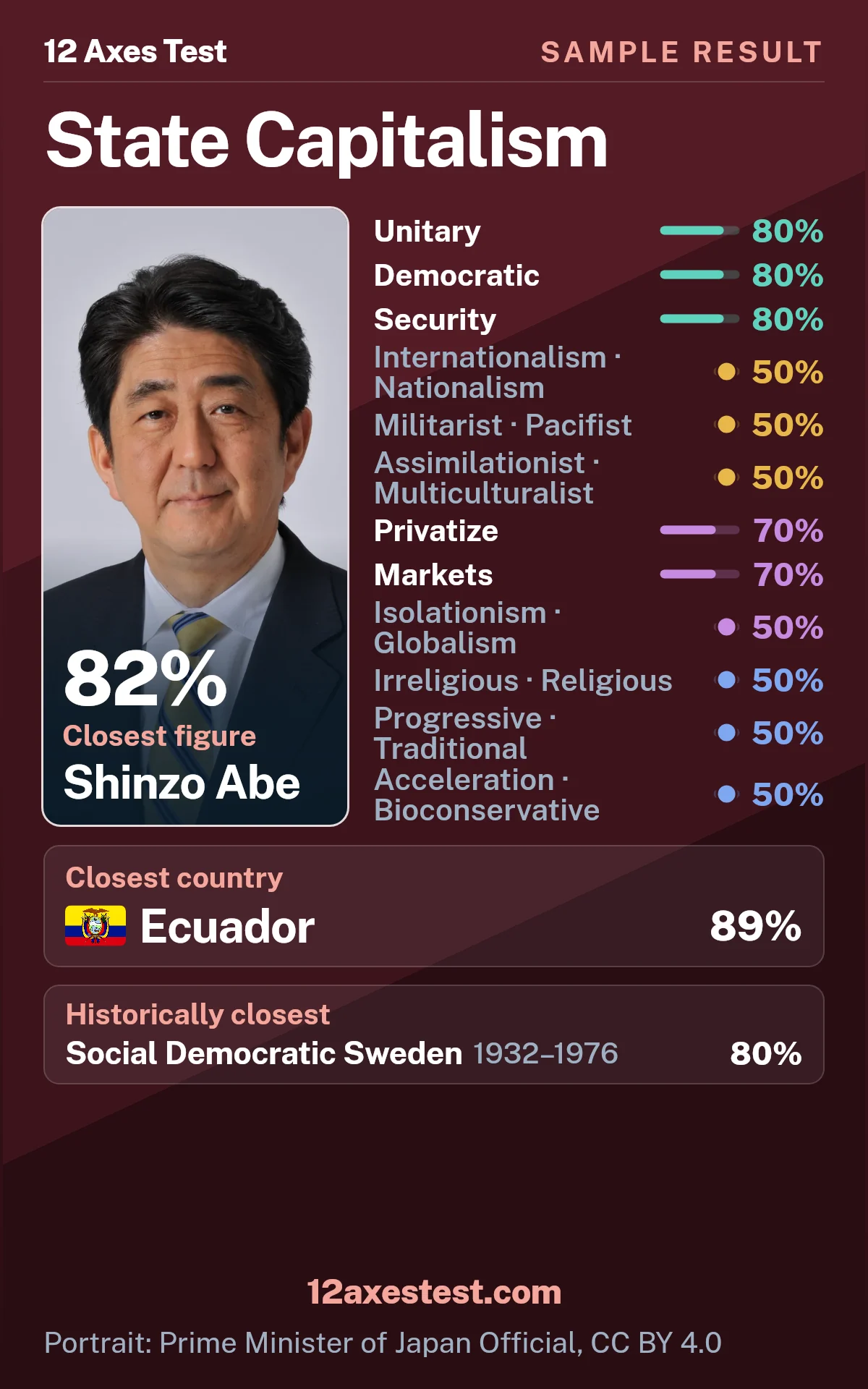
Portrait: Prime Minister of Japan Official, CC BY 4.0, via Wikimedia Commons
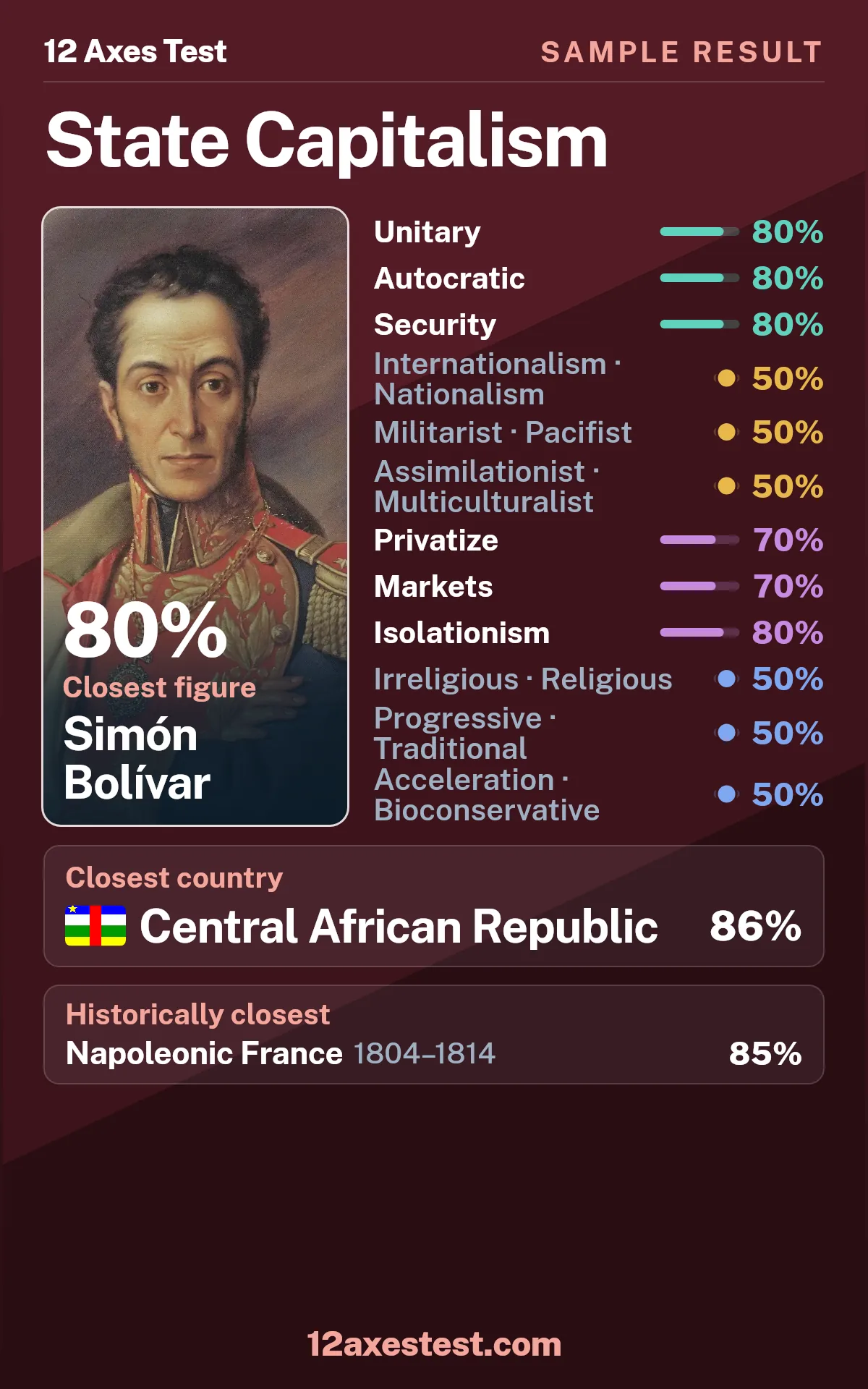
Sample results by family
19 samples in 8 families, in the order of the spectrum from left to right, then libertarian and the systems the left-right words do not place. The other 19 ideologies have no sample on this page; all 38 are described on the ideologies page. Open a name to see its sample, or follow the link under the picture to read about the ideology.
Far left · 3
MarxismSample result
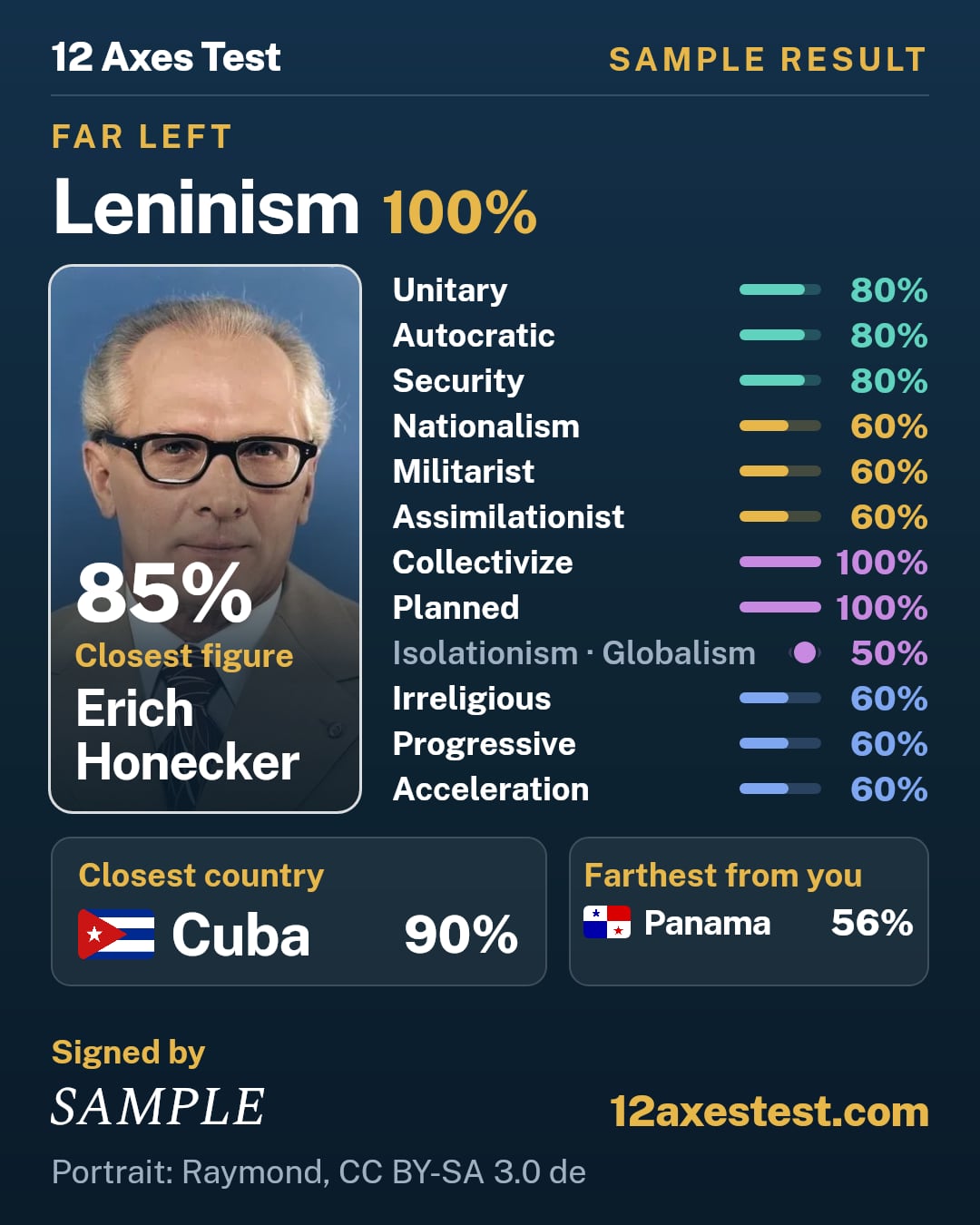
LeninismSample result
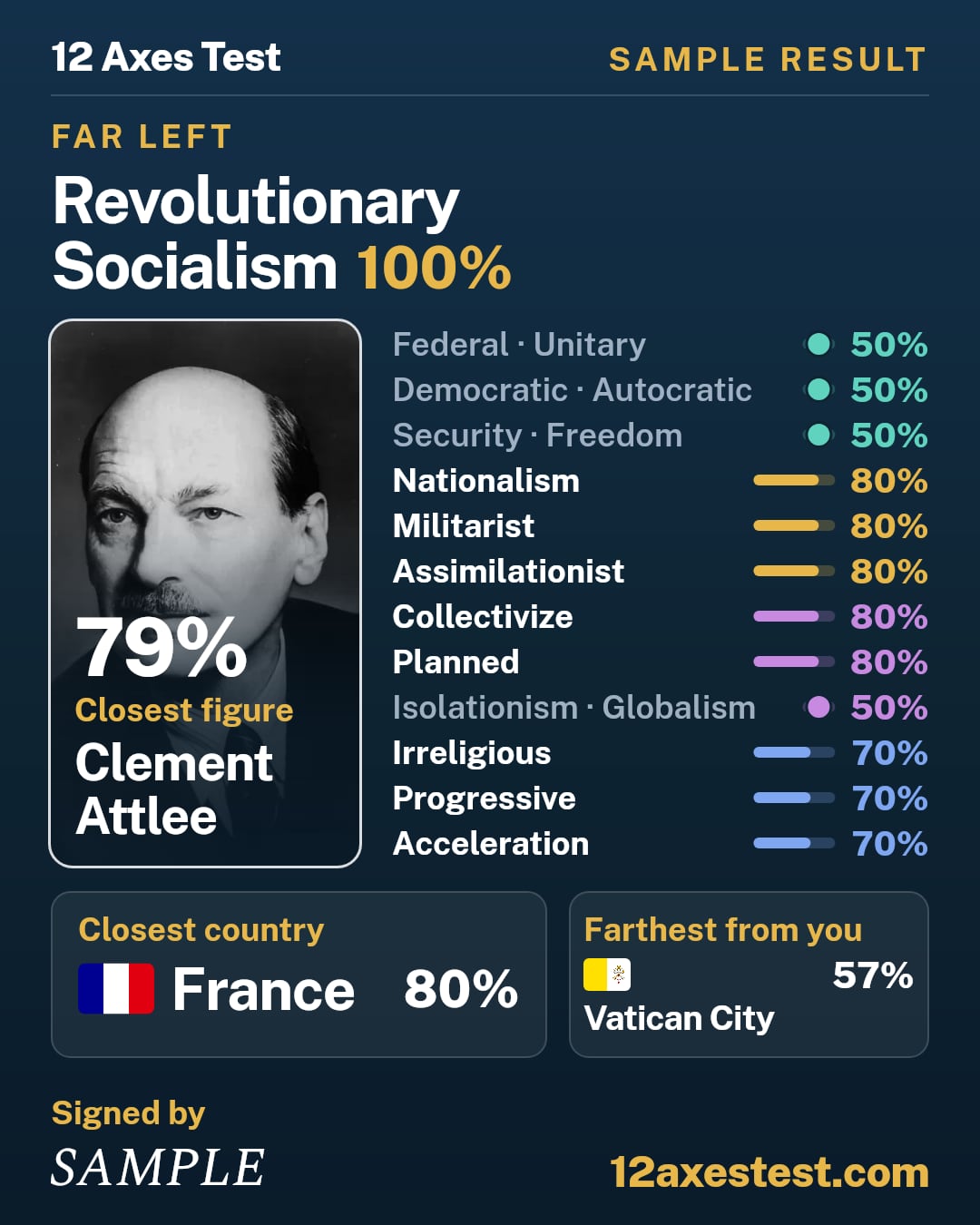
Revolutionary SocialismSample result
Left · 3
Libertarian SocialismSample result
State SocialismSample result
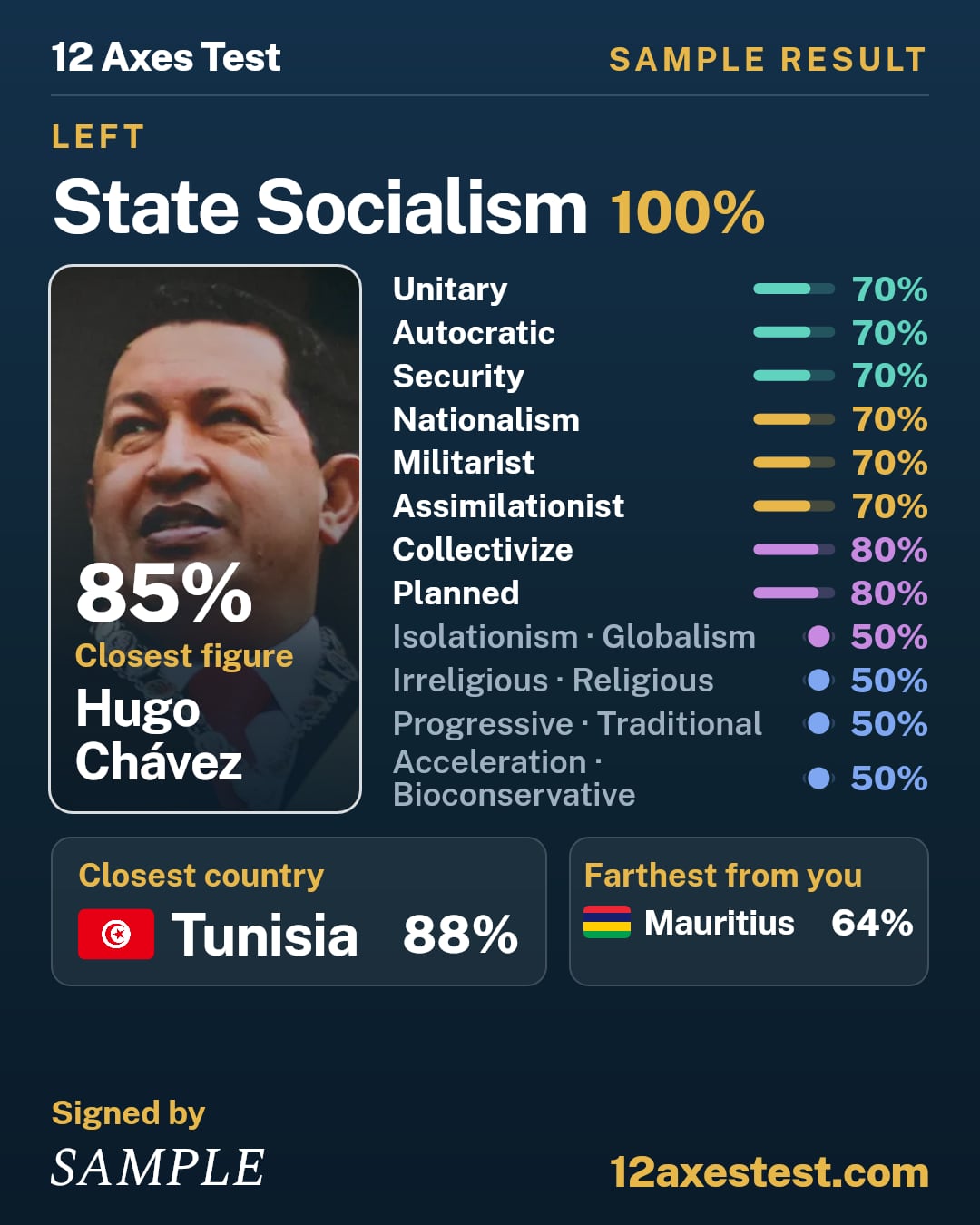
Democratic SocialismSample result
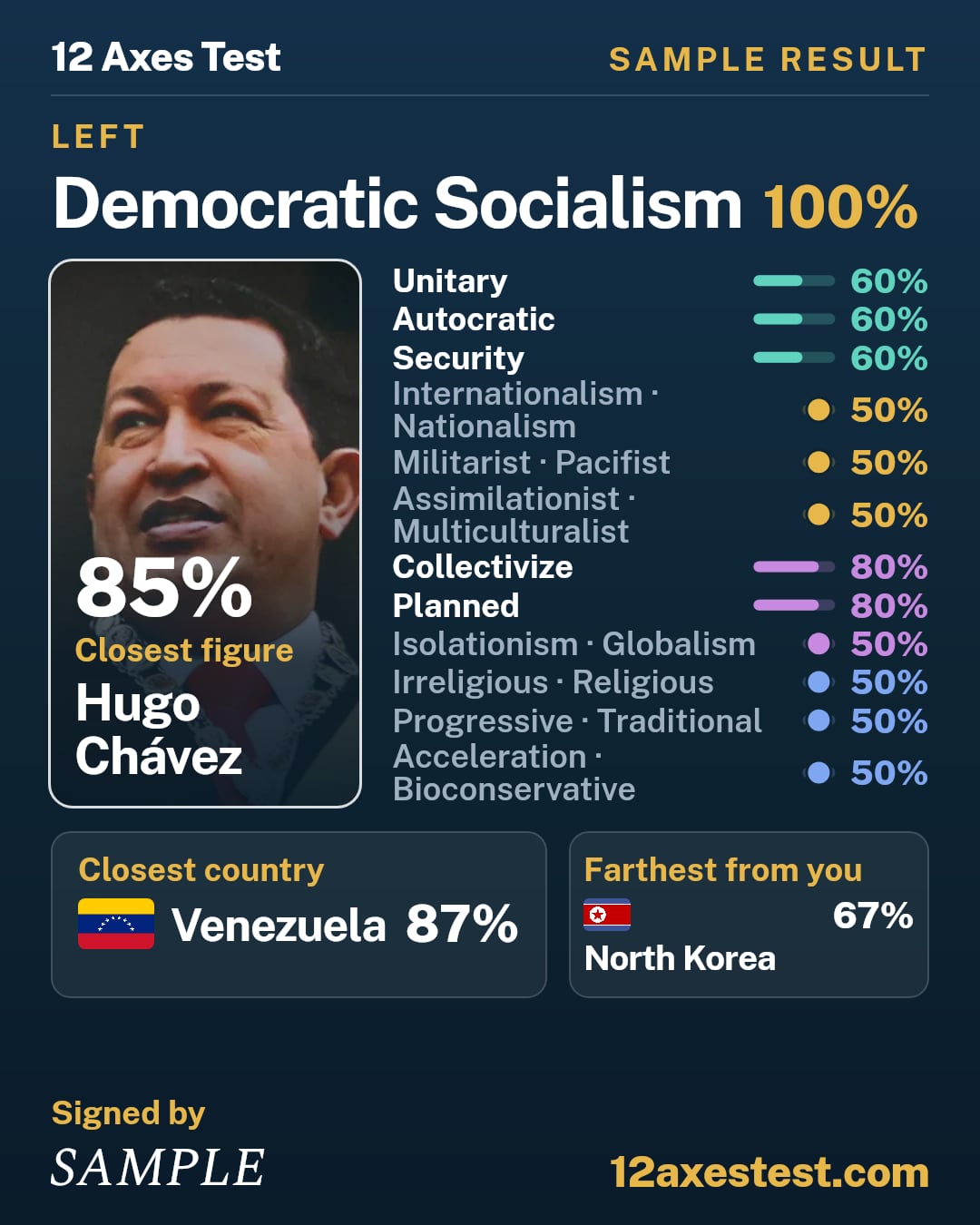
Centre-left · 3
Social DemocracySample result
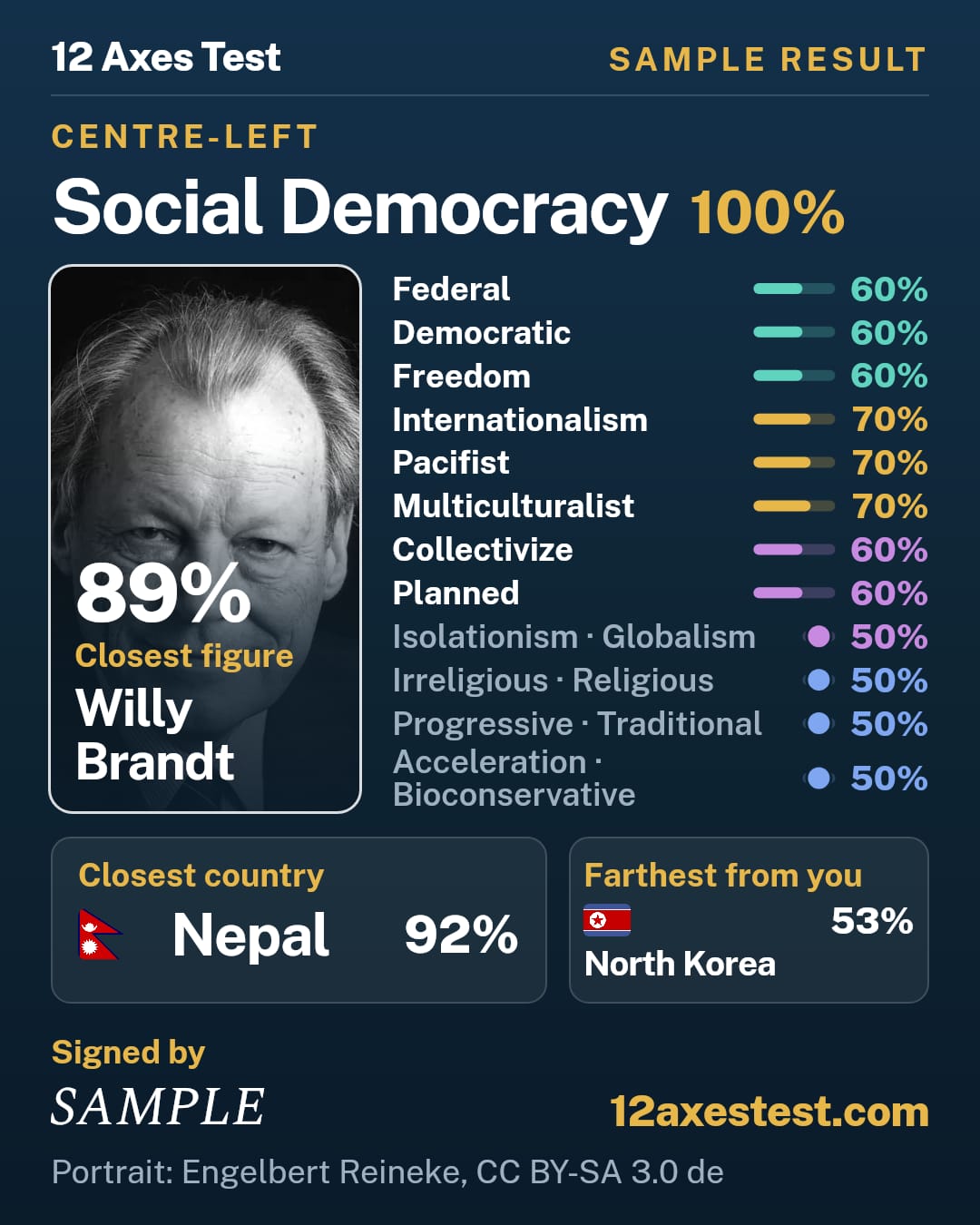
ProgressivismSample result
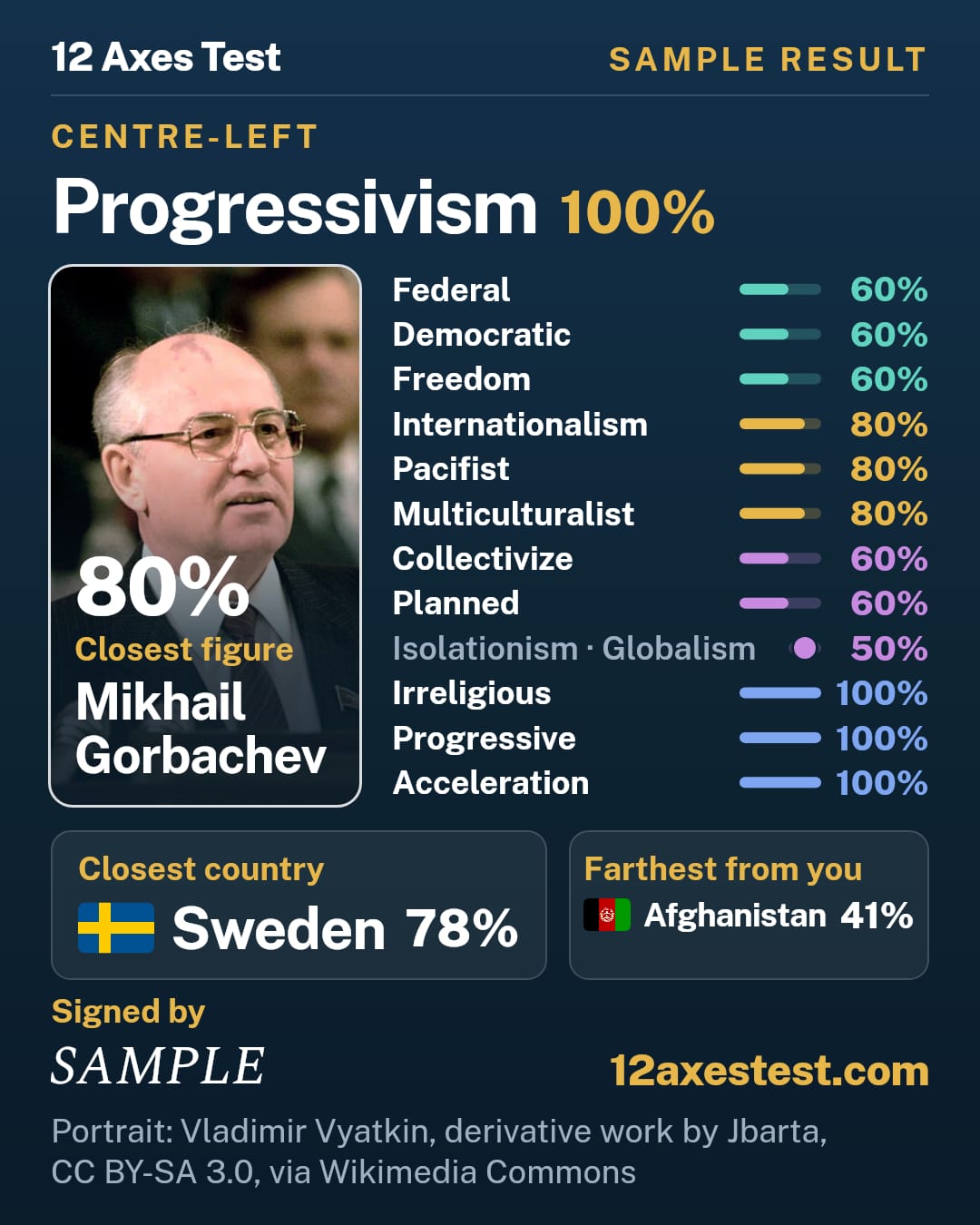
Centre · 2
CentrismSample result
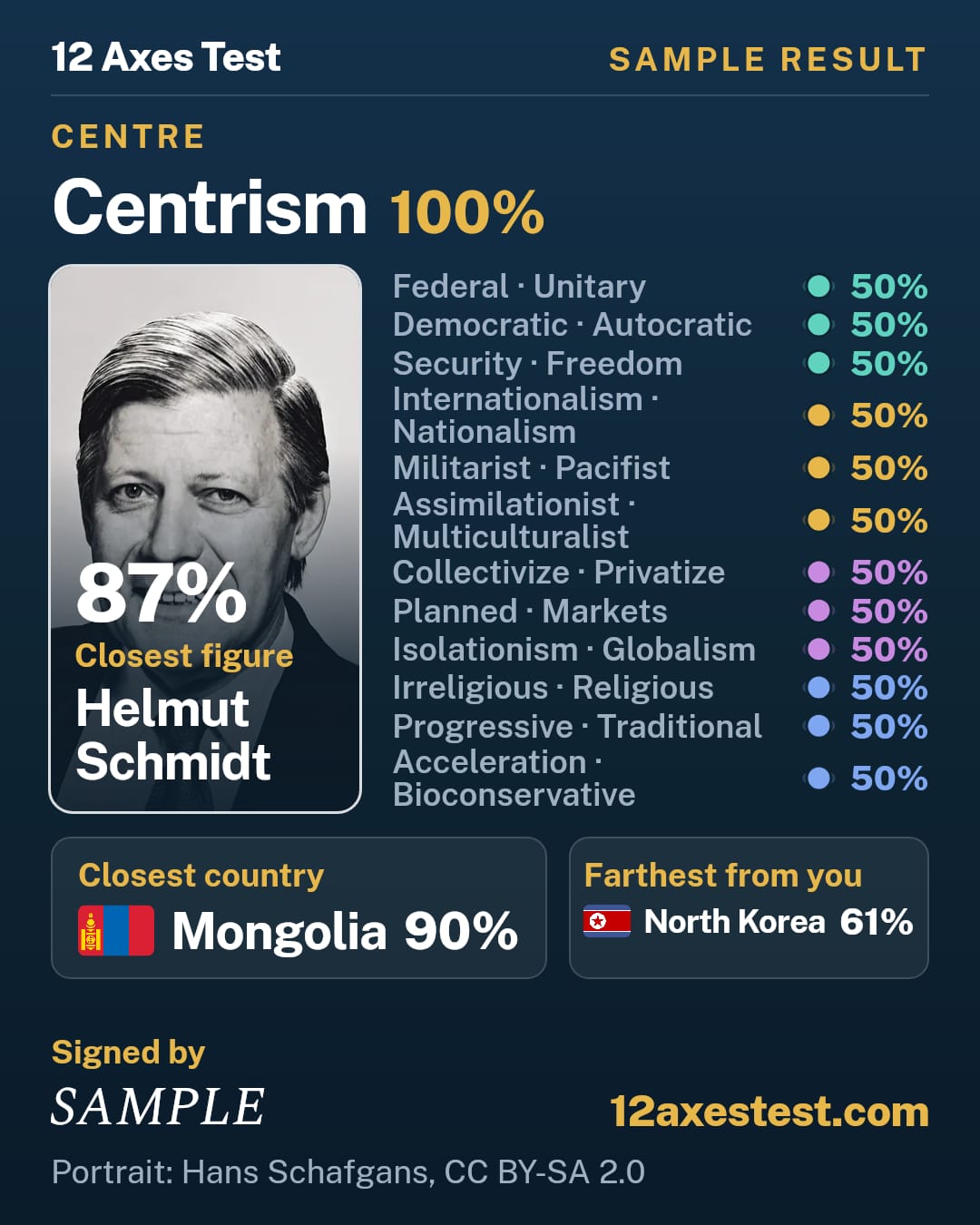
LiberalismSample result
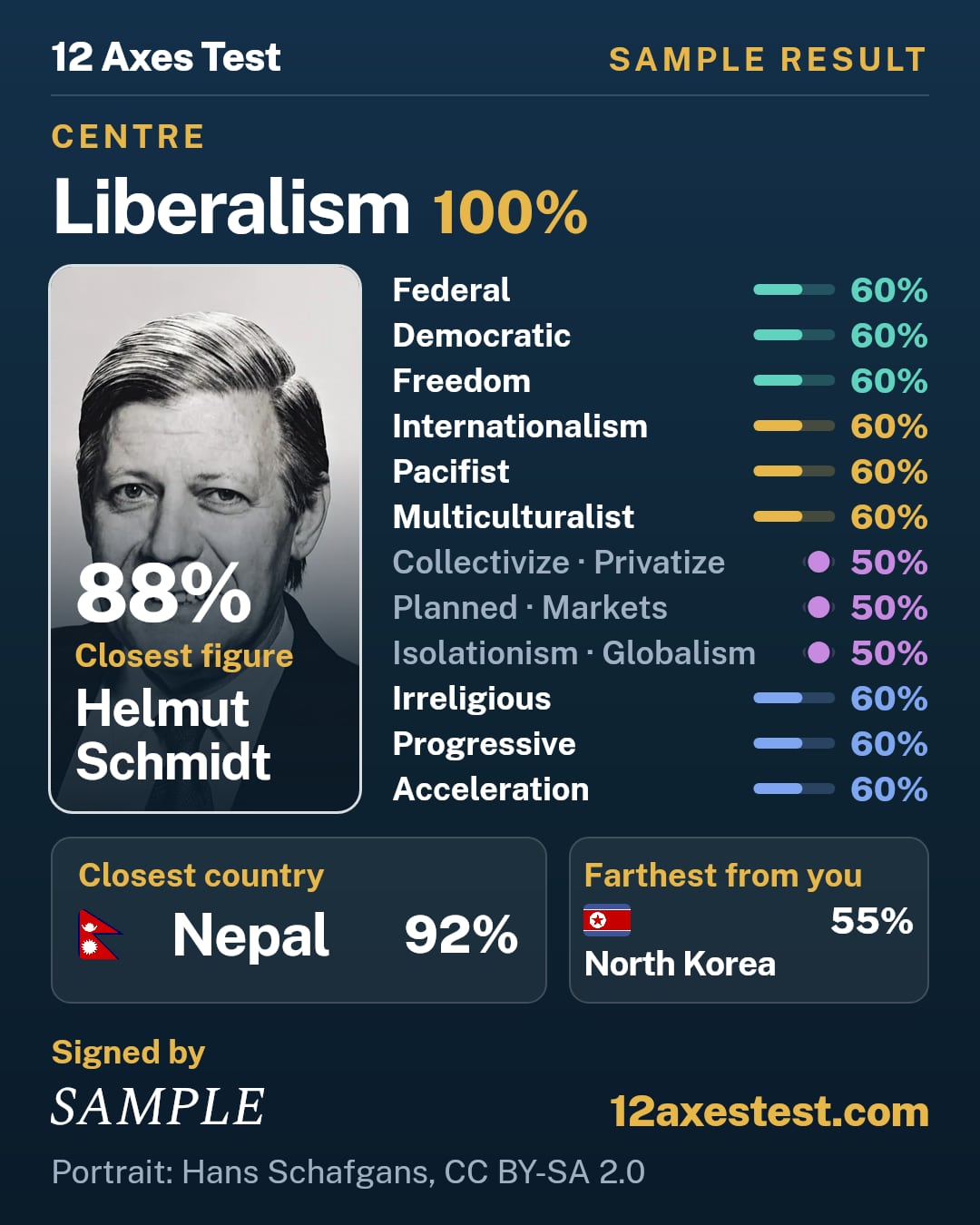
Centre-right · 3
Christian DemocracySample result
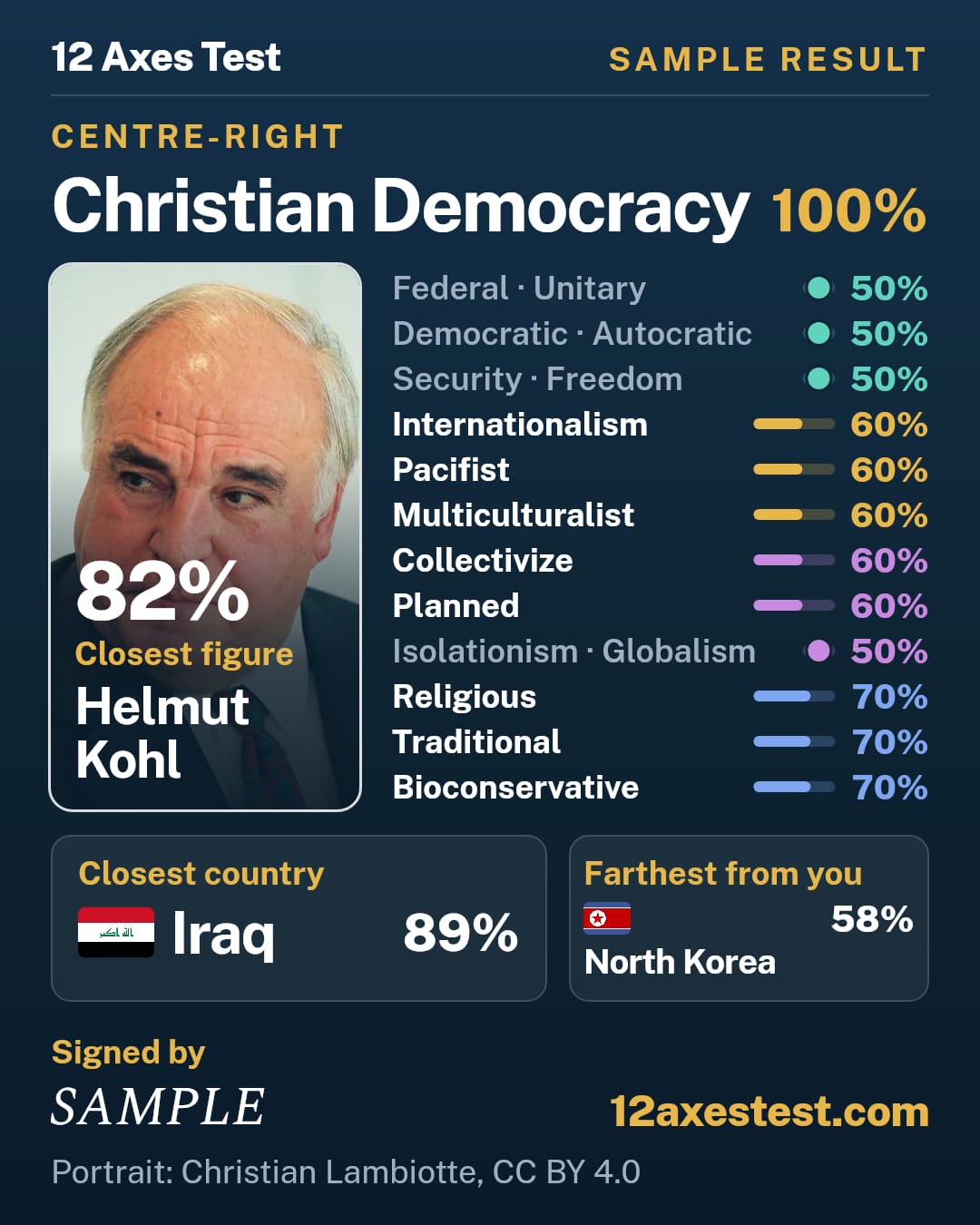
NeoliberalismSample result
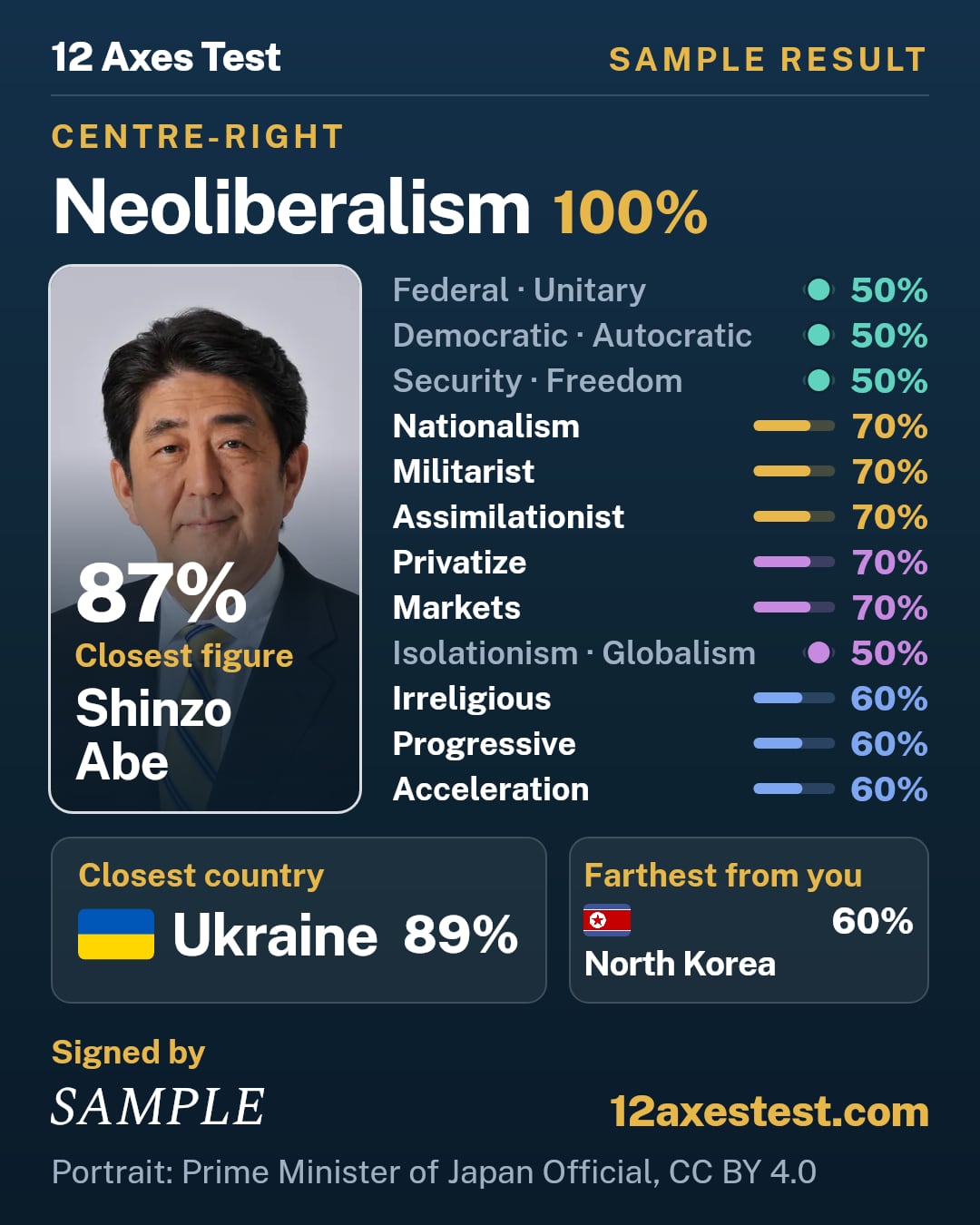
Classical LiberalismSample result
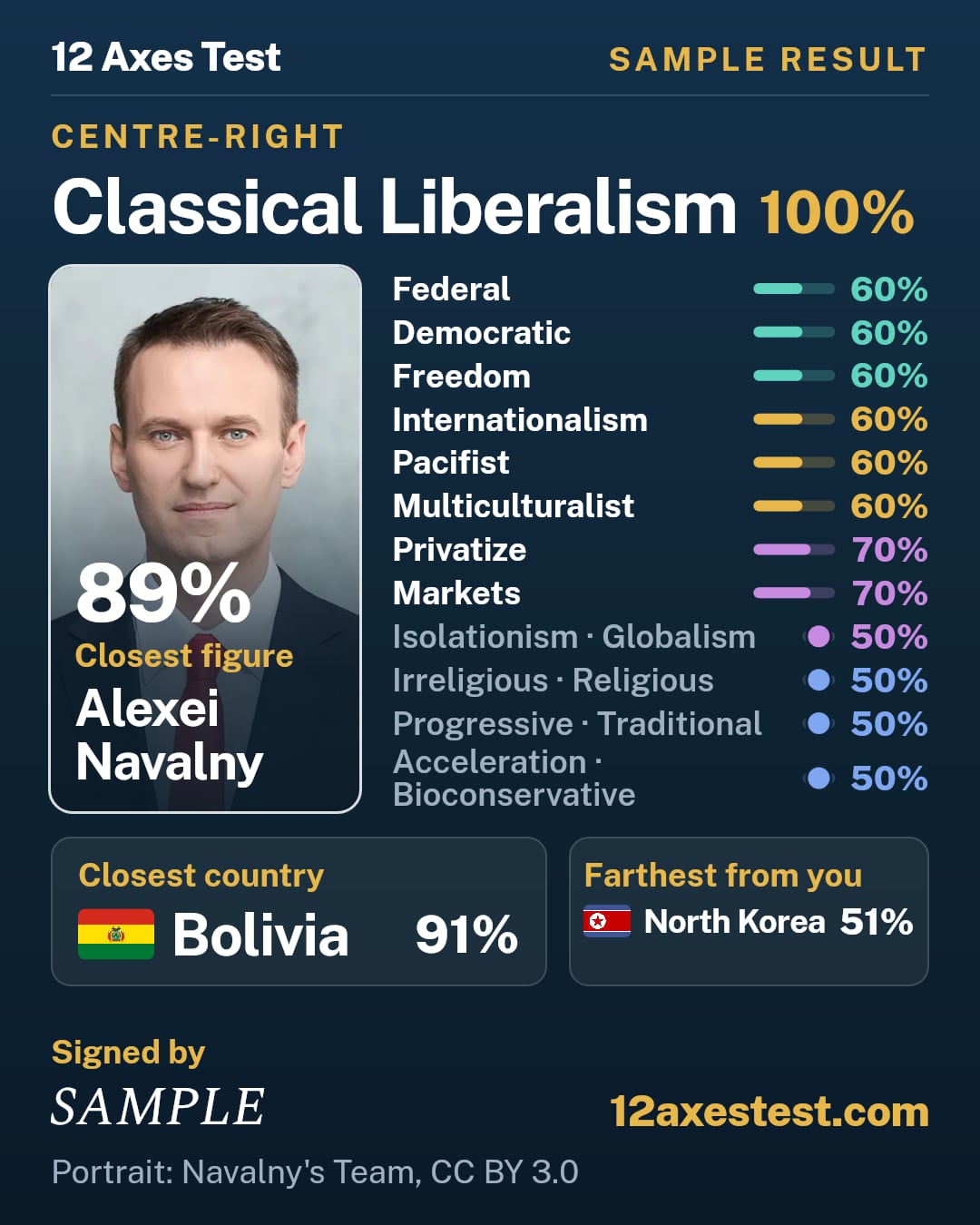
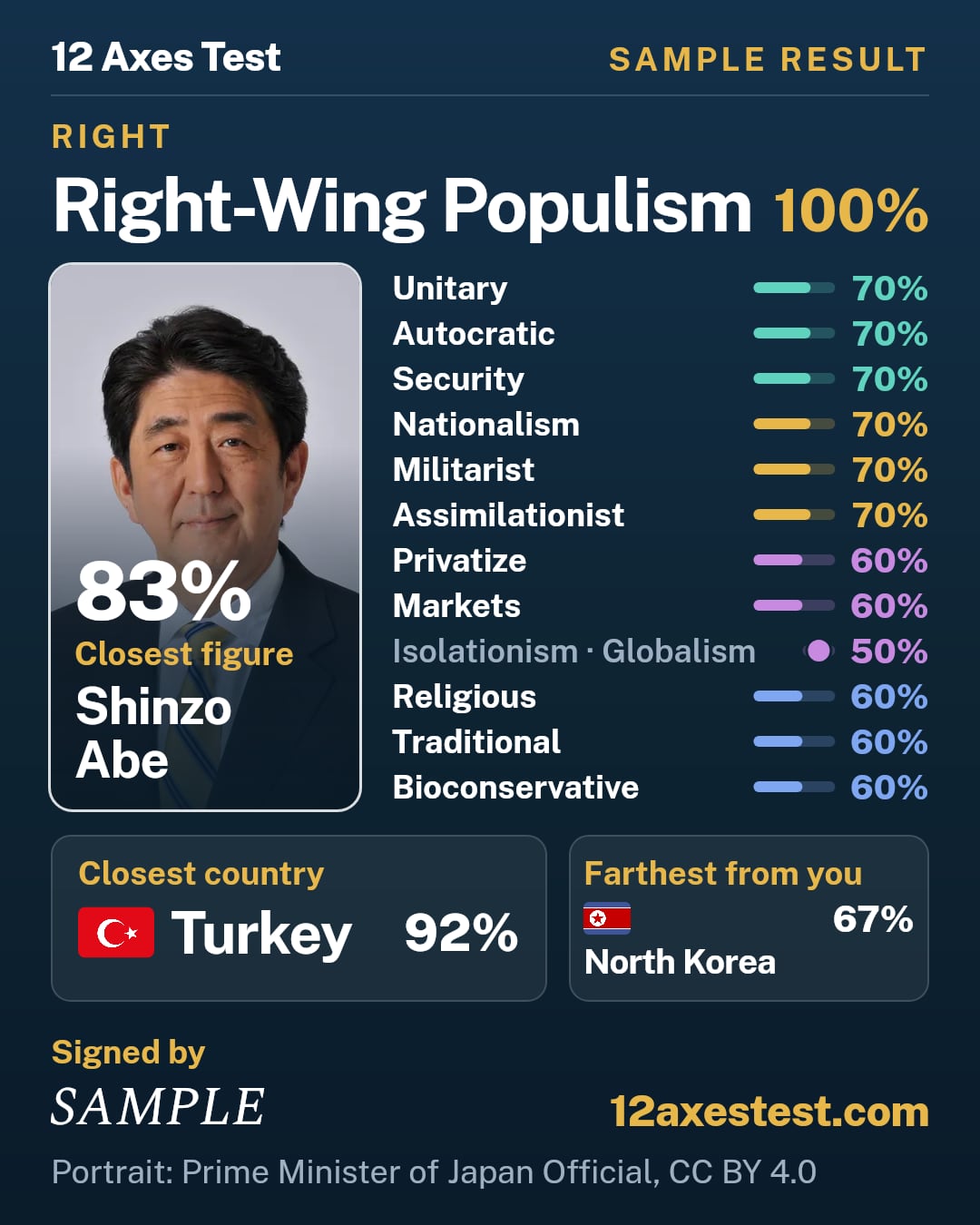
Right · 2
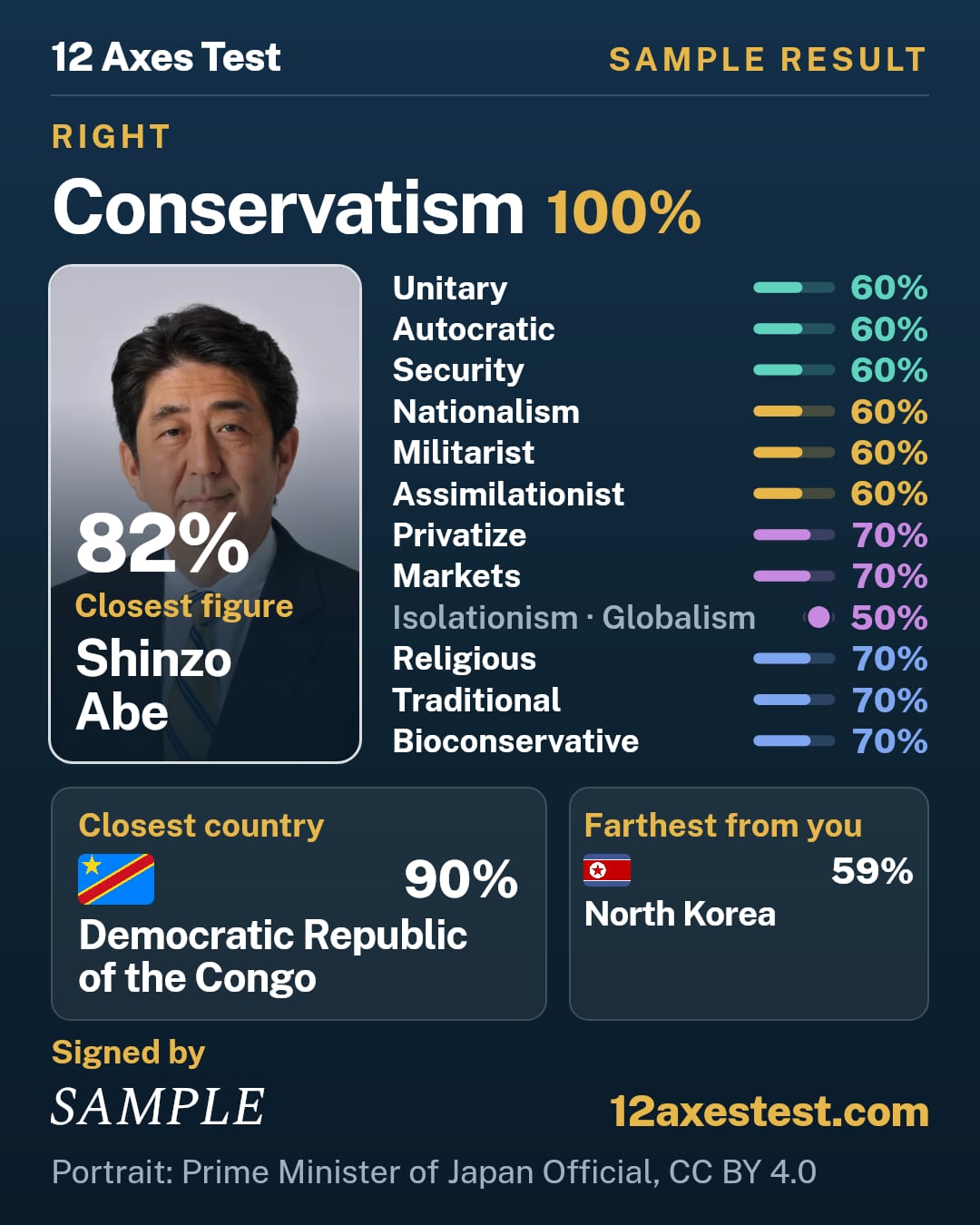
Right-Wing PopulismSample result
ConservatismSample result
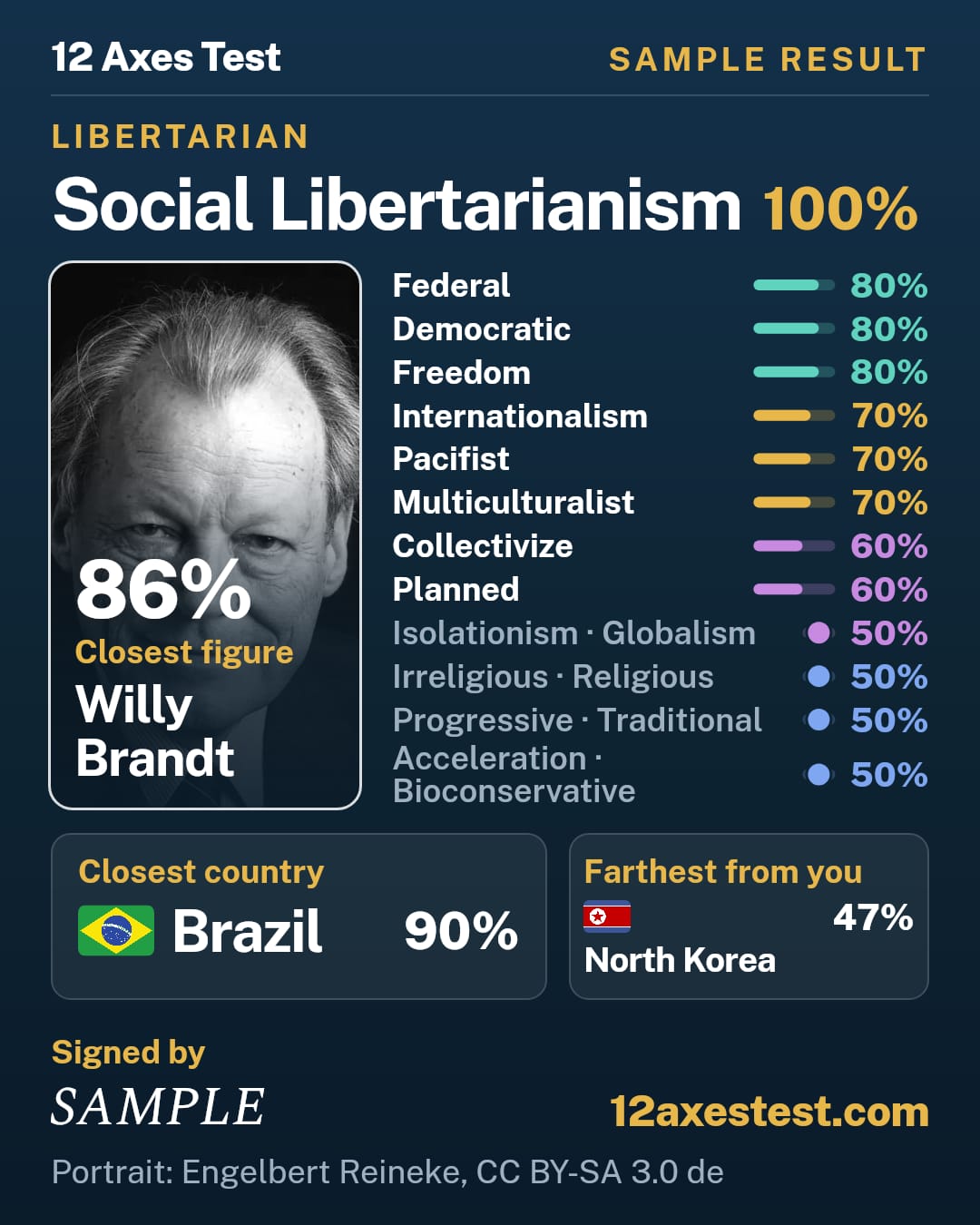
Libertarian · 1
Social LibertarianismSample result
Other · 2
Authoritarian CapitalismSample result
State CapitalismSample result
All 38 possible results
Your closest match is one of these 38 ideologies, from the left of the spectrum to the right. The name opens its description; the second link jumps to its sample result (19 have none).
- Anarcho-CommunismFar left
- TrotskyismFar left
- MarxismFar leftSample result
- De LeonismFar left
- LeninismFar leftSample result
- StalinismFar left
- Revolutionary SocialismFar leftSample result
- Anarcho-SyndicalismFar left
- Libertarian SocialismLeftSample result
- State SocialismLeftSample result
- Democratic SocialismLeftSample result
- Left-Wing PopulismLeft
- Social LiberalismCentre-leftSample result
- Social DemocracyCentre-leftSample result
- ProgressivismCentre-leftSample result
- CentrismCentreSample result
- LiberalismCentreSample result
- Christian DemocracyCentre-rightSample result
- Moderate ConservatismCentre-right
- NeoliberalismCentre-rightSample result
- Classical LiberalismCentre-rightSample result
- Right-Wing PopulismRightSample result
- ReactionaryRight
- ConservatismRightSample result
- NeoconservatismRight
- FascismFar right
- Anarcho-MutualismLibertarian
- Social LibertarianismLibertarianSample result
- Right-LibertarianismLibertarian
- ObjectivismLibertarian
- VoluntaryismLibertarian
- Anarcho-CapitalismLibertarian
- Distributism
- Technocracy
- Religious Anarchism
- Anarcho-Egoism
- Authoritarian CapitalismSample result
- State CapitalismSample result
The twelve axes, one line each
A result has twelve scores, one per axis, in four categories. Each score is the percent of the first value, so 100 minus it is the second.
Government
- Federal – Unitary
- Power held by regions and cities, or by one national government.
- Democratic – Autocratic
- Leaders chosen by voters, or authority that does not answer to them.
- Security – Freedom
- Order and protection first, or liberty and privacy first.
Diplomacy
- Internationalism – Nationalism
- Cooperation through shared institutions, or the nation first.
- Militarist – Pacifist
- Military strength as a tool of policy, or peace as the rule.
- Assimilationist – Multiculturalist
- Newcomers adopt the host culture, or many cultures live side by side.
Economy
- Collectivize – Privatize
- Shared and public ownership, or private property and enterprise.
- Planned – Markets
- The state steers the economy, or prices and competition do.
- Isolationism – Globalism
- Protect local industry, or open trade across borders.
Society
- Irreligious – Religious
- A secular public life, or faith as a guide for society.
- Progressive – Traditional
- Change norms through reform, or keep inherited values.
- Acceleration – Bioconservative
- Adopt new technology fast, or limit it to protect human nature.
Each axis explained: its seven labels, statements and who sits at each end
How the percentages are calculated
Each of the seven answers has a weight: 2, 1, 0.5, 0, −0.5, −1, −2, from Strongly Agree to Strongly Disagree. A statement adds its weight to its axis, or subtracts it when it is worded from the opposite side. The sum for an axis becomes a percent of its first value.
The quick version (36 statements, 3 per axis) scores 50 + (50/6) × the sum, rounded to the nearest 0.5. The standard version (60 statements) scores 50 + 5 × the sum, in steps of 2.5. The full version (288 statements) scores 50 + the sum, in steps of 0.5, between 2 and 98.
How to read a middle score
A score from 40 to 60 gets the middle label of its axis, for example Centrist or Neutral. A middle score can mean a balanced view, answers that pull both ways, or many Neutral/Unsure answers, which add nothing.
On your result each axis shows the pole it leans to and how far: 62 is a 62% lean to the first value, 38 a 62% lean to the second, and 50 leans to neither.
Same score, different answers
Fictional example: five answers on the Security–Freedom axis of the 60-question test. This is one axis, not either person's full result.
| Statement | A | B |
|---|---|---|
| Police need more power and protection. | Neutral/Unsure (0) | Strongly Agree (+2) |
| If you have nothing to hide, then you have nothing to fear. | Neutral/Unsure (0) | Strongly Disagree (-2) |
| The government should have access to the emails of suspected terrorists. | Neutral/Unsure (0) | Neutral/Unsure (0) |
| The right to bear arms should not be infringed. | Neutral/Unsure (0) | Neutral/Unsure (0) |
| The very existence of the state is a threat to our liberty. | Neutral/Unsure (0) | Neutral/Unsure (0) |
A scores 50; B also scores 50. Security is the first pole. B’s +2 and −2 contributions cancel, so both totals are 50 + 5 × 0 = 50. The same score does not mean the same answers, and Neutral/Unsure does not tell us why A chose it.
Reproducible sample from pickQuestions('quick', () => 0.1): triples 4,1,0; 4,2,0; 4,3,0; 4,5,0; 4,7,0 (axis, group, question index, starting at zero). Groups 1–3 add answer weights; groups 5 and 7 reverse them. Actual test questions are randomly selected. Source: src/lib/axes.js and src/data/questions.en.json.
Common misreadings
- A high score is not a stronger belief in everything on the axis. 90 means your answers added up toward the first value far more than toward the second, not that you hold the most extreme view.
- A middle score is not "no opinion". Two opposite answers on the same axis cancel out, and so a mix of strong views can land near 50.
- The ideology is a match on four axes, not on all twelve. It compares economy, government, diplomacy and society. Two people with the same ideology can differ on the other eight axes.
- The closest country is not a place you would be admitted to. It is the country whose current government's policy is nearest to your twelve scores. “Closest country” is a ranking, not a real-world immigration decision.
Questions
Are these real 12 axes test results?
No. Each is a sample made from one ideology's own values, so no one's answers are shown. A real result comes from your answers to 60 or 288 statements.
Why is every sample 100% close to its ideology?
The ideology match uses four axes, and on a sample those four are set to the ideology's own values, so the distance is zero. Nobody's answers fall exactly on an ideology, so a real result shows a lower closeness.
Can I save a picture like this of my own result?
Yes. When you finish the test, your result page has buttons that save a picture of your own result with your scores, in the same layout as the samples on this page. You can sign it with your name.
These are samples. Your result comes from your own answers. Take the test
Social LiberalismSample result