Ideology
CentrismCentre
Seeks a middle path between left and right, avoiding strong ideological commitments and preferring pragmatic compromise, moderate reforms and policies chosen case by case.
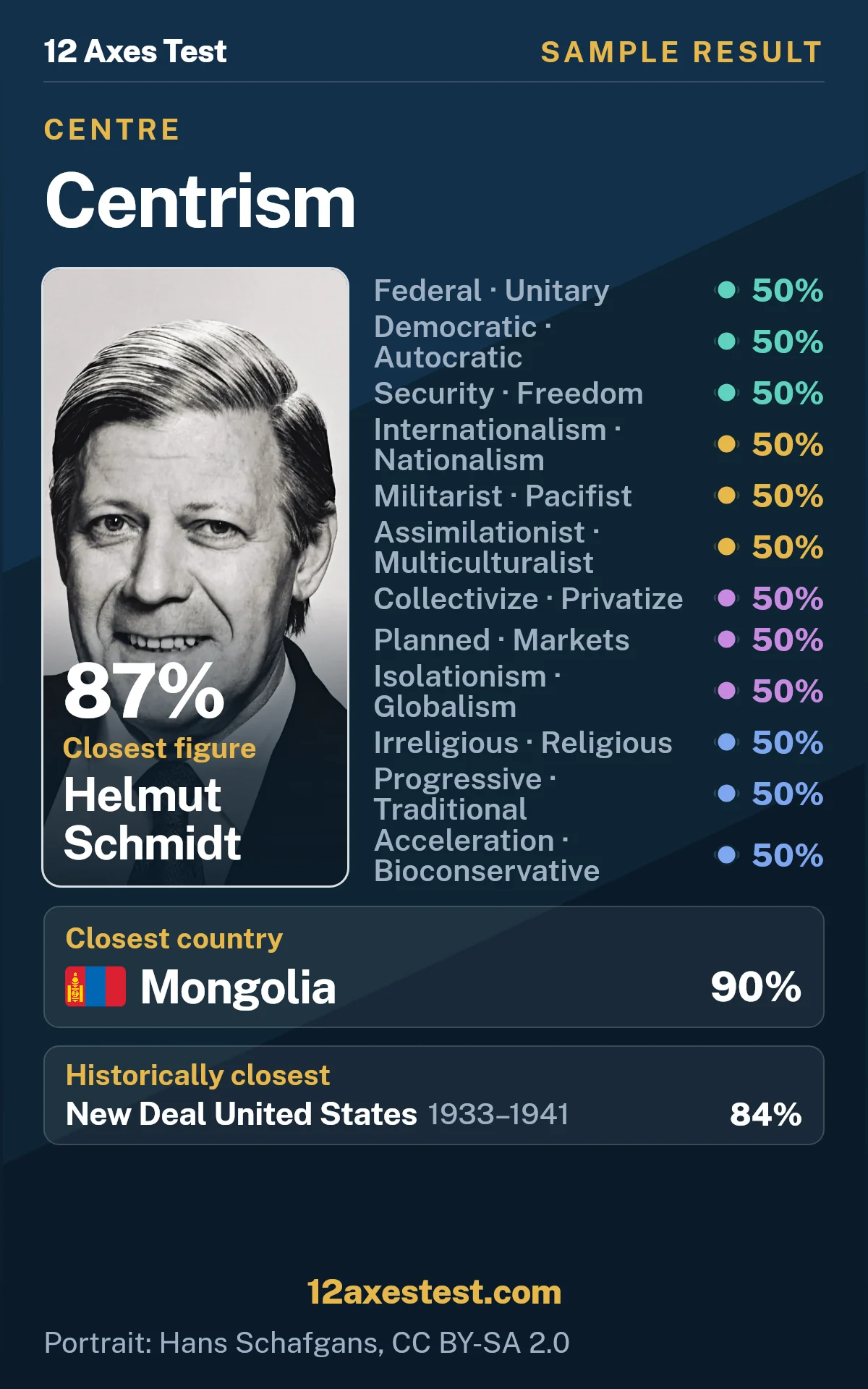
Portrait: Hans Schafgans, CC BY-SA 2.0, via Wikimedia Commons
Core ideas
- Positions between left-wing and right-wing politics on the usual spectrum.
- Support for gradual change rather than sharp breaks.
- Continuing welfare-state policies with moderate emphasis on redistribution.
- Pragmatic, case-by-case policy rather than one doctrine.
- Willingness to build compromise and coalitions across the divide.
Where it sits on the 12 axes
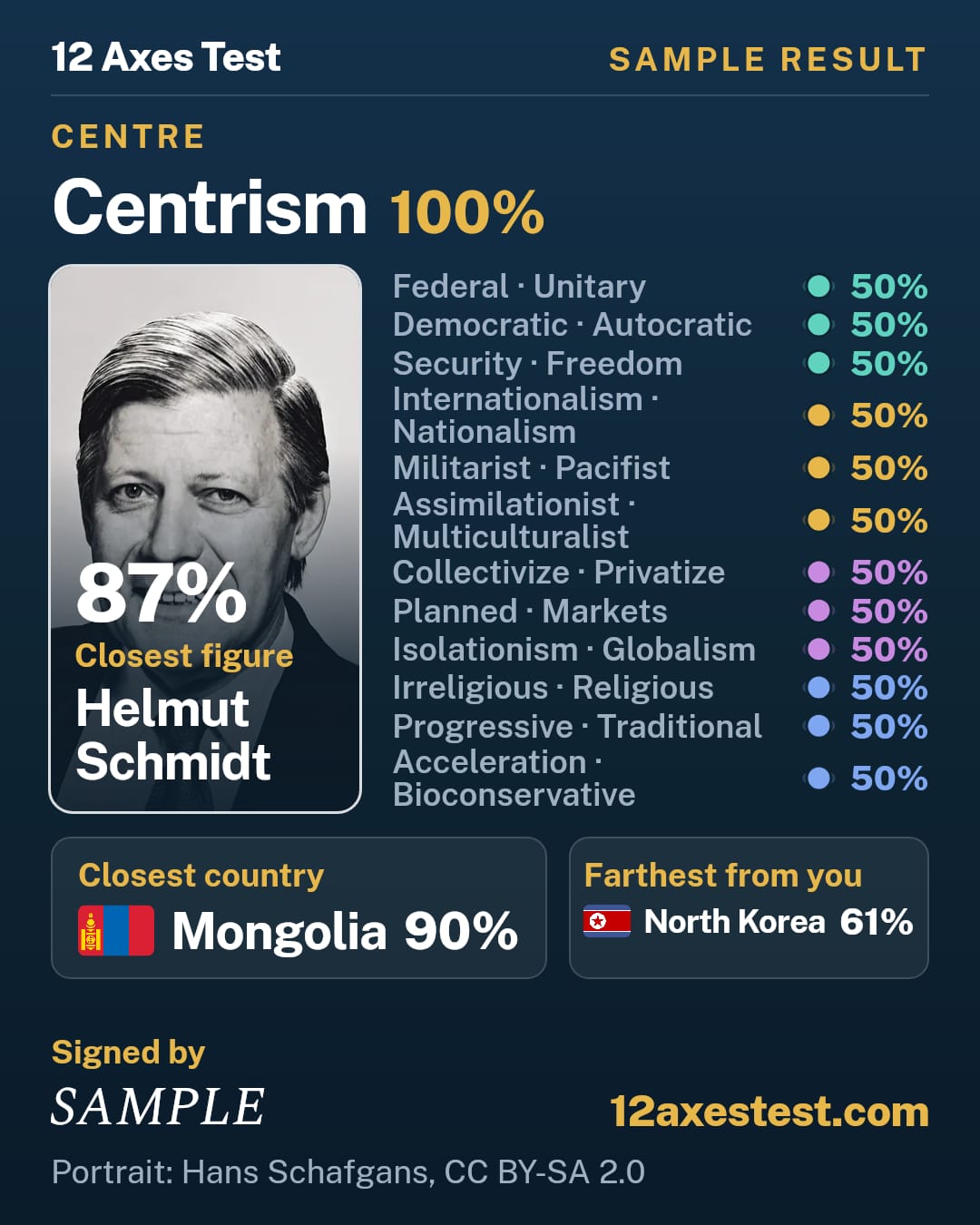
Every one of its four values is 50: economy (econ 50 on Collectivize/Privatize), government (govt 50 on Security/Freedom), diplomacy (dipl 50 on Internationalism/Nationalism) and society (scty 50 on Progressive/Traditional). It is the exact midpoint. The test finds the ideology at the least distance from your four scores, so people with mixed answers, or moderate answers throughout, who do not lean far in any direction, often land here.
The bar shows the position on each of the four axes an ideology is matched on; the middle mark is the centre.
Sample result
History
The left-right spectrum began in the French Revolution, when assemblymen who were neither radicals nor reactionaries sat between the two groups. Liberalism became the dominant centrist ideology in the eighteenth century, challenging conservatism and socialism. Agrarianism was briefly a major centrist movement in Europe in the late nineteenth and early twentieth centuries. After the Cold War ended in the 1990s, centrist liberalism was seen as the dominant force, and centre-left and centre-right moved closer together. It declined after the 2008 financial crisis, as populism and polarization rose.
Common misunderstandings
- It does not mean having no opinions. Centrists may hold strong moderate beliefs, though some people use the label simply because they are not strongly aligned with left or right.
- A middle score is not the same as agreeing with both sides. Someone with very strong left and very strong right views on different issues can also average to the middle.
Related ideologies
Is Centrism your closest ideology?
Take the test and see which of the ideologies your answers sit closest to.
Questions
What is Centrism?
The range of ideologies between left-wing and right-wing politics. It is associated with moderate positions, gradual change and support for a welfare state with moderate redistribution.
Is Centrism left or right?
Neither; by definition it sits between them. Political scientists accept that placement, although radical groups on either side sometimes call centrists leftist or rightist. Radical centrism rejects the left-right line altogether.
Centrism vs liberalism?
Liberalism is a specific ideology that is often associated with the centre, in both left-leaning and right-leaning variants. The centrist label describes a position on the spectrum and does not commit to liberal principles.
How does the 12 Axes test decide I am Centrism?
All four of its stored values are 50, the exact middle. If your economy, government, diplomacy and society scores are all near 50, this is the closest match by distance.