Ideology
Social LiberalismCentre-left
Supports individual liberty and a market economy while holding that government should correct inequality and market failures through regulation, public education, health care and a safety net.
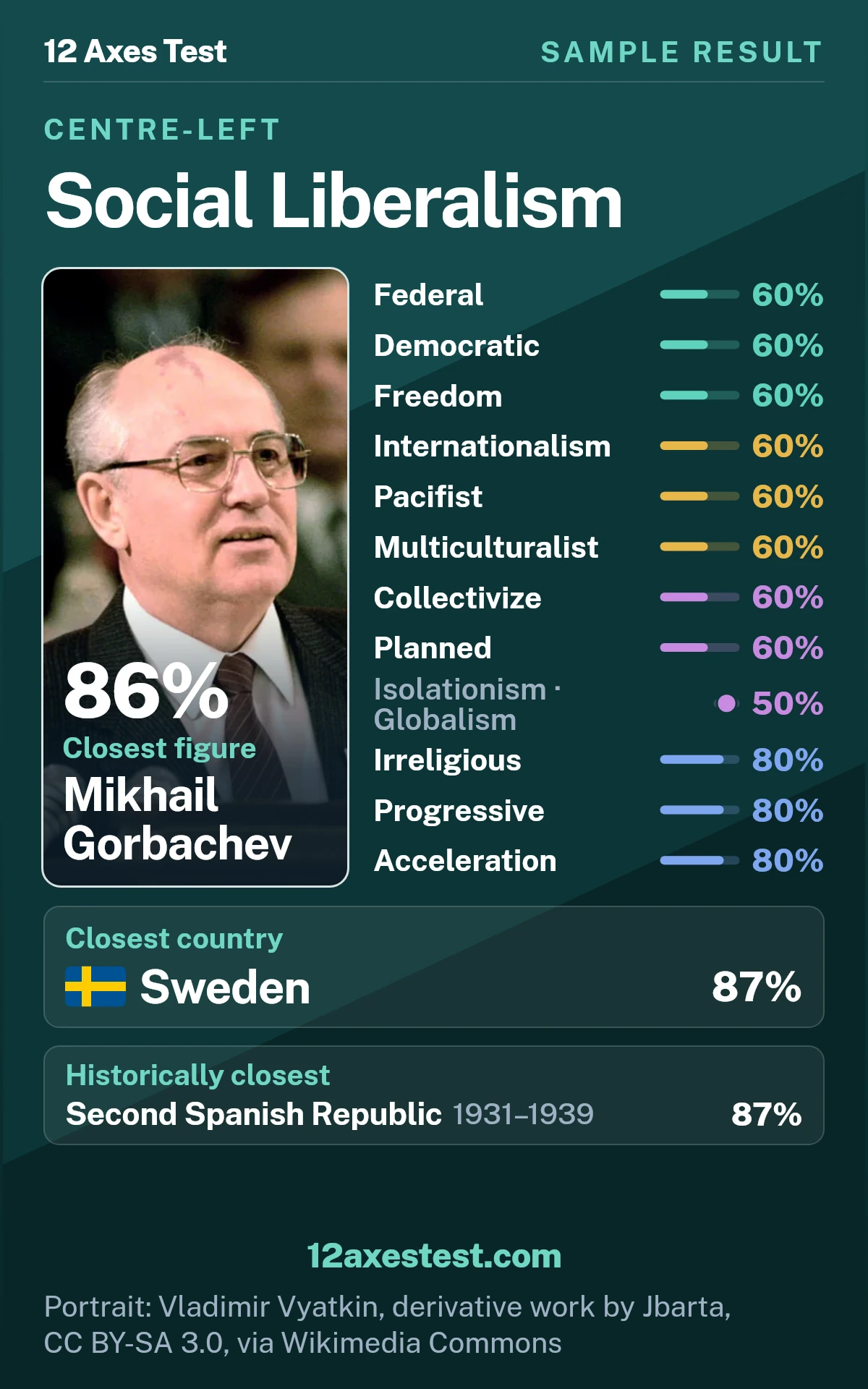
Portrait: Vladimir Vyatkin, derivative work by Jbarta, CC BY-SA 3.0, via Wikimedia Commons
Core ideas
- Individual rights and autonomy remain central.
- Liberty needs favorable social and economic conditions, so the state should address poverty and ignorance.
- A mixed economy with regulation of markets, as against laissez-faire.
- Welfare services, education, health care and infrastructure are public responsibilities.
- Civil and political rights should keep expanding.
Where it sits on the 12 axes
The economy value is mildly toward Collectivize (econ 60 on Collectivize/Privatize), the government value is slightly toward Freedom (govt 40 on Security/Freedom) and diplomacy leans toward Internationalism (dipl 60 on Internationalism/Nationalism). Society is clearly Progressive (scty 80 on Progressive/Traditional). The test measures how far your four scores are from these values, and the smallest distance wins. Nothing else, such as party loyalty or the label you prefer, enters the calculation.
The bar shows the position on each of the four axes an ideology is matched on; the middle mark is the centre.
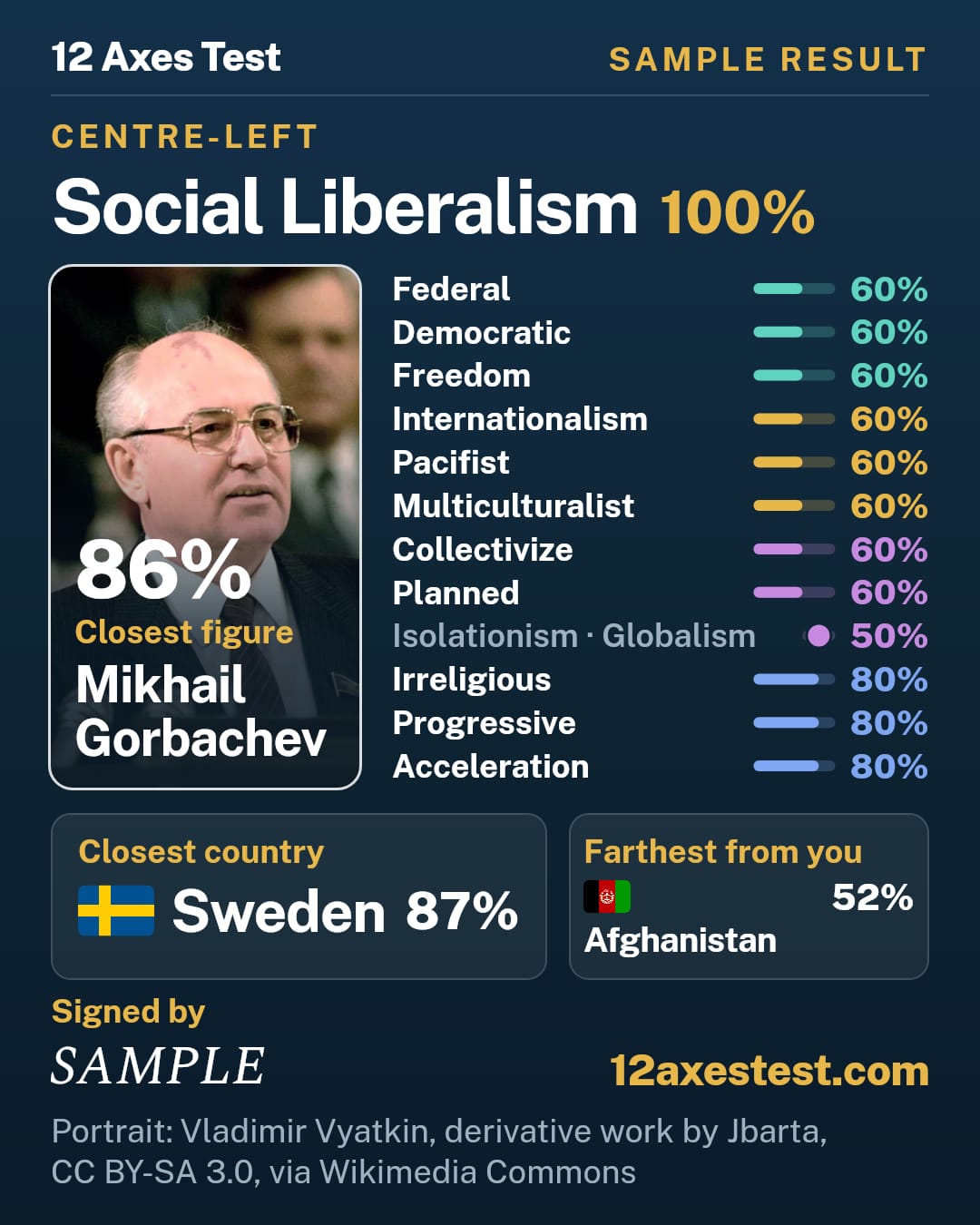
Sample result
History
In the late nineteenth century, a group called the New Liberals, including T. H. Green, L. T. Hobhouse and J. A. Hobson, argued against laissez-faire. They held that poverty and squalor made freedom and individuality impossible, and that collective action by an interventionist state could help. John Stuart Mill's mix of classical liberalism and new ideas influenced them. A reforming liberal government in the early twentieth century introduced welfare reforms: pensions for older adults and health, sickness and unemployment insurance. The term was also used, before the Great Depression and the New Deal, to set it apart from laissez-faire thinking. It is also called progressive liberalism.
Associated thinkers
- T. H. Green
- L. T. Hobhouse
- J. A. Hobson
Common misunderstandings
- It is not socialism. It keeps a market economy and private property; it differs from classical liberalism in accepting more state action to widen opportunity.
- In American usage social liberal can also mean progressive stances on social issues. Here it means the broader political philosophy of a mixed economy plus individual liberty.
Related ideologies
Is Social Liberalism your closest ideology?
Take the test and see which of the ideologies your answers sit closest to.
Questions
What is Social Liberalism?
A variety of liberalism that endorses social justice, social services, a mixed economy and expanded civil and political rights, in contrast to classical liberalism's limited government and more laissez-faire approach.
Is Social Liberalism left or right?
Usually described as centre to centre-left, though some versions sit left or right of that. On this site it is filed as centre-left. Its mix of market economy and welfare state does not fit a single left-right line.
Social Liberalism vs social democracy?
They overlap in accepting market intervention. Social democracy has roots in the socialist labor movement and puts more weight on redistribution and workers' rights. Social liberalism comes from liberalism and gives intervention a supporting role.
How does the 12 Axes test decide I am Social Liberalism?
It compares your economy, government, diplomacy and society scores with the stored values of 38 ideologies. The smallest distance across those four axes decides, not the left-right label.