Ideology
Christian DemocracyCentre-right
A political tradition that applies Christian moral ideas to public life, backing a market economy tempered by social responsibility, support for family and community, and a welfare system grounded in solidarity and human dignity.
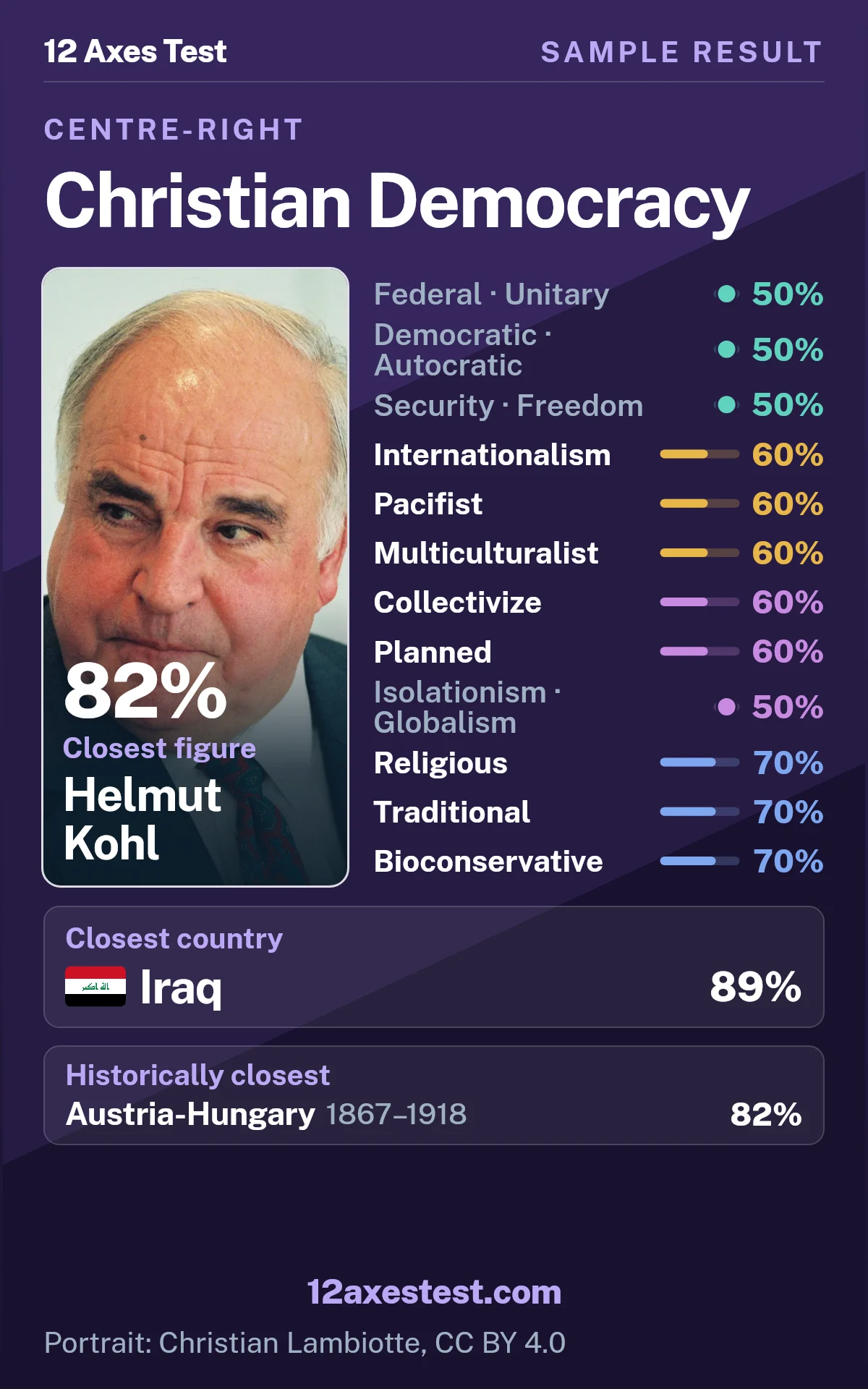
Portrait: Christian Lambiotte, CC BY 4.0, via Wikimedia Commons
Core ideas
- Politics should rest on Christian social teaching, including human dignity, solidarity and subsidiarity.
- A slightly regulated market economy, a social market economy, with an effective social security system.
- Defense of private property against excessive state intervention, together with limits on markets.
- Strong family and community, and generally traditional moral values.
- Gradual change rather than revolution, and a commitment to democracy and human rights.
Where it sits on the 12 axes
The economy value is mildly toward Collectivize (econ 60 on Collectivize/Privatize), the government value is neutral (govt 50 on Security/Freedom) and diplomacy leans toward Internationalism (dipl 60 on Internationalism/Nationalism). Society leans toward Traditional (scty 30 on Progressive/Traditional), reflecting its conservative moral stance. Only these four axes count: the test finds the ideology whose four values are least far from your four scores.
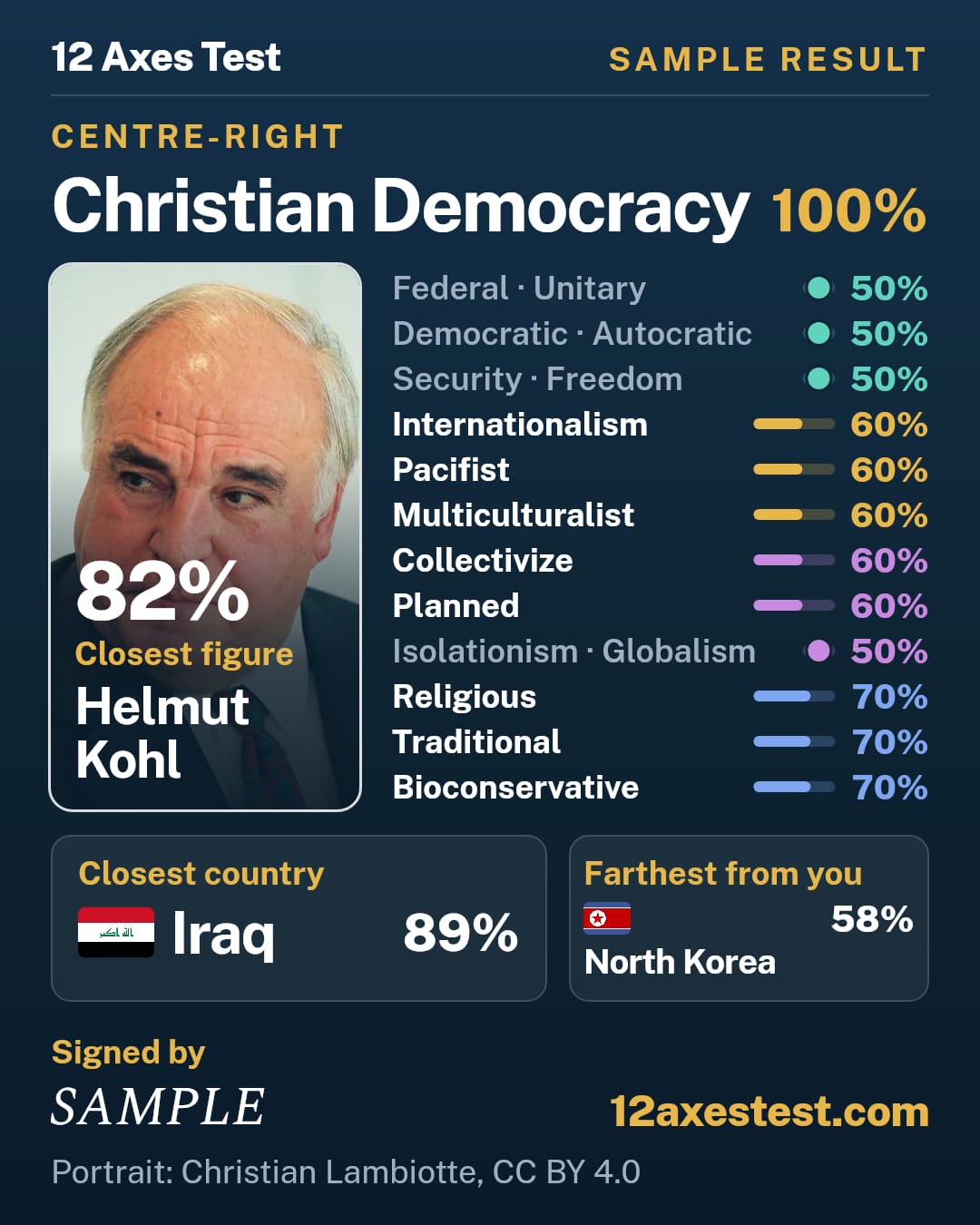
The bar shows the position on each of the four axes an ideology is matched on; the middle mark is the centre.
Sample result
History
In the nineteenth century its concerns were to reconcile Catholicism with democracy, to answer the social question about capitalism and the working class, and to settle church and state tensions. Pope Leo XIII's Rerum novarum of 1891 was a turning point, followed by Pius XI's Quadragesimo anno of 1931. Protestant versions arose too, such as an anti-revolutionary party shaped by the neo-Calvinist Abraham Kuyper. After the Second World War, Christian democrats helped restore democracy in Western and Southern Europe and build welfare states. Konrad Adenauer, Robert Schuman and Alcide De Gasperi, all Christian democrats, were among the key figures at the start of the European project.
Associated thinkers
- Jacques Maritain
- Luigi Sturzo
Common misunderstandings
- It is not rule by the church or a theocracy. It accepts democratic government and freedom of religion, and drew its authority from social teaching rather than state religion.
- It is not simply conservatism. It has often been centre-left on economics and centre-right on moral questions, accepting state welfare.
Related ideologies
Is Christian Democracy your closest ideology?
Take the test and see which of the ideologies your answers sit closest to.
Questions
What is Christian Democracy?
An ideology inspired by Christian social teaching, mainly Catholic with Neo-Calvinist and other strands. It supports democracy, a social market economy, family and community, and a welfare system based on solidarity.
Is Christian Democracy left or right?
It has been called centre-left on economics and centre-right on moral questions, and today it is usually placed centre-right. That split is why a single left-right line does not describe it well.
Christian Democracy vs conservatism?
Both value tradition and family. Christian democrats support a regulated social market economy and state welfare, grounded in solidarity, and are open to change. Conservatism more broadly stresses preserving existing order and institutions.
How does the 12 Axes test decide I am Christian Democracy?
It measures the distance between your economy, government, diplomacy and society scores and each ideology's four stored values. The nearest one is reported; party membership or religion plays no part.