Ideology
Social LibertarianismLibertarian
Seeks maximum personal freedom in social matters together with measures that promote equal opportunity, supporting civil liberties, voluntary association, and sometimes shared ownership of resources, while remaining wary of concentrated power.
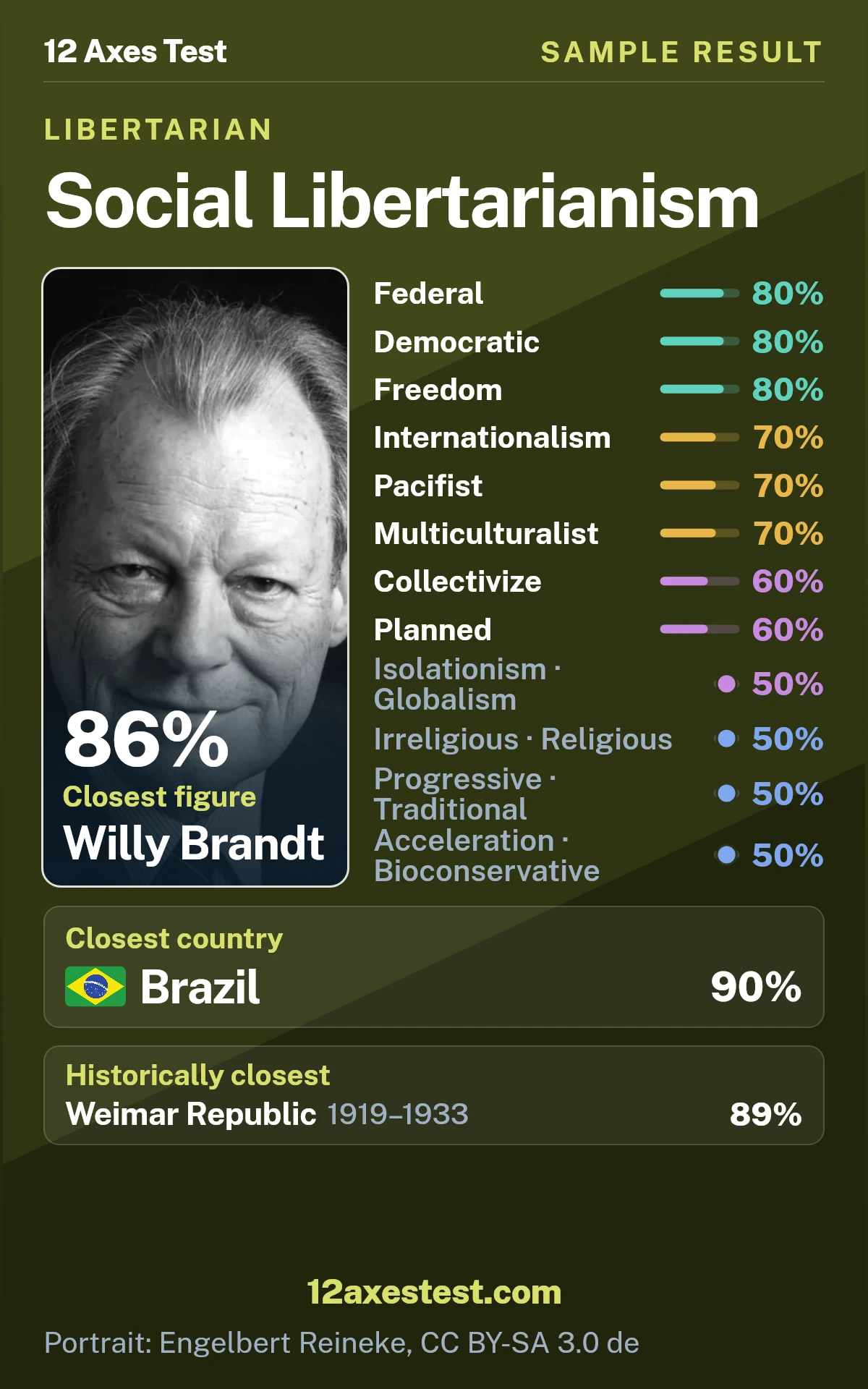
Portrait: Engelbert Reineke, CC BY-SA 3.0 de, via Wikimedia Commons
Core ideas
- Maximum personal freedom in social matters, backed by civil liberties.
- Voluntary association rather than coercion.
- Measures that promote equal opportunity.
- In some versions, natural resources belong to everyone equally, or are owned in common.
- Wariness of concentrated power, whether public or private.
Where it sits on the 12 axes
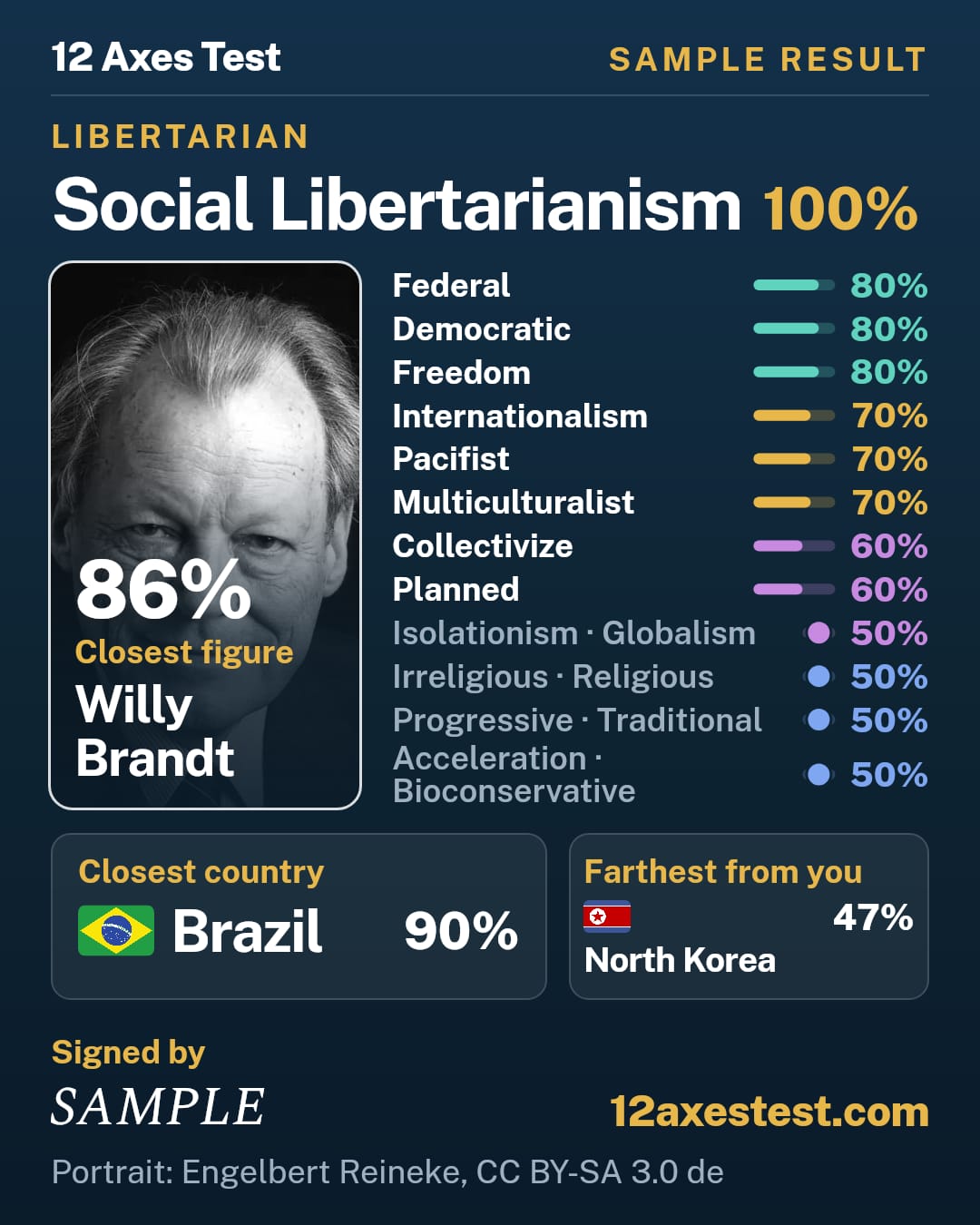
The economy axis (Collectivize to Privatize) is 60, a little toward Collectivize. The government axis (Security to Freedom) is 20, well toward Freedom. Diplomacy (Internationalism to Nationalism) is 70, leaning Internationalism. Society (Progressive to Traditional) is 50, in the middle. Your match is the ideology with the smallest straight-line distance to your four values. The test does not compare the other eight axes, and it does not look at any single answer you gave.
The bar shows the position on each of the four axes an ideology is matched on; the middle mark is the centre.
Sample result
History
The word libertarian was coined in 1857 by the French anarchist communist Joseph Déjacque, and until the 1970s was used mostly by anarchists. As the term became linked with free-market philosophy, some free-market advocates in the New Left, including Roy Childs and Samuel Konkin, called themselves left-libertarians to mark themselves as its left wing. By the turn of the 21st century analytic philosophers such as Hillel Steiner and Peter Vallentyne adopted the label for a view that combines self-ownership with an egalitarian approach to natural resources. Its intellectual forebears include Henry George, Thomas Paine and Herbert Spencer. Left-libertarianism is the predominant form of libertarianism in Europe.
Associated thinkers
- Henry George
- Thomas Paine
Common misunderstandings
- It is not the same as libertarian socialism. Left-libertarianism, in its modern sense, joins self-ownership with an egalitarian share of natural resources. Libertarian socialism is the anti-capitalist branch.
- It is not simply 'libertarianism' as the word is often used today. That usually means the right-libertarian, capitalist version.
Related ideologies
Is Social Libertarianism your closest ideology?
Take the test and see which of the ideologies your answers sit closest to.
Questions
What is Social Libertarianism?
On this site, a form of libertarianism that stresses both individual freedom and social equality. It combines civil liberties and voluntary association with measures for equal opportunity, and in some versions shared ownership of natural resources. It is closely tied to what is called left-libertarianism.
Is Social Libertarianism left or right?
It is filed as libertarian, a label that a single left-right line cannot capture. The economy axis is a little toward Collectivize, the government axis is far toward Freedom, and diplomacy leans Internationalism, so it leans left on the economy while being far from authoritarian.
Social Libertarianism vs libertarian socialism?
Both are libertarian and egalitarian. Libertarian socialism is the anti-capitalist, often anarchist branch that opposes concentrations of wealth. The social libertarian view, as in modern left-libertarianism, keeps self-ownership and may allow markets while sharing natural resources equally.
How does the 12 Axes test decide I am Social Libertarianism?
It measures the straight-line distance between your economy, government, diplomacy and society scores and the four values stored for each of the 38 ideologies. The nearest one is your match. The other eight axes are not used.