12 Axes Political Test Tutorial, step by step
Follow this 12 Axes political test tutorial to take the 12 Axes Test, a free online quiz about political views that scores you on twelve separate axes in four categories: government, diplomacy, economy and society. Four steps, each with a screenshot of the real page, take you from choosing a length to sharing your result.
Start the 12 Axes test60 statements · about 5 min · free
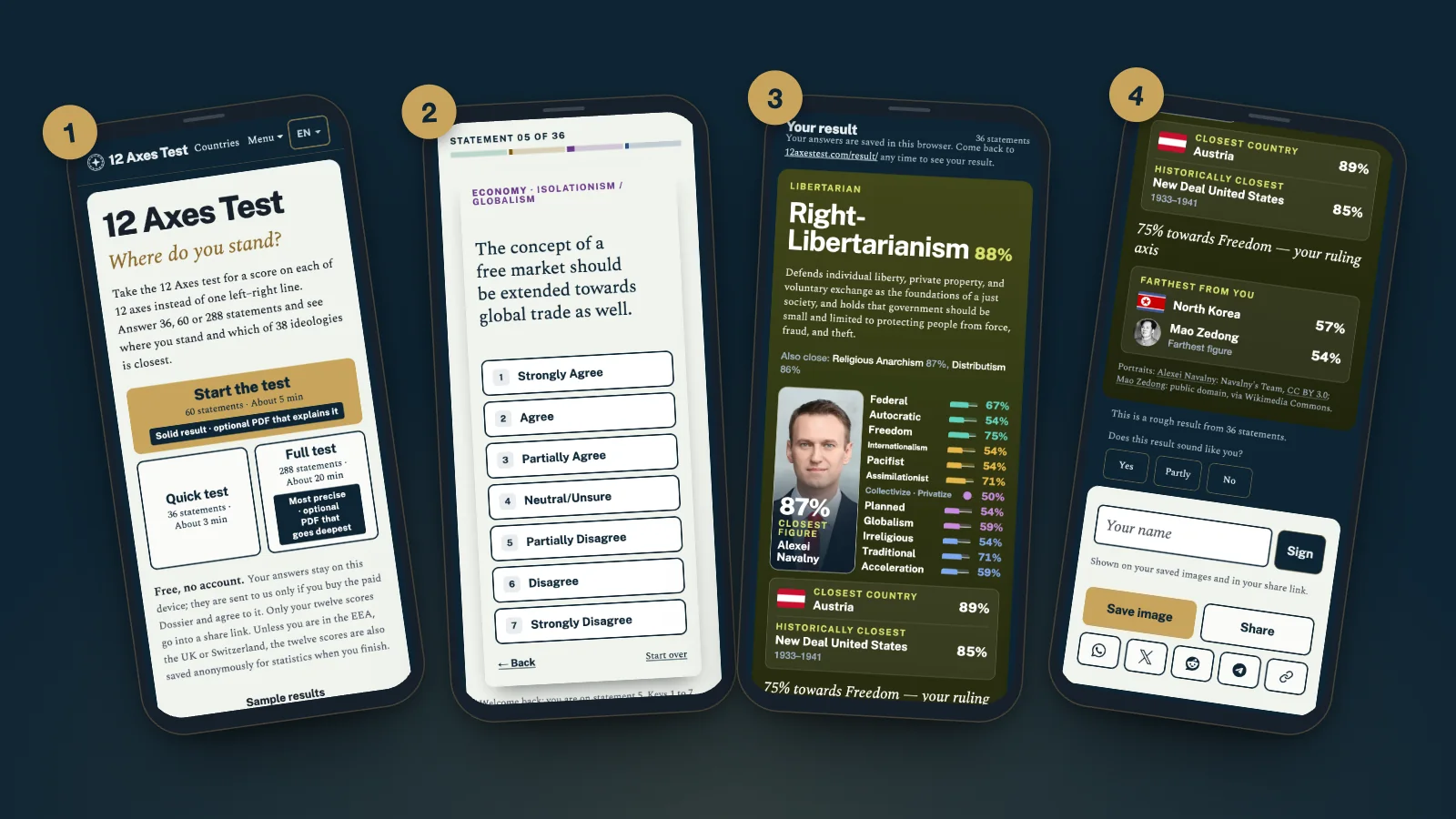
Step 1: Open the 12 Axes test and pick a length
Start on the home page or go straight to the test page. The test comes in three lengths, all drawn from the same bank of 288 statements, and in each of them every axis gets the same number of statements:
- Quick test: 36 statements, about 3 minutes, 3 per axis. A first look; the result page calls it a rough result.
- Start the test: 60 statements, about 5 minutes, 5 per axis. The big button on the home page; a solid result for most people.
- Full test: 288 statements, about 20 minutes, all 24 per axis. The most precise result, for when you have the time.
In the 36 and the 60, the statements of each axis are split 2 to 1 or 3 to 2 between its two ends, and a random draw picks which end gets more; the 288 has 12 for each end.
Not sure which to take? Take the 60. A longer test does not score you in a different way; it gives every axis more answers to add up, so one hasty answer moves a score less. After a 36- or 60-statement test, the result page offers to continue to all 288, keeping the answers you gave.
On the test page the three lengths stand above the first statement as Quick · 36, Standard · 60 and Full · 288. The counter under them shows where you are: "Statement 05 of 36".
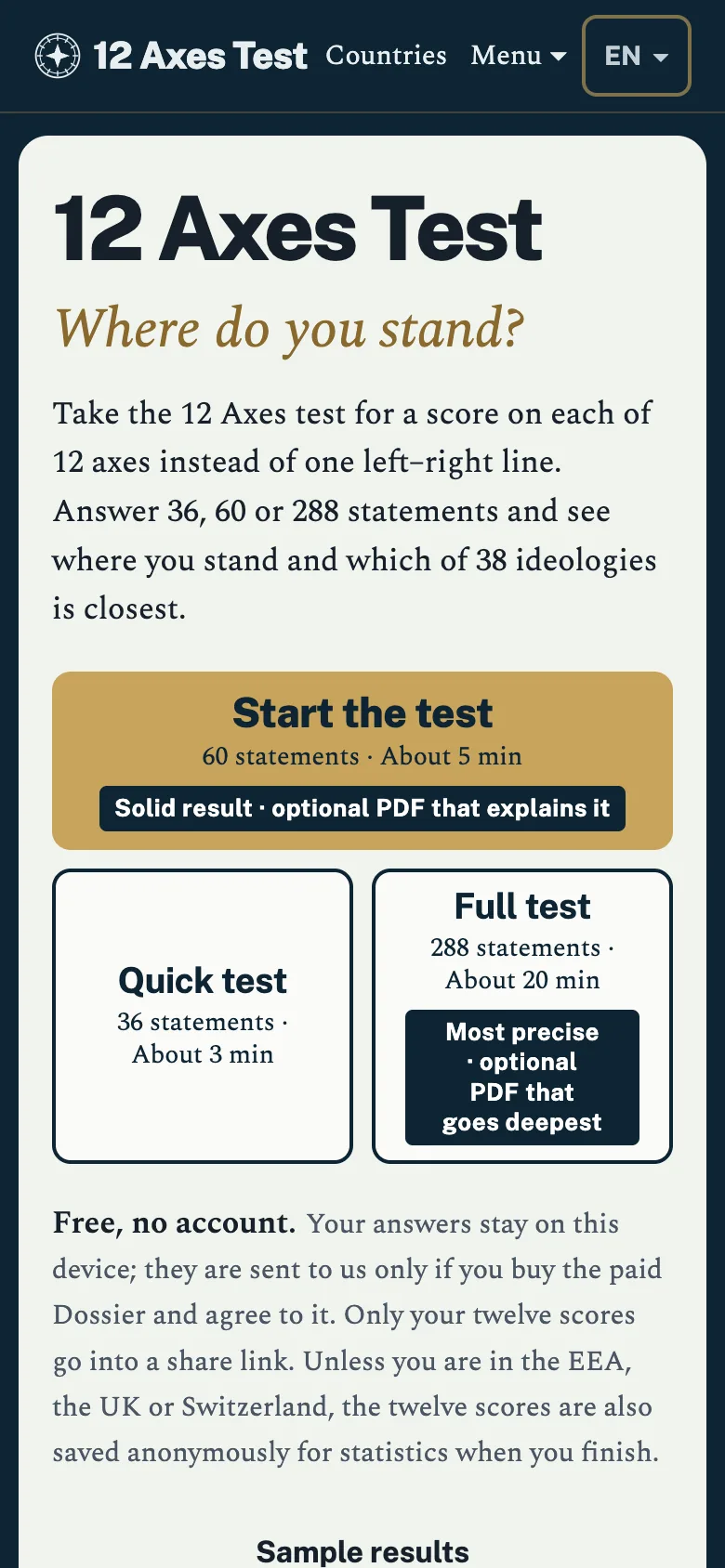
Step 2: Answer the 12 Axes statements one by one
Each screen shows one statement, the category and the axis it belongs to, and 7 answers. There are no right or wrong answers: say how far you agree. This is what each answer does to the axis of the statement:
- Strongly Agree or Strongly Disagree: you are sure. It counts 2, the most one answer can move an axis.
- Agree or Disagree: you agree or disagree, without feeling strongly. It counts 1.
- Partially Agree or Partially Disagree: you lean one way but have doubts. It counts 0.5.
- Neutral/Unsure: you have no view, cannot decide, or do not understand the statement. It counts 0 and leaves the axis where your other answers put it.
Torn between two answers? Take the milder one. If you really cannot say, choose Neutral/Unsure rather than guessing. Read each statement as it stands and answer what you think, not what you expect the axis to want.
Made a mistake? Back takes the last answer away, as many times as you need. Start over begins the test again. Your progress is kept in this browser, so you can close the tab and come back to the same statement later. With a keyboard, the keys 1 to 7 pick an answer.
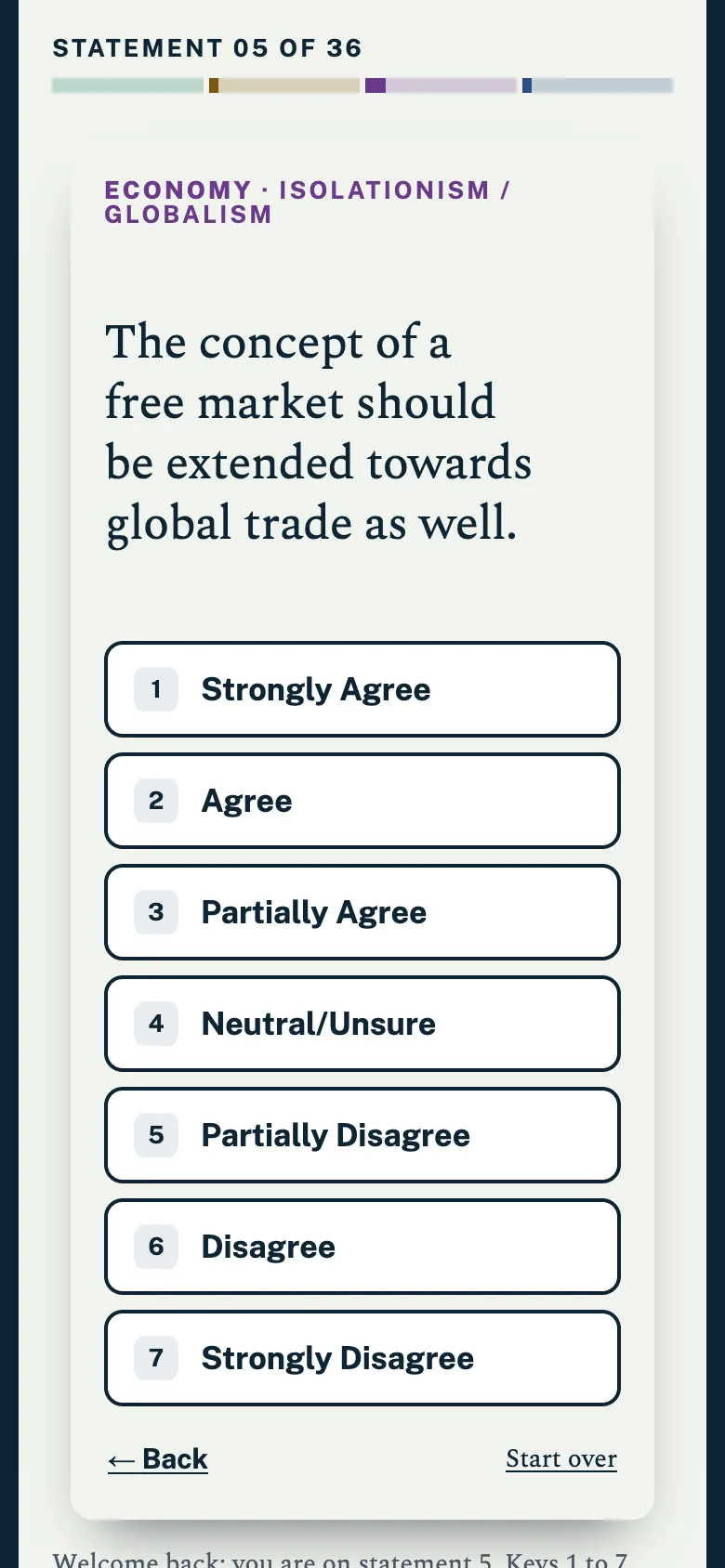
Step 3: Read your 12 Axes result, axis by axis
When you answer the last statement, your result opens. The card at the top sums up twelve separate scores, and each part of it answers a different question.
Twelve scores, one per axis
Every axis runs between two opposite values, such as Federal–Unitary or Collectivize–Privatize. A score goes from 0 to 100 and is the percent of the first value, so 100 minus it is the second: a 70 on Federal–Unitary is 70% Federal and 30% Unitary.
The card does not print the bare score. Each of its twelve rows names the value you lean toward and how far, so "Unitary 63%" stands for a score of 37 on Federal–Unitary. A row at exactly 50% names both values: you sit in the middle. The rows follow the four categories, each in its own colour: government, diplomacy, economy and society.
Read a middle score with care. A score adds up answers, so strong answers in both directions can cancel out and land on 50, just like neutral ones.
Your ruling axis
Under the card, one line in italics names your ruling axis: the axis whose score lies farthest from 50, with the percent toward the value it leans to. If every score is 50, there is no such line.
The closest ideology
The large name at the top is the closest of 38 ideologies, with how close it is in percent, a short description and the next two. It is worked out from four of your scores, on economy, government, diplomacy and society, not from all twelve.
The closest figure and country
The portrait is the closest of 124 historical figures. Beside it come the closest of 195 countries and the state of the past nearest to you, and lower down the country and the figure farthest from you. These use all twelve scores, and the placements of people and countries are our own estimates, not a judgment of anyone.
Every axis, explained under the card
Scroll down to "Twelve axes in four categories": each axis with both values, the one you lean to in bold with its percent, a bar with your position, and one line on what the axis is about. "How to read your result", at the end of the page, explains each part of the card.
What each of the 12 axes measuresHow the percentages are calculated


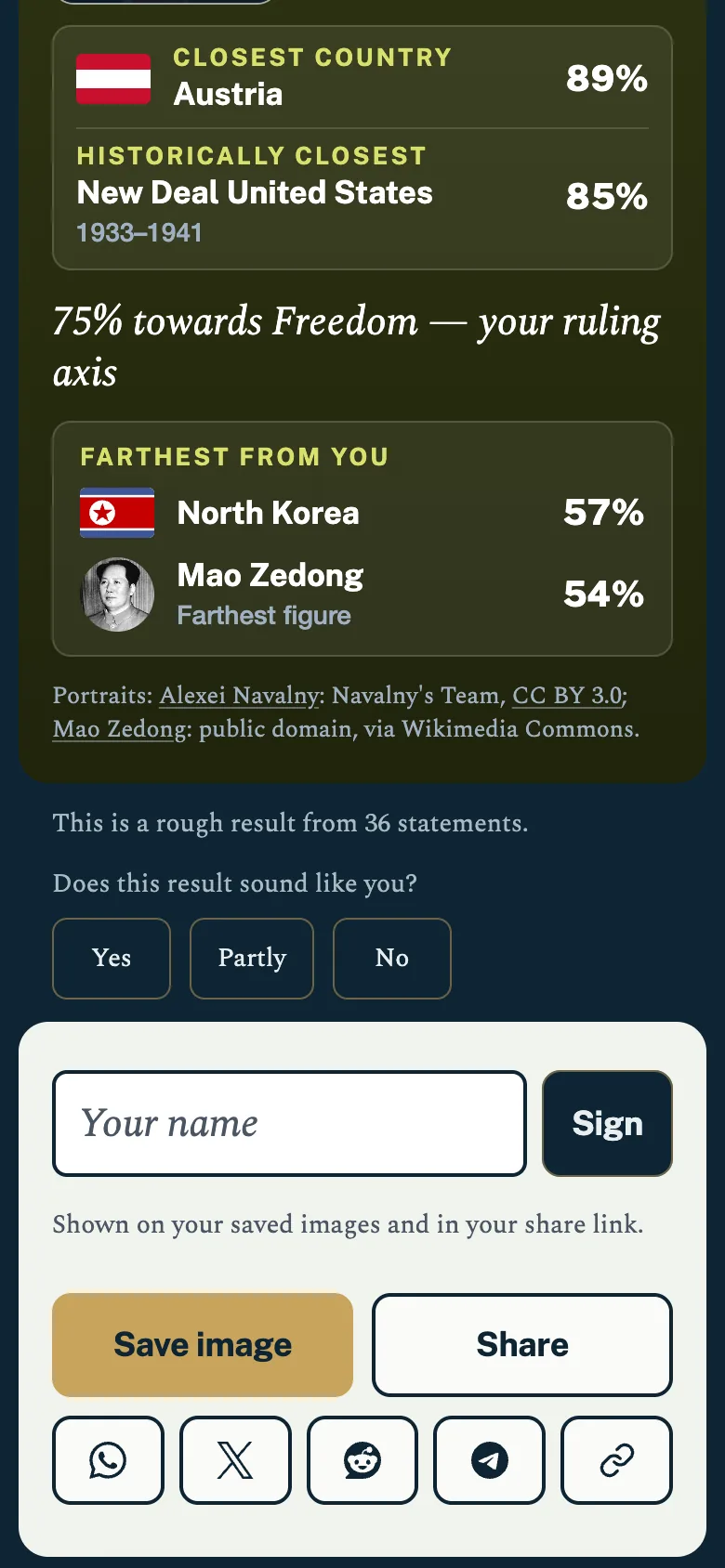
Step 4: Save and share your 12 Axes result
Right under the card sits the share panel. If you want your name on the pictures and in the link, type it and press Sign. It is optional.
Save image saves a picture of your result. Share opens your phone's share menu, on browsers that can share a picture, which is the way to Instagram, WhatsApp and the like. The row of icons under them shares straight to WhatsApp, X, Reddit and Telegram, and the last icon copies the link.
The link carries your twelve scores, and the name if you signed, never your answers. Whoever opens it sees the same result card and a button to take the test. If they take it, their result page shows how close the two results are.
Your result also stays in this browser, so you can come back to it on the same device. Start the test again, at the end of the result page, forgets it and starts over.
Questions about taking the test
Is the 12 Axes test free? Do I need an account?
Yes, it is free, and there is no account or sign-up: the test, the result and the share link cost nothing. An optional written report can be bought separately; you see your full result without it.
How long does the 12 Axes test take, and which length should I pick?
About 3 minutes for 36 statements, 5 for 60 and 20 for all 288. Unsure? Take the 60; you can continue to 288 later without losing your answers.
Is this the original 12axes quiz?
No. The statements come from the open-source 12axes question bank under the MIT licence, and a few that read as insults or calls to violence were rewritten in a milder tone, pushing the same axis the same way. This site is not the original one and has no tie to it.
Is the 12 Axes test scientific?
No. It is meant for self-reflection, not as a scientific measurement: the twelve scores show how you answered these statements, and the closest ideology, country and figure are our estimates, not a verdict on you.
Where are my answers kept?
In this browser, on your device. They leave it only if you order the optional written report and agree to send them. A share link holds only your twelve scores, and your name if you signed. Unless you are in the EEA, the UK or Switzerland, the twelve scores are also saved anonymously for statistics when you finish.
Your turn
Pick a length, answer as you really think, and read your twelve scores. The test is free, and your answers stay on your device.
Start the 12 Axes test60 statements · about 5 min · free