Your result is saved in this browser. View my result
12 Axes TestWhere do you stand?
Take the 12 Axes test for a score on each of 12 axes instead of one left–right line. Answer 36, 60 or 288 statements and see where you stand and which of 38 ideologies is closest.
- 100,000+tests taken
- 82%+say their result sounds like them, fully or partly
- 143countries and territories where the test was finished
- 288statements across 12 axes
- 195countries, 124 figures and 38 ideologies to compare with
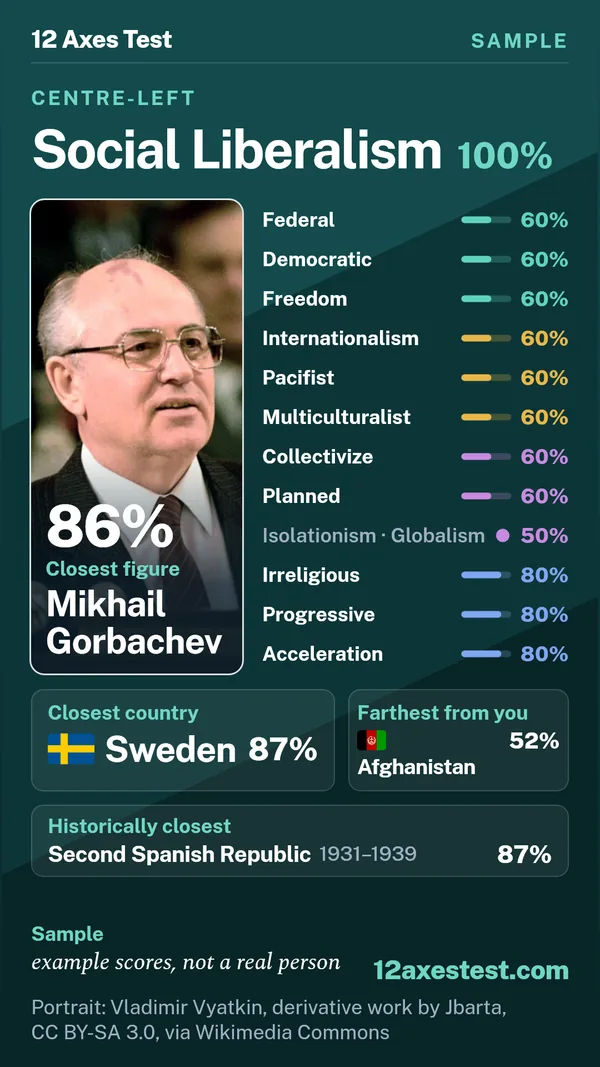
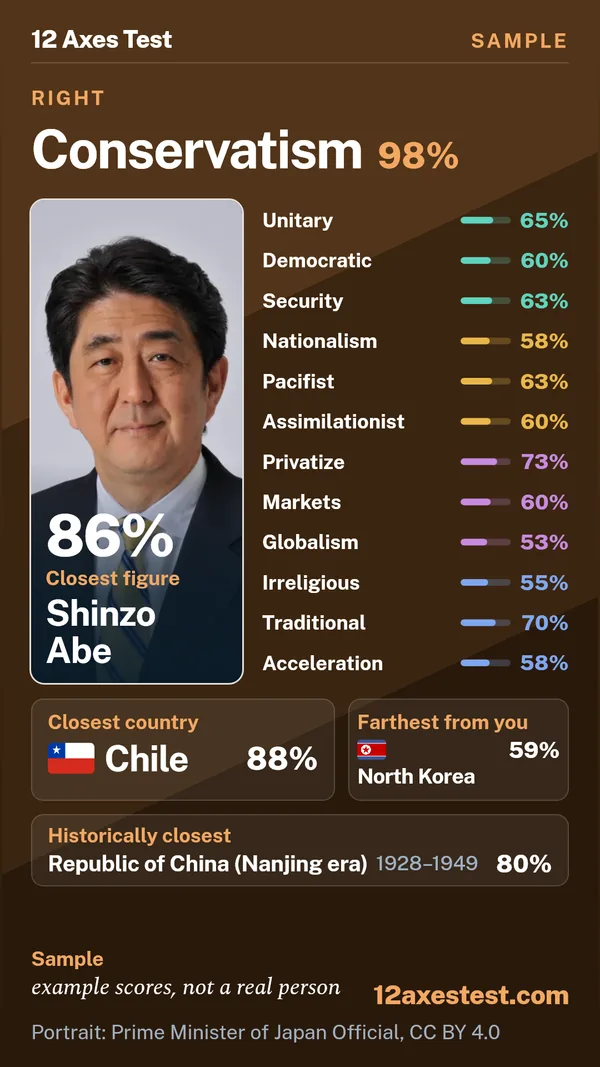
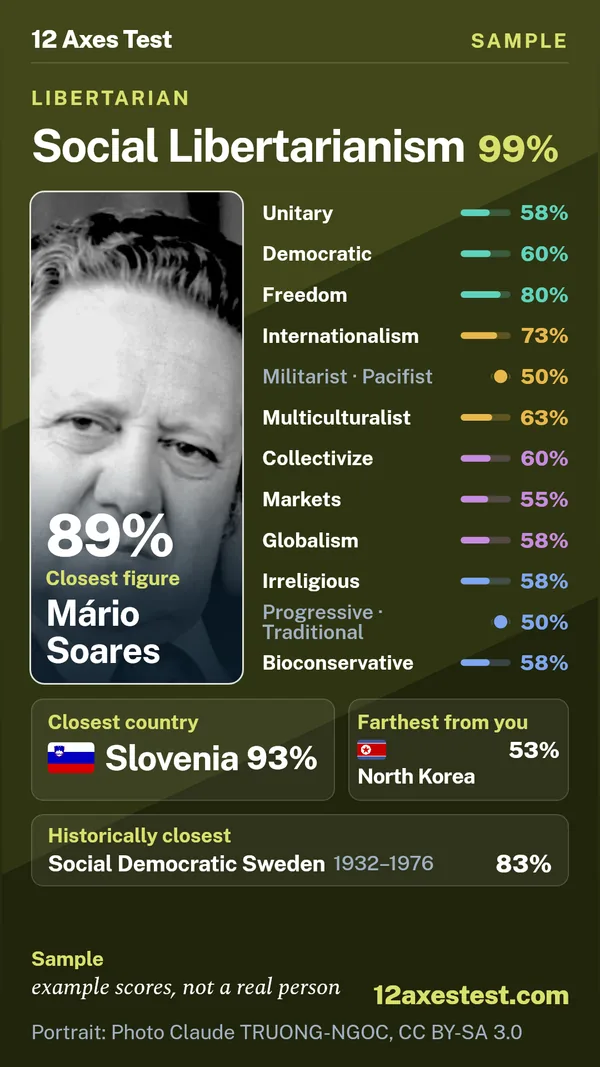
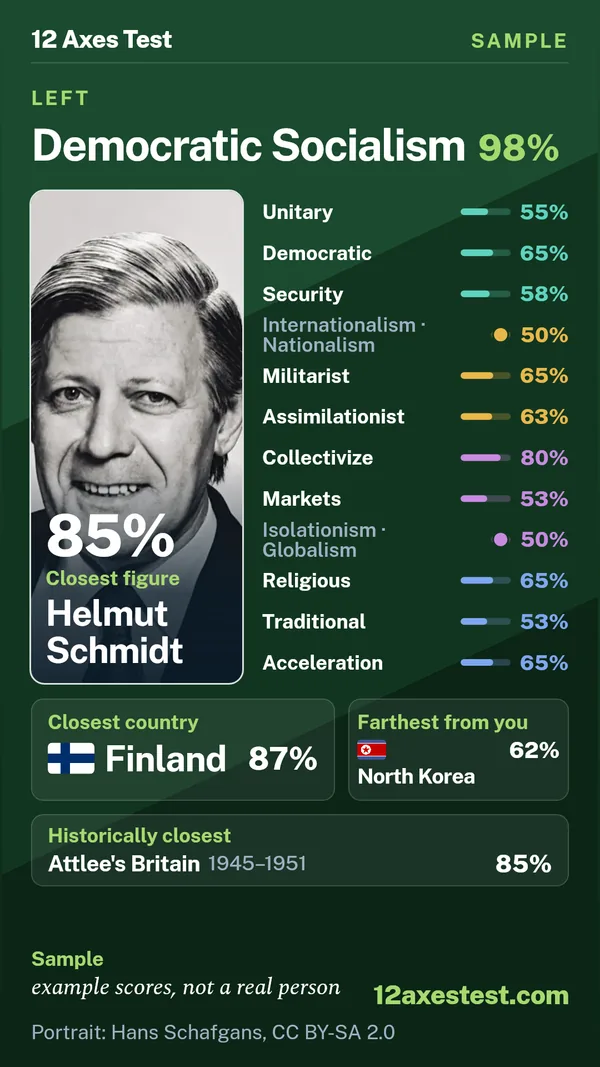
Portrait: Vladimir Vyatkin, derivative work by Jbarta, CC BY-SA 3.0 · Portrait: Prime Minister of Japan Official, CC BY 4.0 · Portrait: Photo Claude TRUONG-NGOC, CC BY-SA 3.0 · Portrait: Hans Schafgans, CC BY-SA 2.0
Twelve axes in four categories
Left and right is one line. Your result records twelve. Each axis sits between two values, and every statement you answer moves you along one of them. The score is the percent of the first value, so 100 minus the score is the second.
What each axis means
Government
Power held by regions and cities, or by one national government.
Leaders chosen by voters, or authority that does not answer to them.
Order and protection first, or liberty and privacy first.
Diplomacy
Cooperation through shared institutions, or the nation first.
Military strength as a tool of policy, or peace as the rule.
Newcomers adopt the host culture, or many cultures live side by side.
Economy
Shared and public ownership, or private property and enterprise.
The state steers the economy, or prices and competition do.
Protect local industry, or open trade across borders.
Society
A secular public life, or faith as a guide for society.
Change norms through reform, or keep inherited values.
Adopt new technology fast, or limit it to protect human nature.
The 12 axes explained: what each axis measures and how it is scored
How the 12 axes test is scored
How a score is computed
The test follows the open-source 12axes code. Each of the seven answers has a weight. A statement adds its weight to its axis, or subtracts it when the statement is worded from the opposite side. The quick test (36 statements) scores 50 + (50/6) × the sum, from 0 to 100 in steps of about 4.2; the standard test (60) scores 50 + 5 × the sum in steps of 2.5; the full test 50 + the sum in steps of 0.5.
The statements come from the original open-source 12axes question bank. Read the 12 axes explained, its origins, how scores are calculated and what the matches mean.
The twelve axes
| Category | First value (high score) | Second value (low score) | Full test | Standard test | Quick test |
|---|---|---|---|---|---|
| Government | Federal | Unitary | 24 | 5 | 3 |
| Government | Democratic | Autocratic | 24 | 5 | 3 |
| Government | Security | Freedom | 24 | 5 | 3 |
| Diplomacy | Internationalism | Nationalism | 24 | 5 | 3 |
| Diplomacy | Militarist | Pacifist | 24 | 5 | 3 |
| Diplomacy | Assimilationist | Multiculturalist | 24 | 5 | 3 |
| Economy | Collectivize | Privatize | 24 | 5 | 3 |
| Economy | Planned | Markets | 24 | 5 | 3 |
| Economy | Isolationism | Globalism | 24 | 5 | 3 |
| Society | Irreligious | Religious | 24 | 5 | 3 |
| Society | Progressive | Traditional | 24 | 5 | 3 |
| Society | Acceleration | Bioconservative | 24 | 5 | 3 |
The seven answers
| Answer | Weight |
|---|---|
| Strongly Agree | 2 |
| Agree | 1 |
| Partially Agree | 0.5 |
| Neutral/Unsure | 0 |
| Partially Disagree | −0.5 |
| Disagree | −1 |
| Strongly Disagree | −2 |
What your result shows
Twelve scores, one for each axis, and the closest of 38 ideologies, worked out from four of them. The closest country and figure use all twelve.
Closest ideology
The closest of the 38 ideologies, by the distance on four axes: economy, government, diplomacy and society. Closeness: 100 minus half that distance.
Political ideologiesTwelve axes
A score from 0 to 100 on each axis: the percent of its first value, so 100 minus it is the second. Your result marks your three strongest axes and lists all twelve.
The twelve axesClosest matches
The country and the figure nearest to your scores on all twelve axes, out of 195 countries and 124 figures, each with its closeness. Their placements are our estimates.
See a sample result for every ideologySee all 38 resultsThe twelve axes
Applied, processed, issued
ApplicationAnswer 60 statements, one at a time, from strongly agree to strongly disagree. Go back whenever you like.
ProcessingYour answers are plotted on twelve axes and compared with 38 ideologies.
IssuedYour result shows your closest ideology, then is saved as an image or a link to share.

Explore the register
Find your closest countries
Move the twelve axes to describe your views. Countries are ranked by the same distance calculation as the test. This is an exploration of government profiles, not a completed test result.
The example starts at 50% on every axis. Move a slider to explore, or take the test for scores based on your answers.
Neutral example · 50% on every axis
Questions
What is the 12 Axes test?
A free political values test that scores you on 12 axes in 4 categories: government, diplomacy, economy and society. It then shows the closest of 38 ideologies, plus the nearest countries and figures. Its statements come from the open-source 12axes question bank.
How long does the 12 Axes test take?
About 5 minutes for the standard 60 statements. The full version has 288 statements and takes about 20 minutes. A short version of 36 statements takes about 3 minutes. Progress is saved in your browser, so you can close the tab and come back.
Is the 12 Axes test free, and do I need to sign up?
Yes, it is free, with no account and no email. Your answers stay in your browser unless you order the Dossier, which is written from them. Unless you are in the EEA, the UK or Switzerland, your twelve scores, not your answers, are saved anonymously for statistics when you finish.
Which political test is the most accurate?
None is a scientific measurement. This one is for self-reflection: the statements are short, and the same answer can mean different things in different countries. With 12 axes and up to 288 statements it is finer than a two-axis test, but still a rough guide.
How is the 12 Axes test different from the Political Compass?
The Political Compass plots you on two axes, economic and social. The 12 Axes test scores 12 axes in 4 categories and matches you to 38 ideologies, countries and figures. Both are quizzes for self-reflection, made by different people.
What do the 12 axes measure?
Each axis sits between two values, such as Federal and Unitary or Planned and Markets. Your score is the percent toward the first value. The axes are grouped as government, diplomacy, economy and society, three in each.
How is the 12 Axes test scored?
Each of the seven answers has a weight, added to the axis or subtracted when the statement is worded from the other side. The sum becomes a score from 0 to 100. Scores move in steps of 0.5 points on the full test and 2.5 on the standard one.
Is the 12 Axes test available in other languages?
Yes: English, Portuguese, Spanish, German and French. Pick the language before you start.
Is this the original 12 Axes test, or the 12axes Vercel app?
Neither. The statements come from the open-source 12axes question bank (MIT licence). 12axestest is an independent site with its own result page and its own country and figure matches. 12axes.vercel.app and politicaltests.github.io/12axes are separate sites made by other people.
Does it show which country and figure are closest to me?
Yes. Your twelve scores are compared with 195 countries and 124 political figures, and the closest of each is named. The farthest country is named too, which is only the farthest in this ranking. Ideology, country and figure are separate comparisons.
Is there a longer, personal report after the test?
Yes, the Dossier: a PDF written in English around your own answers and sent to your email. It costs US$14.90 for the full 288-statement test and US$6.90 for the 60-statement one, paid once. The test and your result stay free.