Ideology
ConservatismRight
Aims to uphold traditional values, established institutions, and social continuity, favoring gradual change, respect for religion and family, a strong national identity, and cautious skepticism toward rapid reform and untested ideas.
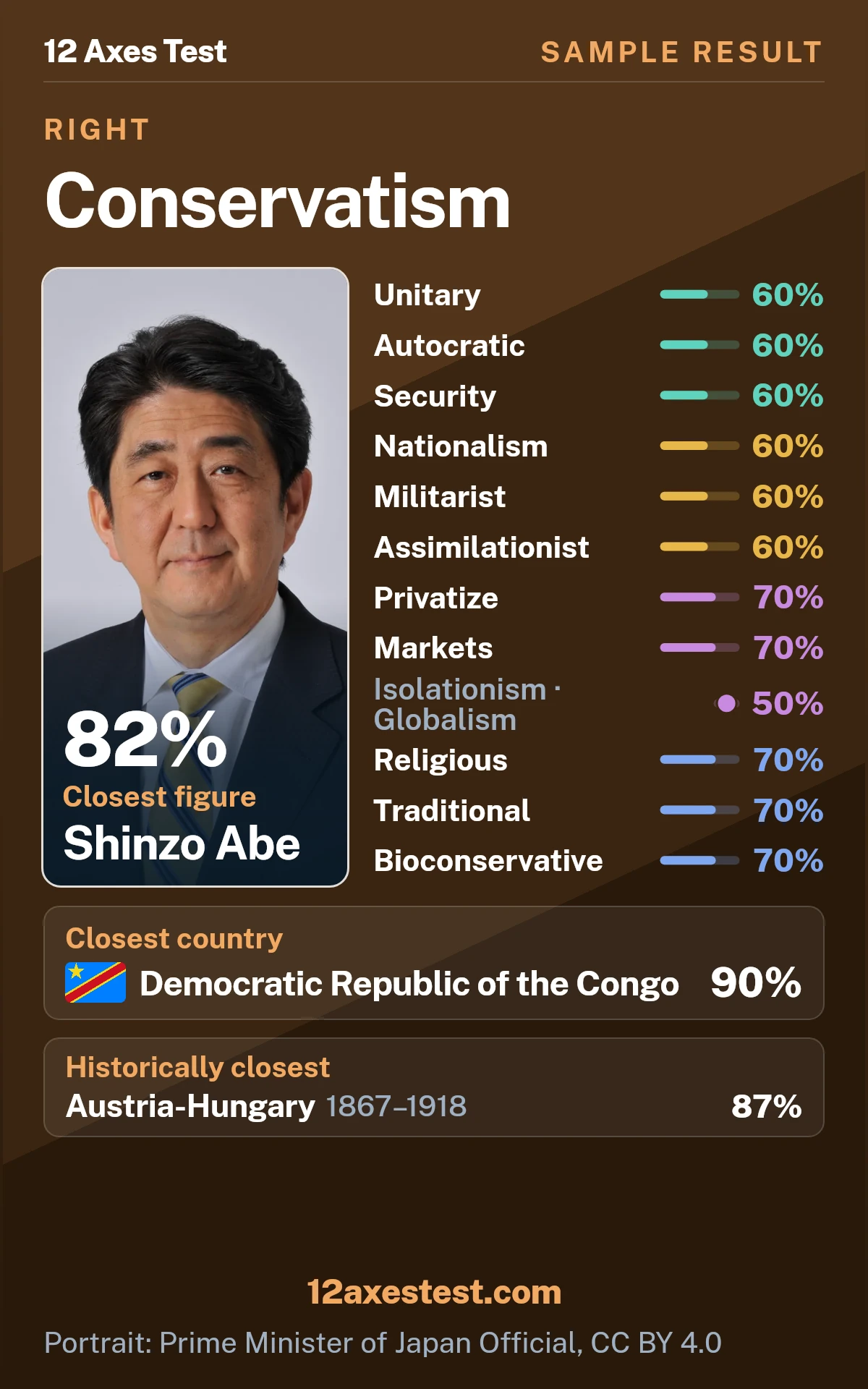
Portrait: Prime Minister of Japan Official, CC BY 4.0, via Wikimedia Commons
Core ideas
- Promote and preserve traditional institutions, customs and values.
- Favour gradual change and distrust sweeping reform and untested ideas.
- Respect for religion, family and the nation-state.
- Human nature is imperfect, so accumulated institutions deserve caution.
- Property rights and the rule of law are protected.
Where it sits on the 12 axes
The economy axis (Collectivize to Privatize) is 30, leaning toward Privatize. The government axis (Security to Freedom) is 60, leaning toward Security. Diplomacy (Internationalism to Nationalism) is 40, slightly toward Nationalism. Society (Progressive to Traditional) is 30, leaning toward Traditional. Your match is the ideology whose four values are nearest yours by straight-line distance. Only these four axes are compared, and the other eight play no part in the choice of ideology.
The bar shows the position on each of the four axes an ideology is matched on; the middle mark is the centre.
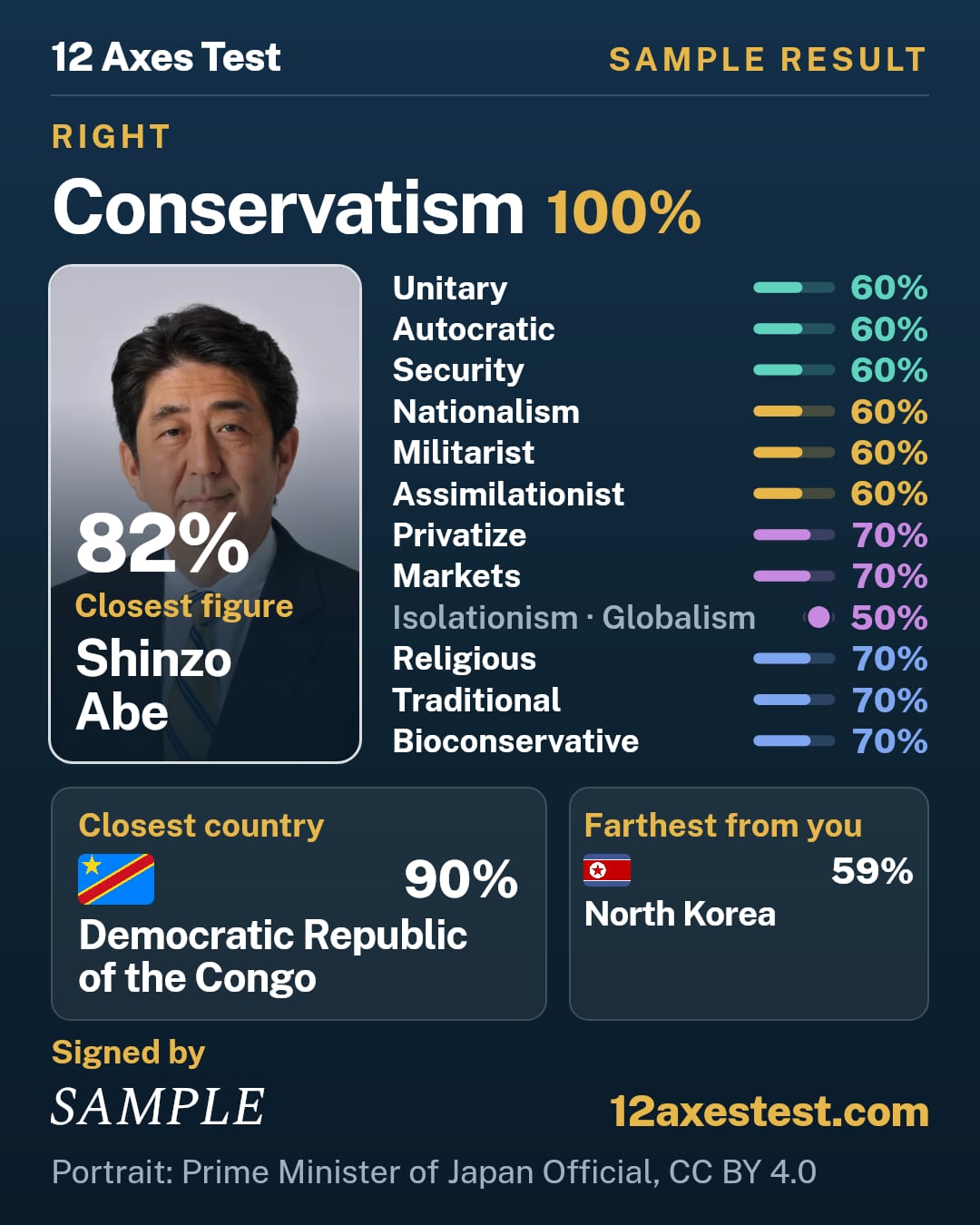
Sample result
History
Edmund Burke, the Anglo-Irish statesman who opposed the French Revolution, is credited as a forefather of Western conservative thought in the 1790s, along with Joseph de Maistre. The first established use of the term in a political context came in 1818 from Francois-Rene de Chateaubriand, during the Bourbon Restoration. Conservatism varies considerably with each national culture and tradition, so conservatives in different countries can disagree widely. Political scientist Andrew Heywood lists five central beliefs: tradition, human imperfection, organic society, hierarchy and authority, and property. It is described as one of the three major ideologies along with liberalism and socialism, and may be libertarian or authoritarian, populist or elitist, moderate or extreme.
Associated thinkers
- Edmund Burke
- Michael Oakeshott
- Russell Kirk
Common misunderstandings
- The 'conservatism' in accounting (the principle of caution in recording losses) and in psychology ('conservatism bias') is unrelated to the political ideology.
- Conservatism is not reactionary: a conservative seeks to preserve the order that exists now, while a reactionary wants to restore an earlier one.
Related ideologies
Is Conservatism your closest ideology?
Take the test and see which of the ideologies your answers sit closest to.
Questions
What is Conservatism?
A cultural, social and political philosophy that seeks to promote and preserve traditional institutions, customs and values. What it conserves depends on the country and era: the family, organized religion, the nation-state, property rights, or the rule of law, among others.
Is Conservatism left or right?
Right: it is historically associated with right-wing politics, though the label covers a wide range. On this site it sits leaning toward Privatize, Security, Nationalism and Traditional, which a single left-right line cannot show on its own.
Conservatism vs liberalism?
Liberalism arose in the Enlightenment to replace hereditary privilege and traditional order with rights, consent and the rule of law. Conservatism, shaped partly by opposition to the French Revolution, stresses tradition and gradual change. Both support property rights, but they weigh tradition and liberty differently.
How does the 12 Axes test decide I am Conservatism?
It compares your economy, government, diplomacy and society scores with the four values stored for each of the 38 ideologies, and the smallest straight-line distance wins. The other eight axes are not used.