Ideology
LiberalismCentre
Emphasizes individual rights, limited and accountable government, rule of law, free expression, and open markets, while generally accepting that the state has a role in protecting freedoms and providing some public goods.
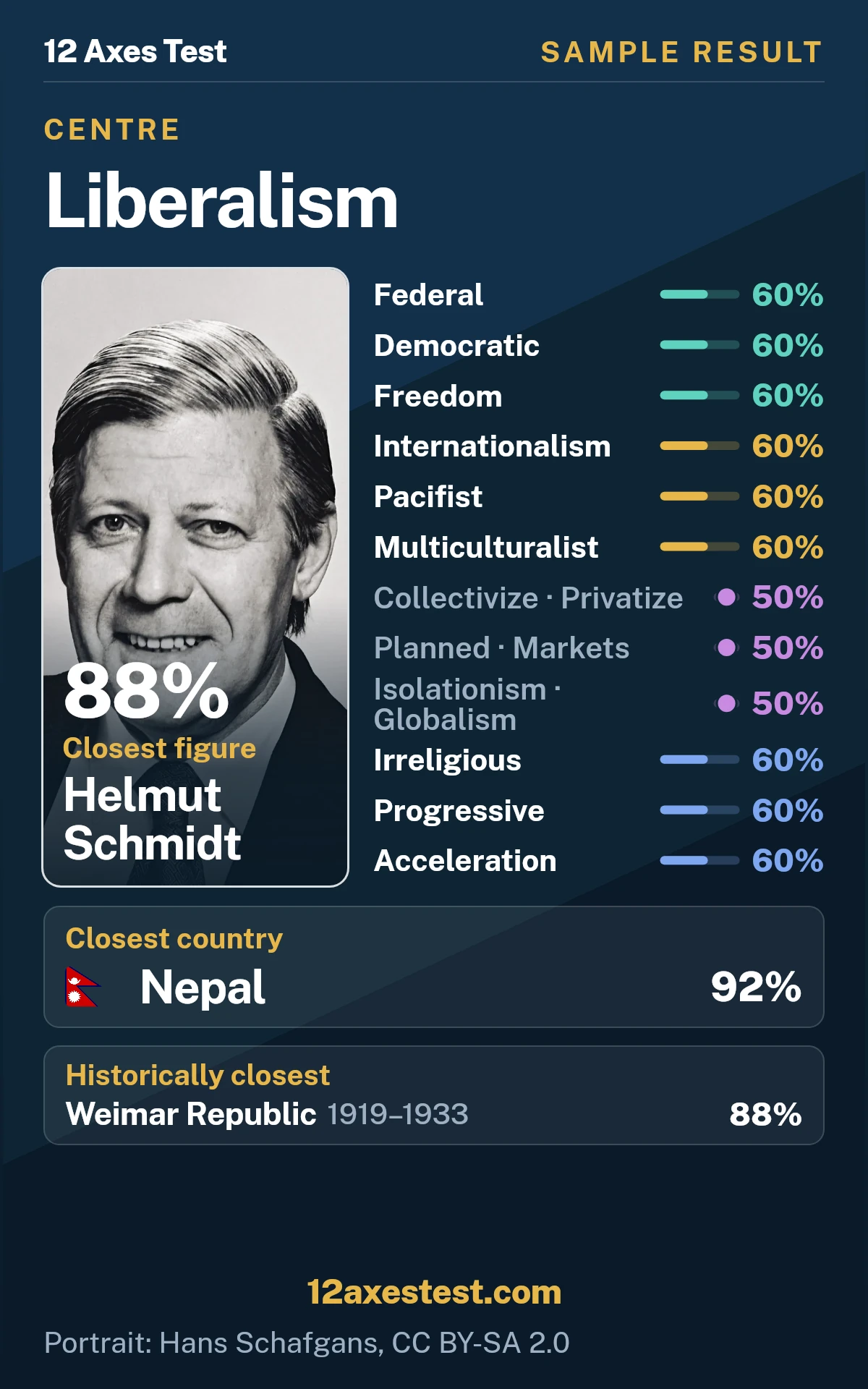
Portrait: Hans Schafgans, CC BY-SA 2.0, via Wikimedia Commons
Core ideas
- Individual rights, including freedom of speech, the press, assembly and religion, come first.
- Government rests on the consent of the governed and is bound by the rule of law.
- Citizens are politically equal and equal before the law.
- Private property and market economies are generally supported.
- Liberals disagree among themselves on how much the state should do to protect liberty.
Where it sits on the 12 axes
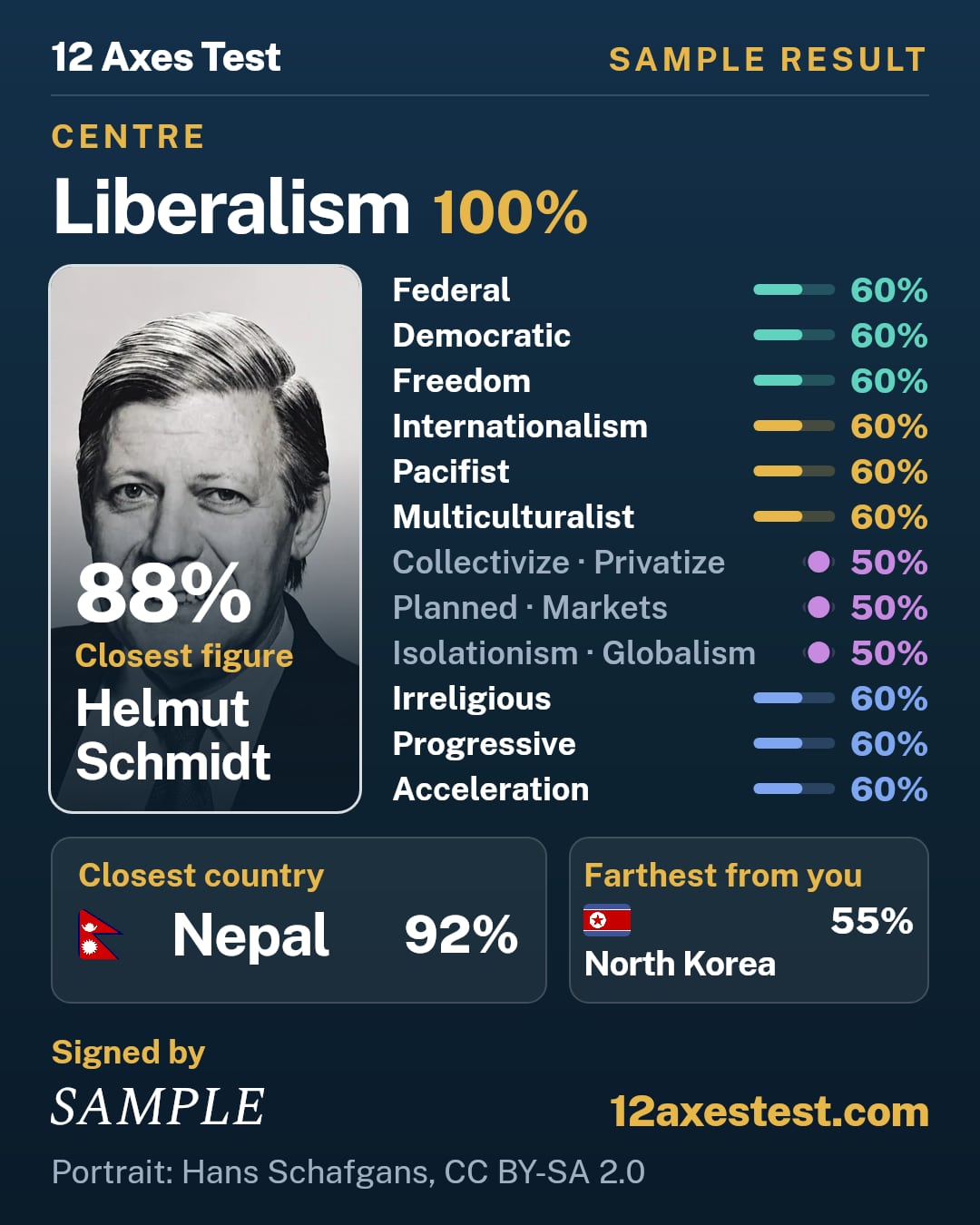
On the four axes that decide the match, the economy axis (Collectivize to Privatize) sits at 50, exactly in the middle. The government axis (Security to Freedom) is 40, a little toward the Freedom end. Diplomacy (Internationalism to Nationalism) is 60 and society (Progressive to Traditional) is 60, both leaning toward the first value, Internationalism and Progressive. Your result is the ideology whose four values are nearest to yours, measured as straight distance on those four axes only. Nothing else is compared.
The bar shows the position on each of the four axes an ideology is matched on; the middle mark is the centre.
Sample result
History
Liberalism became a distinct movement in the Age of Enlightenment, set against hereditary privilege, state religion and absolute monarchy. John Locke is often credited with founding the tradition; his Two Treatises (1690) rested government on the social contract and natural rights. The Glorious Revolution of 1688, the American Revolution of 1776 and the French Revolution of 1789 all drew on liberal ideas. Adam Smith's The Wealth of Nations (1776) supplied the case for free trade. In the 19th century liberal governments were set up in Europe and South America. Later liberals such as T. H. Green argued for a larger role for the state in promoting the common good. Liberalism then faced fascism and Marxism-Leninism, and liberal democracies were among the victors of both world wars and the Cold War.
Associated thinkers
- John Locke
- Adam Smith
- John Stuart Mill
Common misunderstandings
- Liberalism is not a single set of policies. Liberals espouse various and sometimes conflicting views, from market-friendly to reform-minded ones, so it does not map neatly onto 'the left'.
- It is not the same as libertarianism: liberals generally accept a state role in protecting freedoms and providing some public goods.
Related ideologies
Is Liberalism your closest ideology?
Take the test and see which of the ideologies your answers sit closest to.
Questions
What is Liberalism?
A political and moral philosophy based on individual rights, liberty, consent of the governed, political equality and equality before the law. Liberals generally support liberal democracy, private property, market economies, secularism and the rule of law, though they disagree on how to weigh these.
Is Liberalism left or right?
On this site it is filed in the centre. In the broad sense it spans centre-left to centre-right depending on the country. A single left-right line hides that: the four axes show it leaning toward Freedom, Internationalism and Progressive, with an economy in the middle.
Liberalism vs libertarianism?
Both prize individual liberty. Libertarians give it strict priority and want government kept small, often limited to protecting people from force, fraud and theft. Liberals generally accept a larger state role in protecting freedoms and providing some public goods, and differ among themselves about how large.
How does the 12 Axes test decide I am Liberalism?
It compares your economy, government, diplomacy and society scores with the four values stored for each of the 38 ideologies. The one with the smallest straight-line distance is your match. The other eight axes are not used for ideologies.