Ideology
Classical LiberalismCentre-right
Stresses individual freedom, constitutional limits on government, the rule of law, private property and free trade, arguing that voluntary markets and minimal state interference protect choice and produce prosperity.
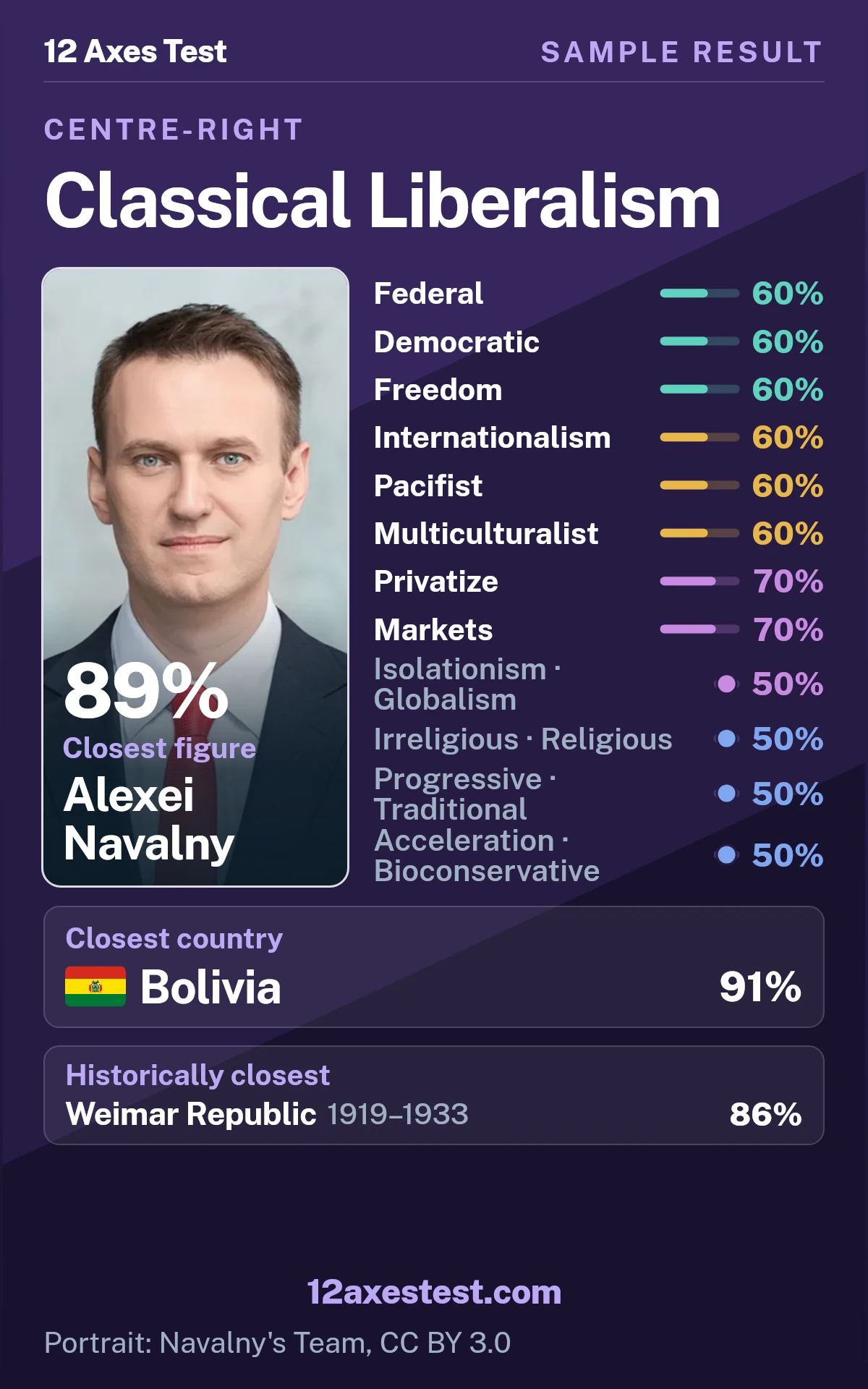
Portrait: Navalny's Team, CC BY 3.0, via Wikimedia Commons
Core ideas
- Individuals have natural or inherent rights, above all to life, liberty and property.
- Government should be limited by a constitution and the rule of law.
- Markets and free trade, not state direction, create prosperity.
- Religious toleration and freedom of speech are basic.
- Power should be checked, because those who hold it tend to abuse it.
Where it sits on the 12 axes
On the Economy axis (Collectivize to Privatize) the profile is at 30, toward the Privatize end. Government is at 40, a mild lean toward Freedom on Security to Freedom. Diplomacy is at 60, a mild lean toward Internationalism, which fits its support for free trade. Society is at 50, in the middle of Progressive to Traditional. The test looks only at these four axes: it computes the distance from your scores to each ideology's four values, and the closest one is your match.
The bar shows the position on each of the four axes an ideology is matched on; the middle mark is the centre.
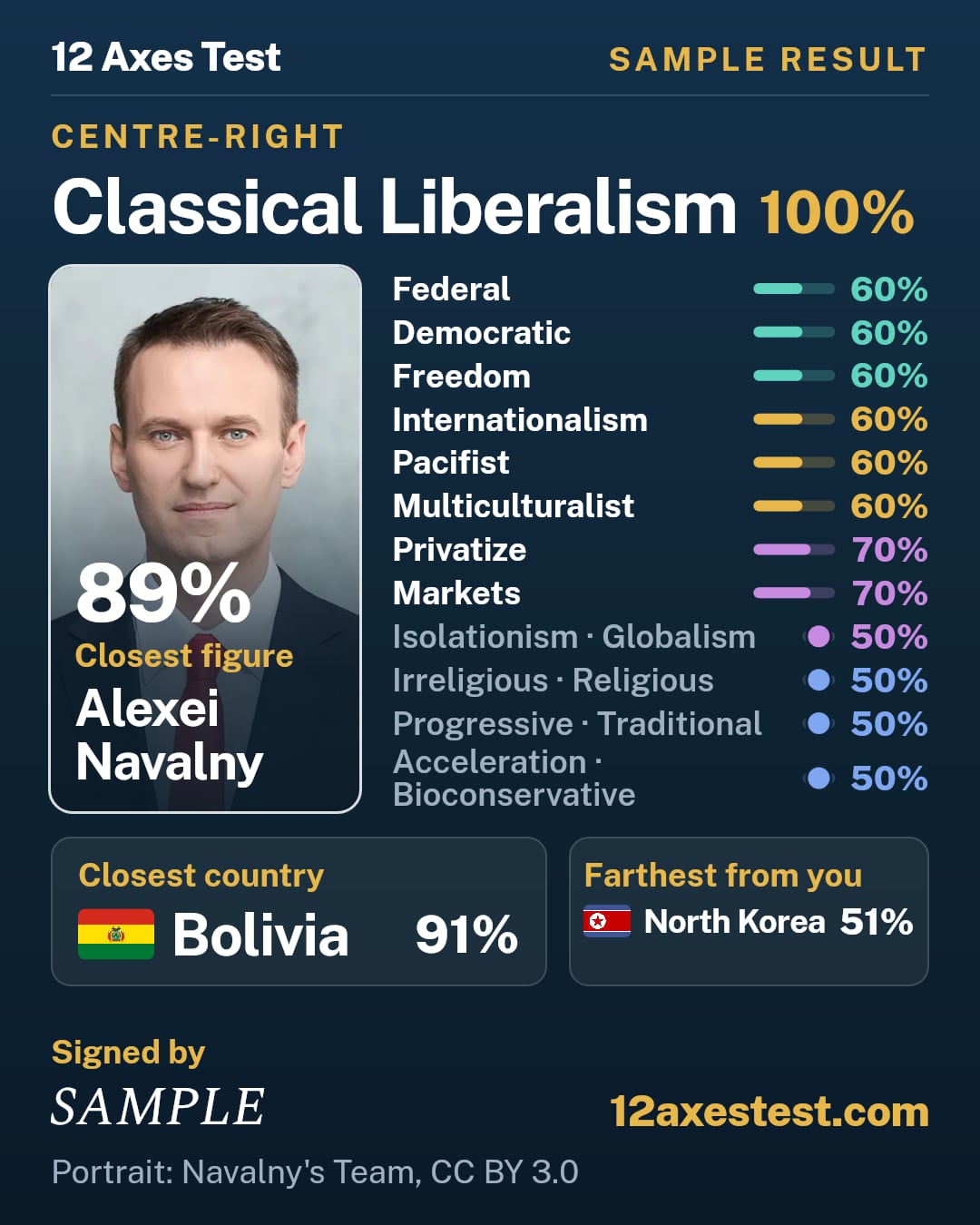
Sample result
History
Classical liberalism drew heavily on John Locke's Second Treatise of Government and A Letter Concerning Toleration, written as a defence of the Glorious Revolution of 1688 and later read by Whigs, radicals and revolutionaries as justification for limited government. Adam Smith's The Wealth of Nations (1776) supplied much of the economics, and John Stuart Mill's Principles of Political Economy (1848) carried it further; Jeremy Bentham's utilitarianism was also influential. Until the Great Depression and the rise of social liberalism it was called economic liberalism. The label "classical" was applied later, as a retronym, to set 19th-century liberalism apart from social liberalism, which accepted a larger role for the state.
Associated thinkers
- John Locke
- Adam Smith
- John Stuart Mill
Common misunderstandings
- It is not the same as libertarianism. Many libertarians want a far smaller state; classical liberals generally accept a limited government that enforces law and provides some public goods.
- Classical does not mean old-fashioned conservative. It was a reform movement against inherited privilege, and it is not the same as modern liberalism in the social-welfare sense.
Related ideologies
Is Classical Liberalism your closest ideology?
Take the test and see which of the ideologies your answers sit closest to.
Questions
What is Classical Liberalism?
A tradition from the Enlightenment that puts individual liberty first: rights, a government limited by law, private property, free trade and toleration. Its founding texts include Locke's Two Treatises and Smith's The Wealth of Nations.
Is Classical Liberalism left or right?
On the usual spectrum it is centre-right today, because the parties that stand for limited government and free markets sit there. In its own time it was a radical, reforming movement. One axis cannot hold both facts.
Classical Liberalism vs Neoliberalism?
Both back free markets. Classical liberalism, from the 18th and 19th centuries, stresses rights and constitutional limits. Neoliberalism, from the 20th, is a policy programme of privatization and deregulation, and it accepts an active state that builds markets.
How does the 12 Axes test decide I am Classical Liberalism?
The test compares your scores on four of the twelve axes (Economy, Government, Diplomacy, Society) with a stored profile for each of the 38 ideologies. The profile at the shortest distance across those four is your match.