Ideology
Authoritarian Capitalism
Combines a market economy with strong political control: private enterprise is allowed, while the state limits dissent and political freedoms, on the view that order and firm leadership support growth.
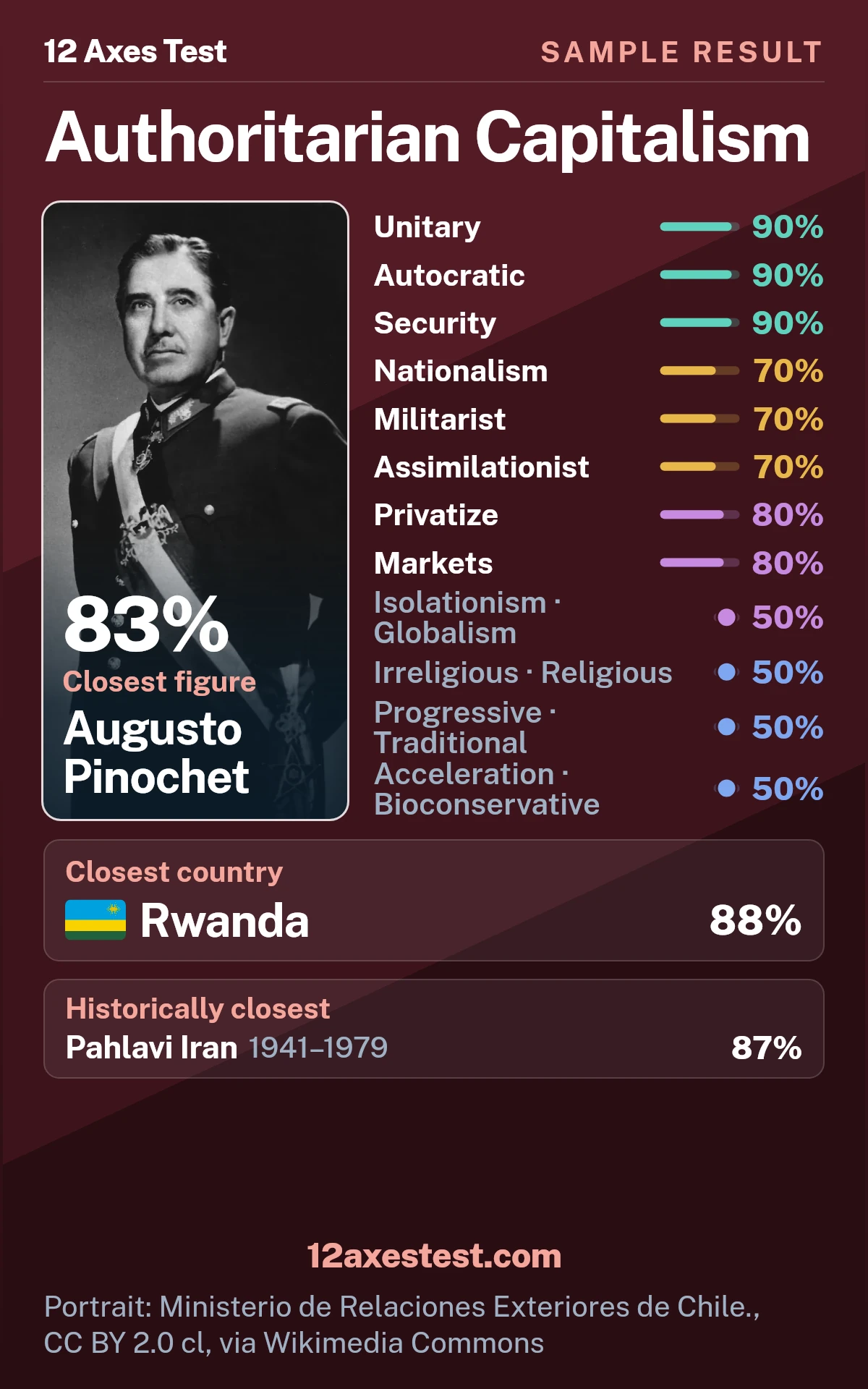
Portrait: Ministerio de Relaciones Exteriores de Chile., CC BY 2.0 cl, via Wikimedia Commons
Core ideas
- Private property and markets drive most economic activity.
- Political power stays concentrated and is not open to free competition.
- Dissent, the press and organized opposition are limited.
- Economic growth is used to justify and sustain the political order.
- The state steers key sectors without necessarily owning them.
Where it sits on the 12 axes
On the Economy axis (Collectivize to Privatize) the profile is at 20, well toward the Privatize end. Government is at 90, deep in the Security end of Security to Freedom. Diplomacy is at 30, on the Nationalism side. Society is at 50, in the middle. So the profile pairs a market economy with a very high Security value. The test uses these four values only and picks the ideology whose profile is nearest to your scores.
The bar shows the position on each of the four axes an ideology is matched on; the middle mark is the centre.
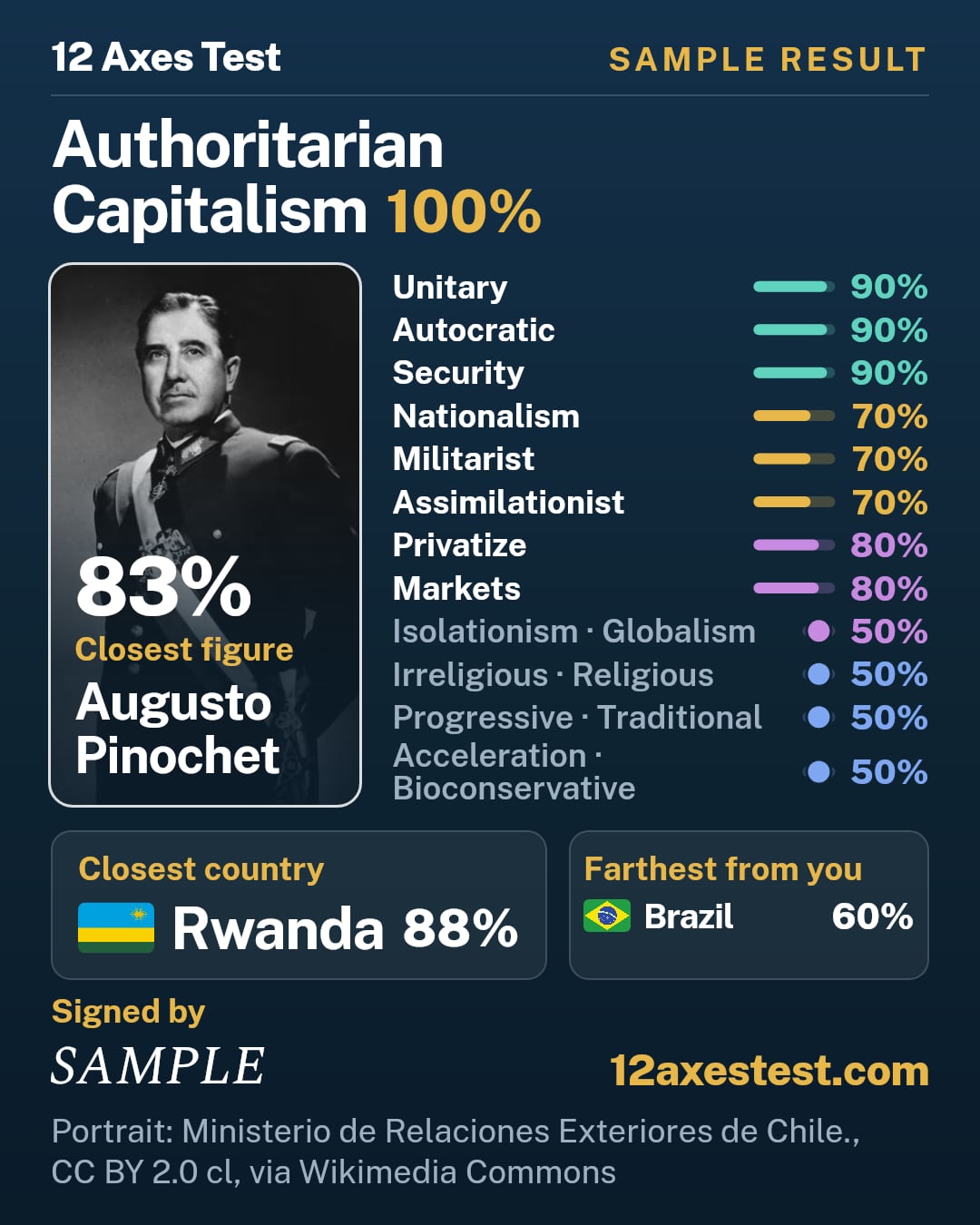
Sample result
History
The label, also given as illiberal capitalism, describes a liberal capitalist market economy existing alongside an authoritarian government, and it overlaps significantly with state capitalism. The system was relatively little discussed during the Cold War, because authoritarianism in the First World was seen as having failed. It rose to prominence as authoritarian states moved to capitalist economic models. It had been expected that adopting capitalism would lead to liberal democracy; as authoritarian capitalist systems persisted, that expectation lost popularity. The term is also applied to military dictatorships of the Cold War era. Political scientists disagree on whether such a combination can last in the long run, and on which cases fit.
Common misunderstandings
- It is not fascism. Fascism is a mass movement built on ultranationalism and a single party ideology; this label describes an economic and political arrangement, and does not imply that ideology.
- It does not mean no state role in the economy. The state can steer or favour firms; what separates it from state capitalism is a matter of degree and ownership.
Related ideologies
Is Authoritarian Capitalism your closest ideology?
Take the test and see which of the ideologies your answers sit closest to.
Questions
What is Authoritarian Capitalism?
A system that keeps a market economy and private business but limits political freedom. Power is concentrated, dissent is restricted, and growth is used to justify the order. The term describes a system, not a single movement.
Is Authoritarian Capitalism left or right?
It does not fit a single left-right line. The test files it under Other, since regimes of very different politics have combined markets with tight control. The four-axis profile is capitalist on economics and high on Security.
Authoritarian Capitalism vs Fascism?
Fascism is a revolutionary mass ideology: ultranationalist, one-party, hostile to liberal democracy. Authoritarian capitalism is a looser label for market economies under restricted politics, and it does not require that ideology or mass mobilization.
How does the 12 Axes test decide I am Authoritarian Capitalism?
The test compares your scores on four of the twelve axes (Economy, Government, Diplomacy, Society) with a stored profile for each of the 38 ideologies. The profile at the shortest distance across those four is your match.