Ideology
NeoliberalismCentre-right
Promotes free markets through privatization, deregulation, lower taxes, reduced public spending and open trade, arguing that competition and private enterprise allocate resources better than government.
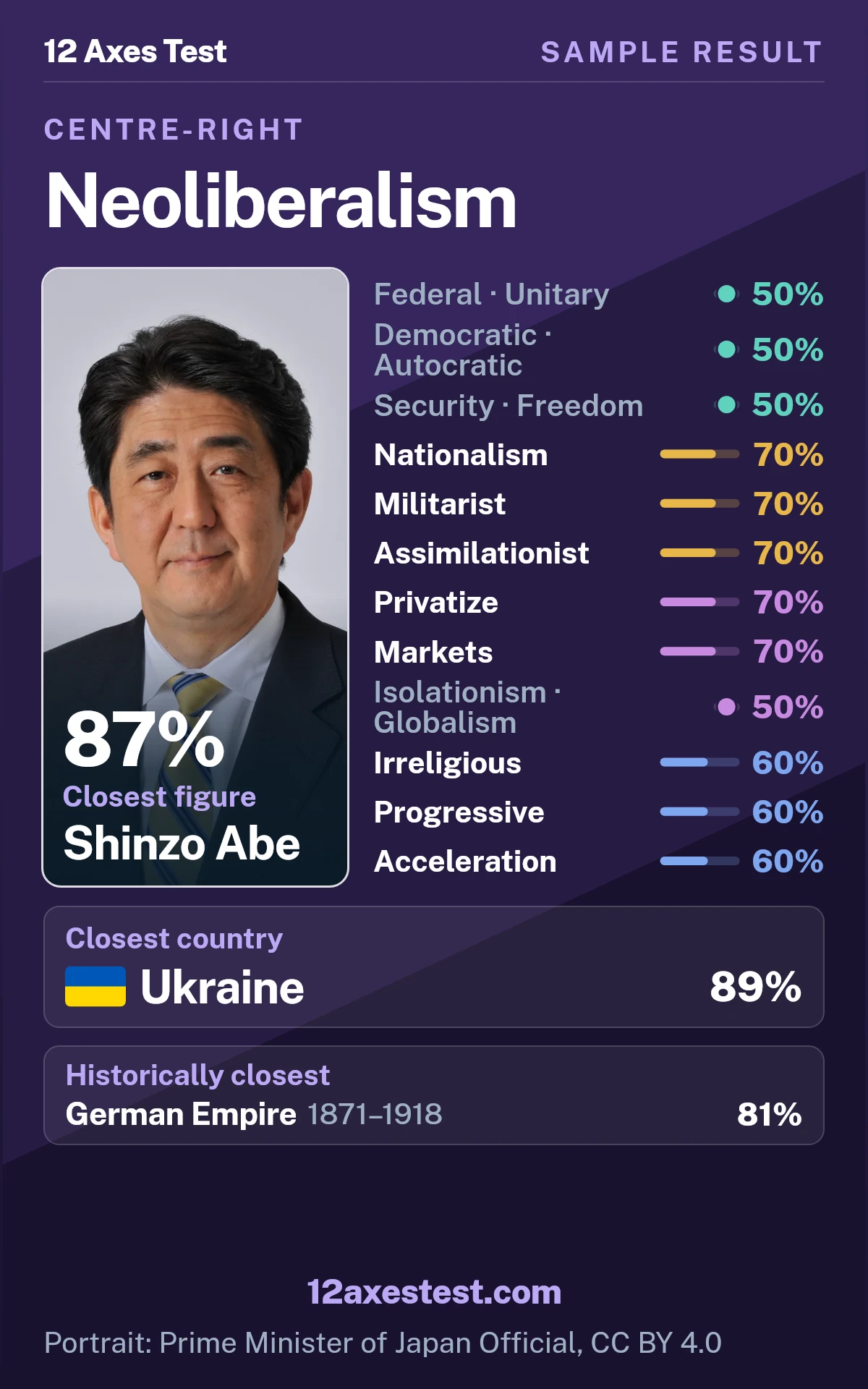
Portrait: Prime Minister of Japan Official, CC BY 4.0, via Wikimedia Commons
Core ideas
- Competitive markets coordinate economic life better than central planning or large public bureaucracies.
- State-owned firms and services should be privatized where possible.
- Regulation, taxes and public spending should be kept lower than under mid-century welfare economics.
- Trade and capital should move across borders with few barriers.
- The state's role is to protect property, contracts and the rules of competition.
Where it sits on the 12 axes
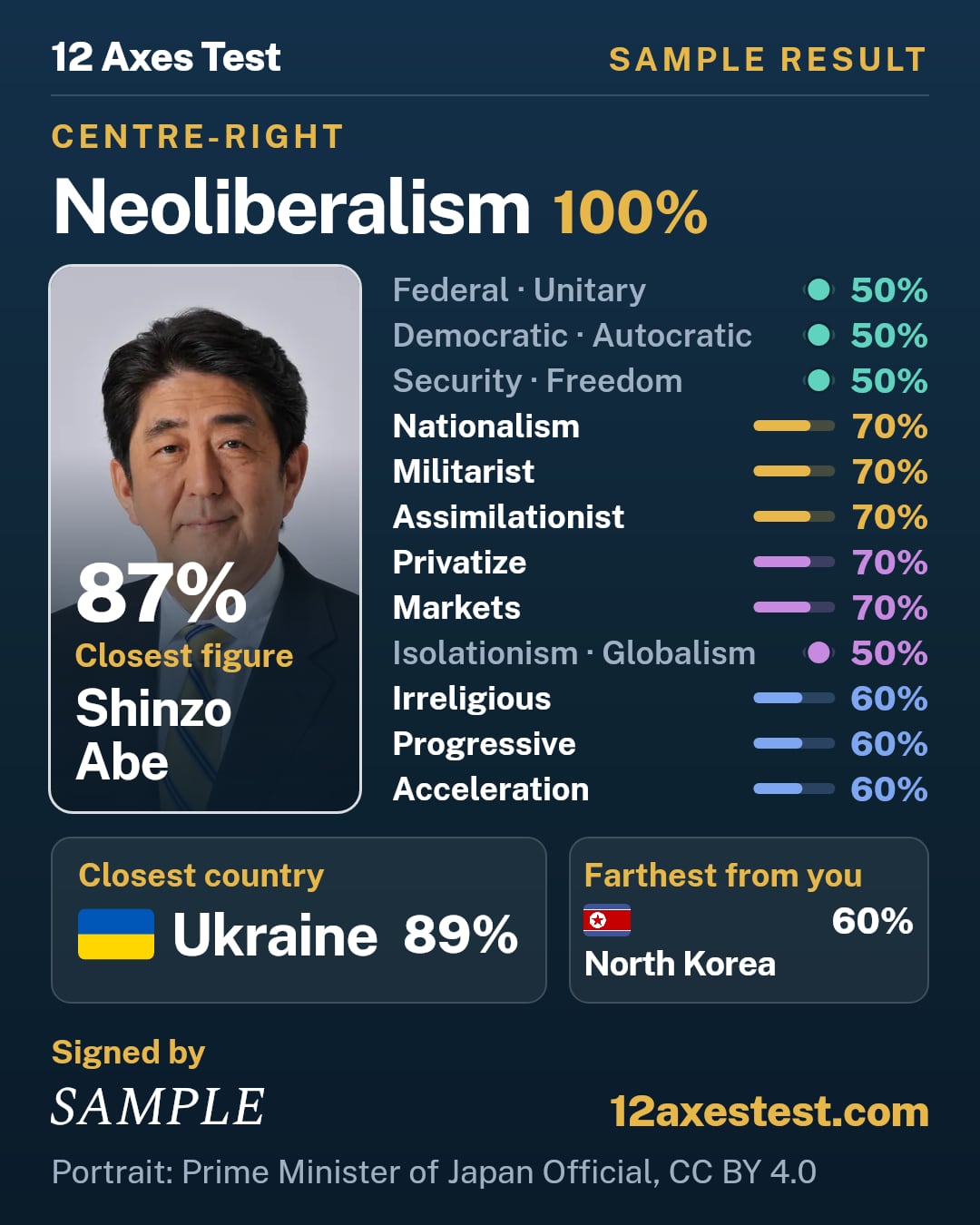
On the Economy axis (Collectivize to Privatize) the profile sits at 30, clearly toward the Privatize end. Government is at 50, in the middle between Security and Freedom. Diplomacy is at 30, on the Nationalism side of Internationalism to Nationalism. Society is at 60, slightly toward the Progressive end of Progressive to Traditional. The test uses these four values only: it measures the distance from your scores to each ideology's four values, and the nearest profile is your match. This is a broad profile, not a rule about any one policy.
The bar shows the position on each of the four axes an ideology is matched on; the middle mark is the centre.
Sample result
History
The term was in use by the 1930s. To renew liberalism after the Great Depression, 25 liberal intellectuals, among them Walter Lippmann, Friedrich Hayek, Ludwig von Mises, Wilhelm Röpke and Alexander Rüstow, met at the Walter Lippmann Colloquium of 1938, where the name neoliberalism was adopted. The meeting did little at the time and was overtaken by the Second World War. The movement gathered pace with the founding of the Mont Pelerin Society in 1947, whose founders included Hayek, Milton Friedman, Karl Popper, George Stigler and Mises. Friedman and the Chicago school later promoted monetarism and market reform. The word entered common academic use in the 1980s, mostly through critics of market reform, and it is rarely used by the people it describes.
Associated thinkers
- Friedrich Hayek
- Milton Friedman
Common misunderstandings
- It is not the same as liberal in everyday speech. The word refers to market-oriented economic policy, and its supporters and critics disagree about what it covers.
- It is not the same as neoconservatism. One is mainly about markets and the economy; the other is mainly about foreign policy and culture, though the two have overlapped.
Related ideologies
Is Neoliberalism your closest ideology?
Take the test and see which of the ideologies your answers sit closest to.
Questions
What is Neoliberalism?
A market-oriented set of economic ideas: privatization, deregulation, lower taxes, reduced public spending and open trade. Supporters say competition raises growth and living standards. Critics say it widens inequality. The term rose to prominence in the 1970s and 1980s.
Is Neoliberalism left or right?
Usually placed centre-right to right on economics, and the test files it as centre-right. A single left-right line misses a lot, since it says little about culture, war or civil liberties.
Neoliberalism vs Classical Liberalism?
Both favour markets and limited intervention. Classical liberalism is older, from the 18th and 19th centuries, and focuses on individual rights and constitutional limits. Neoliberalism is a 20th-century reformulation of classical-liberal ideas that accepts a state active in building and policing markets.
How does the 12 Axes test decide I am Neoliberalism?
The test compares your scores on four of the twelve axes (Economy, Government, Diplomacy, Society) with a stored profile for each of the 38 ideologies. The profile at the shortest distance across those four is your match.