Ideology
Right-Wing PopulismRight
Frames politics as a contest between the common people and out-of-touch elites, and often pairs appeals to national identity, tradition, and sovereignty with skepticism toward established institutions, immigration, and international bodies.
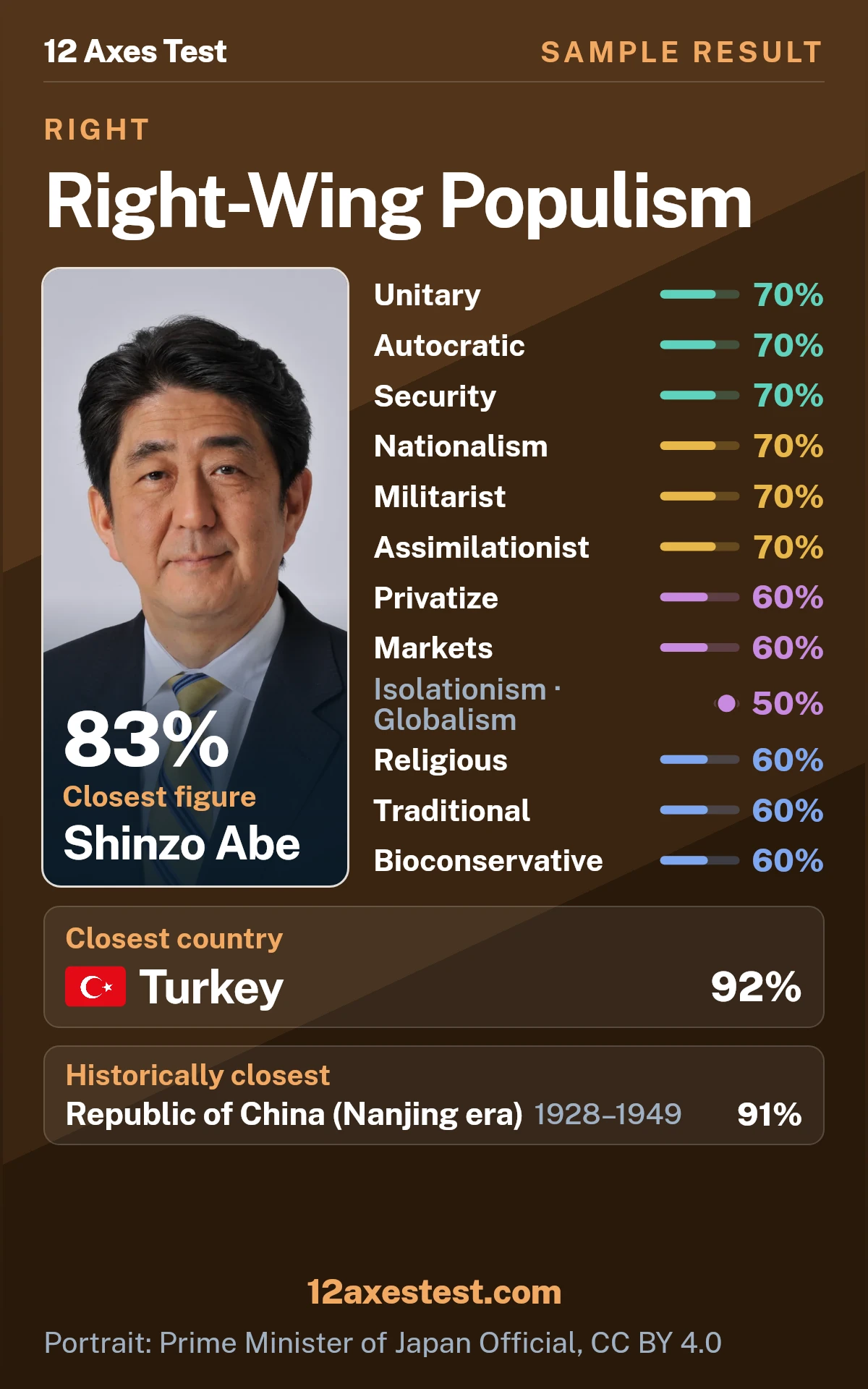
Portrait: Prime Minister of Japan Official, CC BY 4.0, via Wikimedia Commons
Core ideas
- Politics is a contest between the common people and an out-of-touch establishment.
- National culture, identity and economy need defending against outside pressure.
- Sovereignty is placed above international bodies and supranational institutions.
- Social conservatism and tighter limits on immigration are common themes.
- Economic positions vary, from fiscal conservatism to protectionism and a welfare state limited to those seen as deserving.
Where it sits on the 12 axes
The economy axis (Collectivize to Privatize) is 40, a little toward Privatize. The government axis (Security to Freedom) is 70, leaning toward Security. Diplomacy (Internationalism to Nationalism) is 30, leaning toward Nationalism, and society (Progressive to Traditional) is 40, a little toward Traditional. The test picks your match purely by straight distance on these four axes, so the 'against the elite' part of populism, which is not an axis, plays no role.
The bar shows the position on each of the four axes an ideology is matched on; the middle mark is the centre.
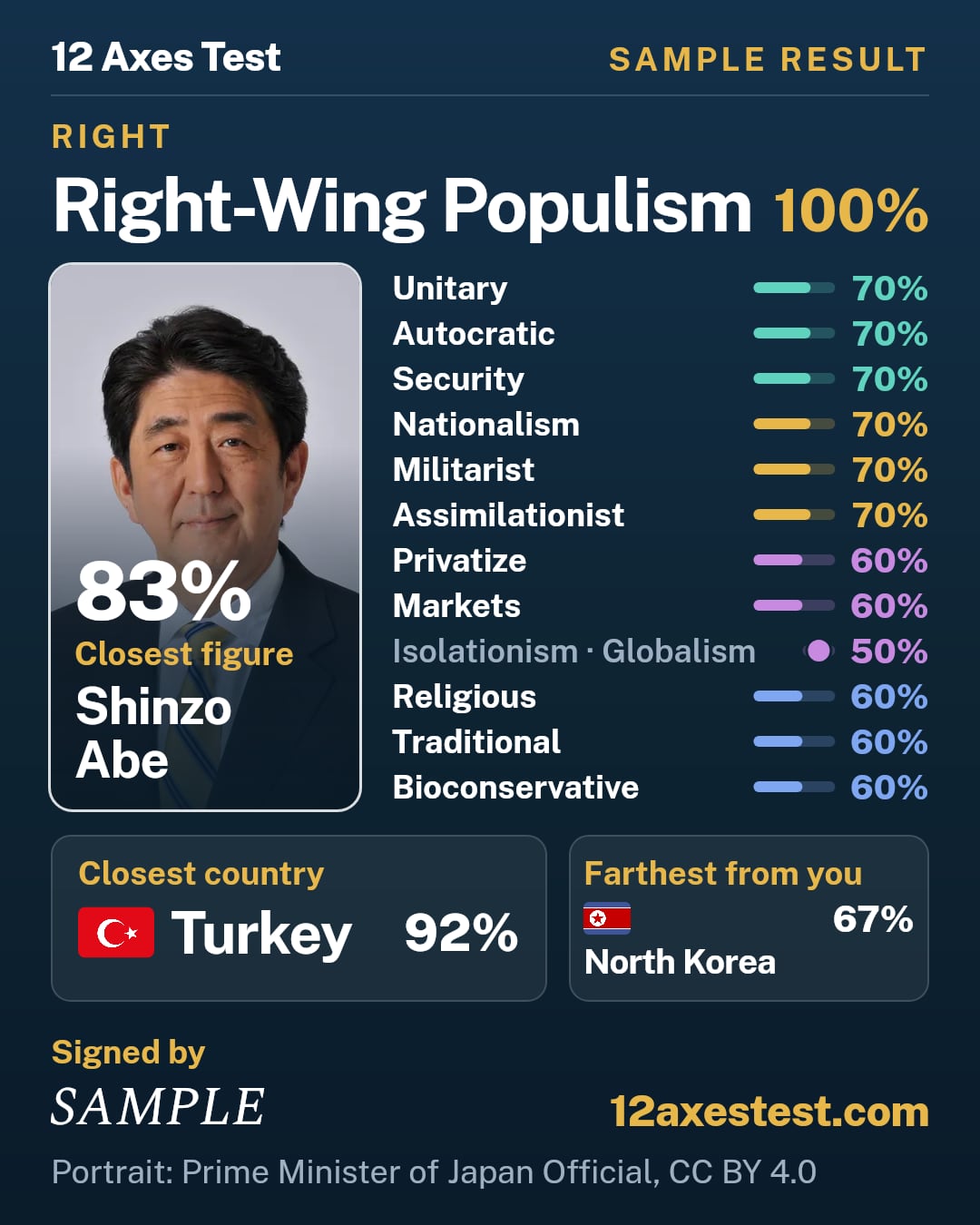
Sample result
History
Right-wing populism combines right-wing politics with populist rhetoric: anti-elitism and opposition to the Establishment. In the 1970s anti-tax Progress Parties in Scandinavia won large vote shares, one taking almost 16% in 1973. From the 1980s small anti-immigration parties began winning seats, and from the 1990s such parties became established in the legislatures of various democracies. After the September 11 attacks a new wave appeared, and after the Great Recession European movements grew, driven by opposition to immigration, rising Euroscepticism and discontent with the European Union's economic policies. Some forms draw on libertarian themes such as federalism and sound money. Some parties have been linked with authoritarian elements, and some far-right populists draw comparisons to fascism.
Common misunderstandings
- It is not simply fascism. Right-wing populist parties have been established in the legislatures of various democracies, though some have authoritarian elements and some far-right populists are compared to fascism.
- It is not always free-market. Some right-wing populists support expanding the welfare state, but only for those they deem fit to receive it, a stance called 'welfare chauvinism'.
Related ideologies
Is Right-Wing Populism your closest ideology?
Take the test and see which of the ideologies your answers sit closest to.
Questions
What is Right-Wing Populism?
A political ideology that combines right-wing politics with populist rhetoric. It is anti-elitist and opposes the Establishment, while often defending national culture, identity and economy. Recurring themes include neo-nationalism, social conservatism, economic nationalism and fiscal conservatism.
Is Right-Wing Populism left or right?
Right, by its own name, ranging from right to far right in this site's filing. The four axes add detail: slightly Privatize on economy, leaning Security on government, leaning Nationalism on diplomacy, a little Traditional on society.
Right-Wing Populism vs left-wing populism?
Both pit 'the people' against elites. The right-wing form pairs that with national identity, social conservatism and often immigration limits. The left-wing form attacks elites mainly over economics and inequality. The shared style is why they are often compared, even though they sit on opposite sides of the economy and society axes.
How does the 12 Axes test decide I am Right-Wing Populism?
Your economy, government, diplomacy and society scores are compared with the four values stored for each of the 38 ideologies. The smallest straight-line distance wins. Populist style is not measured, only those four axes.